Choi Hong Sang, Kim Bongseong, Han Kyung-Do, Oh Tae Ryom, Suh Sang Heon, Kim Minah, Kim Chang Seong, Bae Eun Hui, Ma Seong Kwon, Kim Soo Wan
Department of Internal Medicine, Chonnam National University Medical School, Gwangju, Republic of Korea.
Department of Statistics and Actuarial Science, Soongsil University, Seoul, Republic of Korea.
Kidney Res Clin Pract. 2023 Jan;42(1):86-97. doi: 10.23876/j.krcp.21.294. Epub 2022 Sep 8.
Several studies have reported that depression is prevalent in patients with diabetes or chronic kidney disease. However, the relationship between weight changes and the risk of depression has not been elucidated in patients with diabetic kidney disease (DKD).
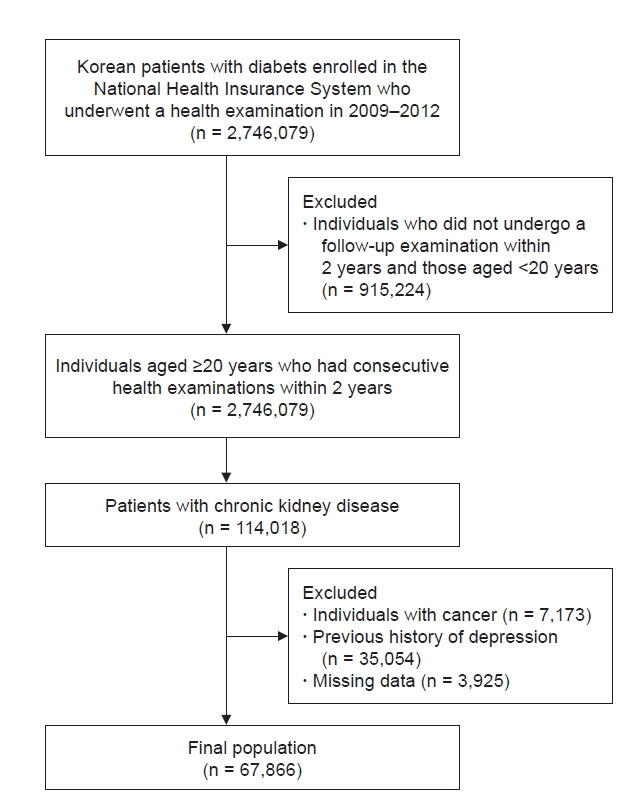
From the Korean National Health Insurance Service database, we selected 67,866 patients with DKD and body weight data from two consecutive health examinations with a 2-year interval between 2009 and 2012. Weight change over 2 years was categorized into five groups: ≥-10%, <-10% to ≥-5%, <-5% to <5%, ≥5% to <10%, and ≥10%. The occurrence of depression was monitored via the codes of International Statistical Classification of Diseases, 10th revision through the end of 2018.
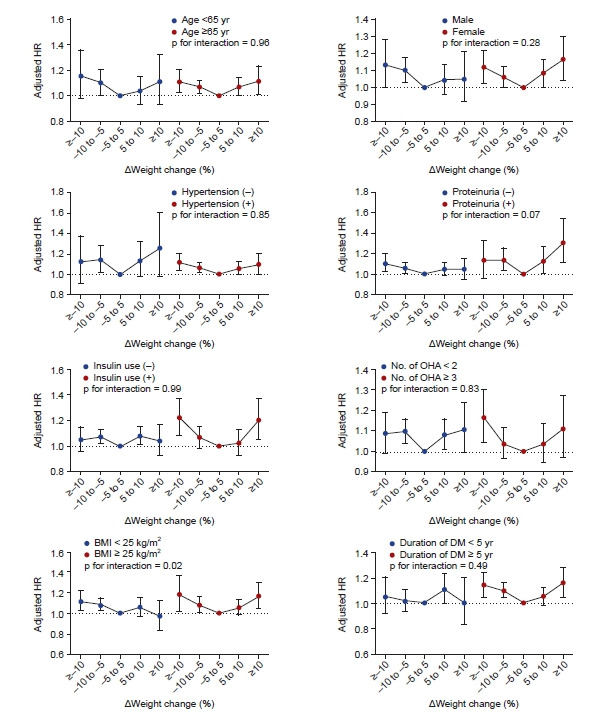
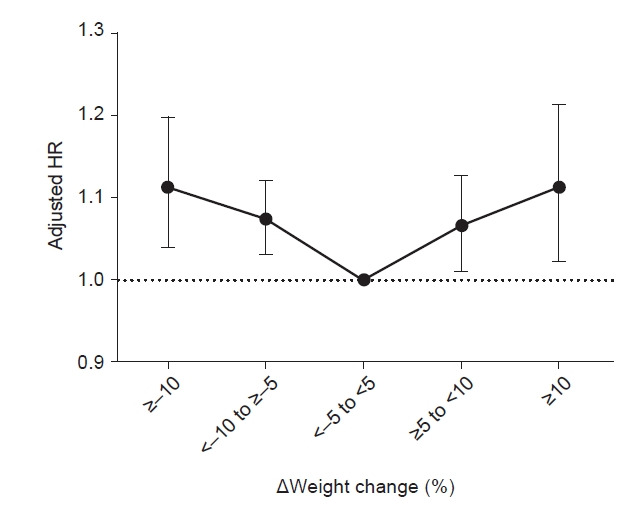
During the 5.24-year follow-up, 17,023 patients with DKD developed depression. Weight change and the risk of depression had a U-shaped relationship: patients with ≥-10% weight change (hazard ratio [HR], 1.12) and those with ≥10% weight change (HR, 1.11) showed higher HRs for depression than those with <-5% to <5% weight change, even after adjusting for several confounding factors. In the subgroup analyses, the risk of depression tended to increase as weight gain or weight loss increased in all subgroups.
Both weight loss and weight gain increased the risk of depression in patients with DKD.
多项研究报告称,抑郁症在糖尿病或慢性肾脏病患者中普遍存在。然而,糖尿病肾病(DKD)患者体重变化与抑郁症风险之间的关系尚未阐明。
我们从韩国国民健康保险服务数据库中选取了67866例DKD患者,并获取了他们在2009年至2012年期间两次间隔2年的连续健康检查中的体重数据。将2年内的体重变化分为五组:≥-10%、<-10%至≥-5%、<-5%至<5%、≥5%至<10%以及≥10%。通过国际疾病分类第10版编码监测截至2018年底抑郁症的发生情况。
在5.24年的随访期间,17023例DKD患者患上了抑郁症。体重变化与抑郁症风险呈U形关系:即使在调整了多个混杂因素后,体重变化≥-10%的患者(风险比[HR],1.12)和体重变化≥10%的患者(HR,1.11)患抑郁症的HR高于体重变化在<-5%至<5%之间的患者。在亚组分析中,所有亚组中抑郁症风险均倾向于随着体重增加或体重减轻而升高。
体重减轻和体重增加均增加了DKD患者患抑郁症的风险。