Department of Blood Purification, Kidney Hospital, The First Affiliated Hospital of Xi'an Jiaotong University, Xi'an, China.
Ren Fail. 2022 Dec;44(1):1309-1318. doi: 10.1080/0886022X.2022.2106872.
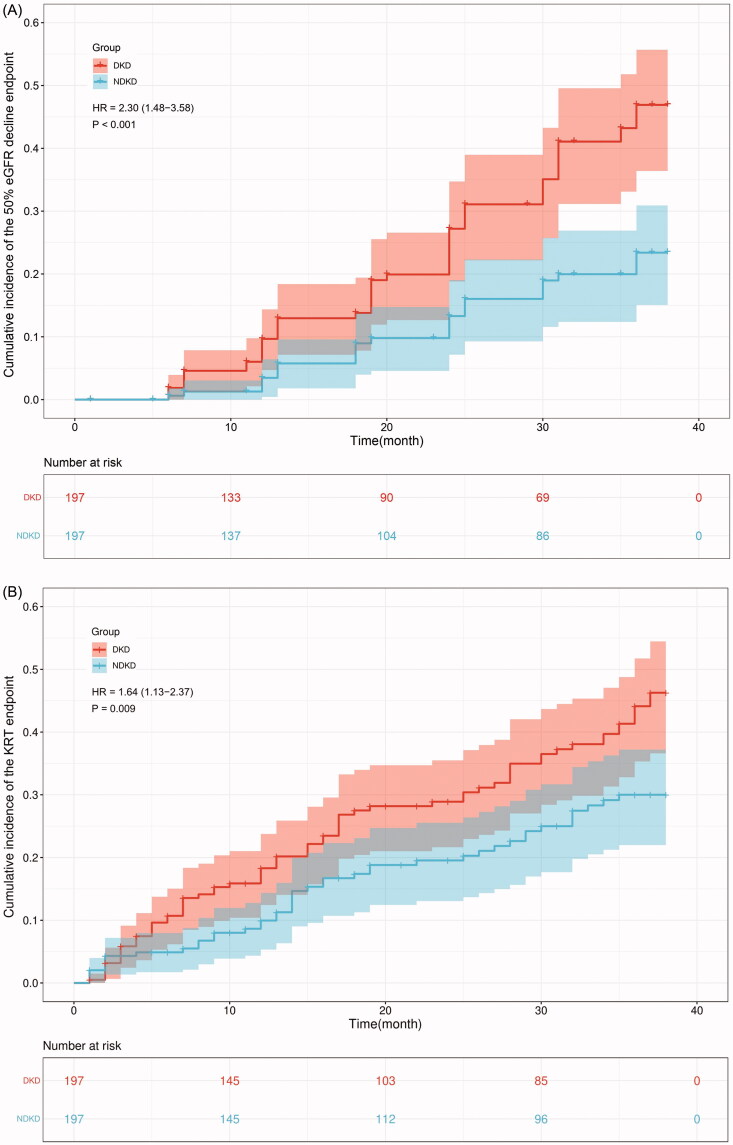
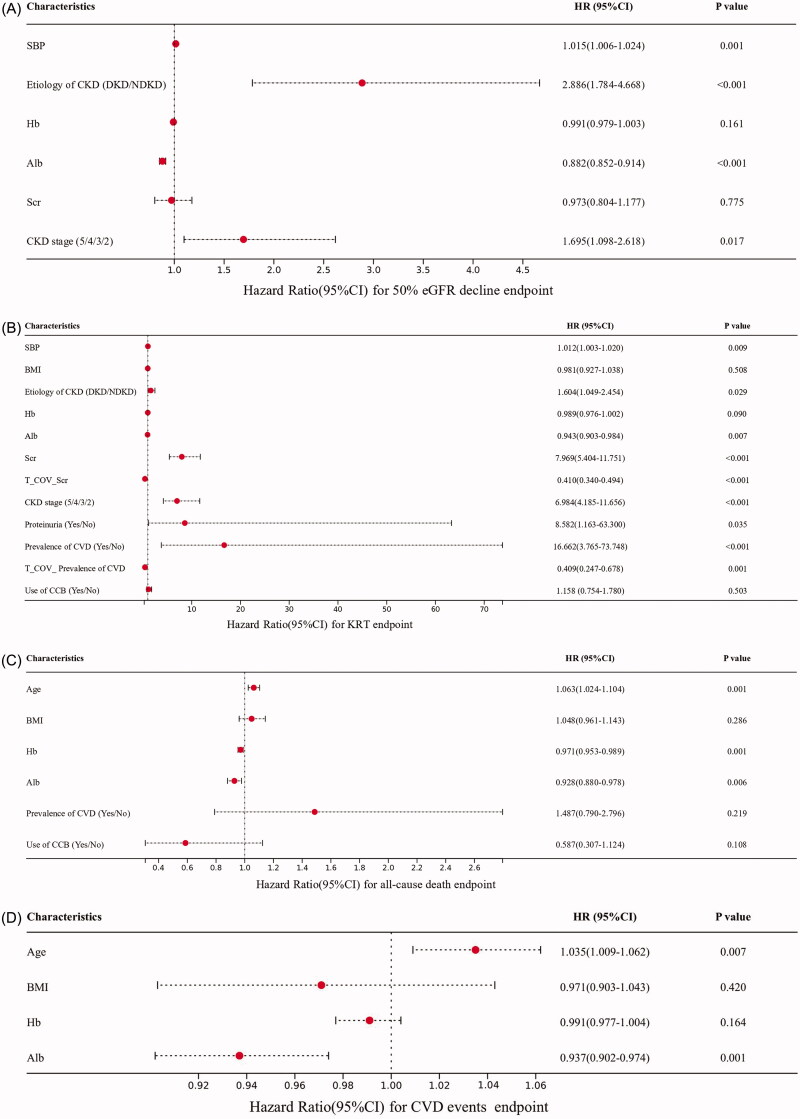
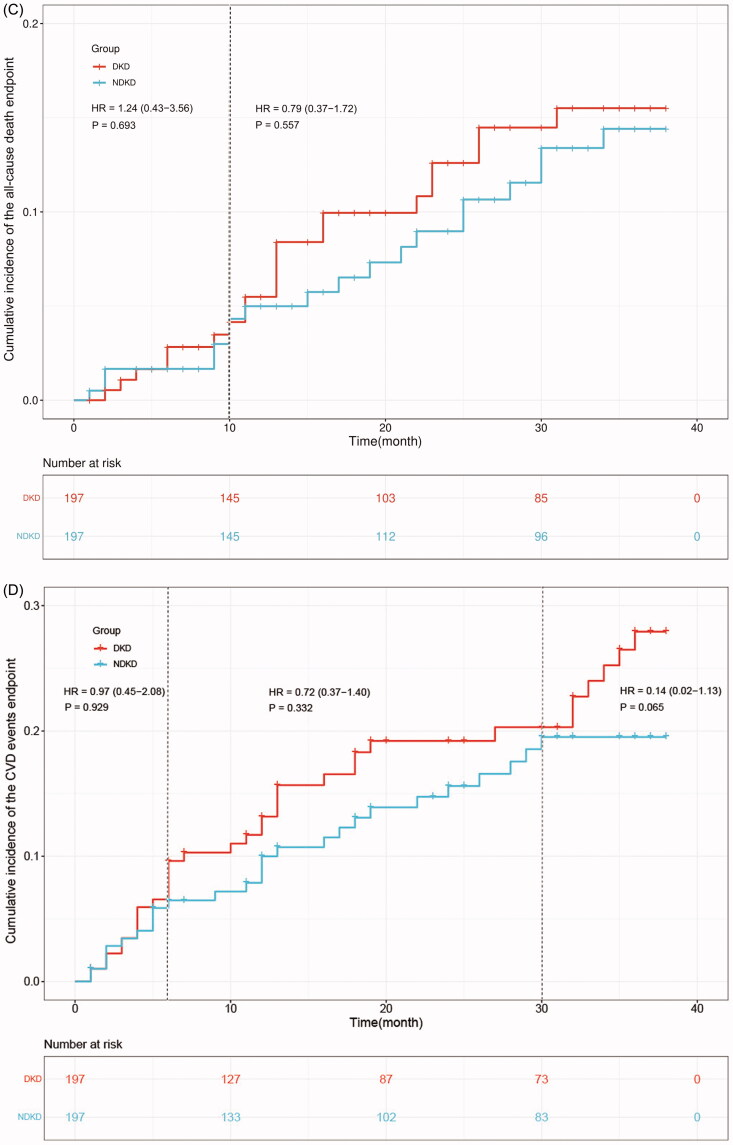
Diabetic kidney disease (DKD) is emerging rapidly as the leading cause of chronic kidney disease (CKD) worldwide. In this 3-year prospective, multicenter cohort study, a total of 1138 pre-dialysis CKD patients were recruited. Patients were categorized into two groups according to the etiologies of DKD and non-diabetic kidney disease (NDKD). Propensity score matching was performed to adjust for confounding factors, resulting in 197 patients being assigned to DKD and NDKD groups, respectively. The primary endpoints were 50% estimated glomerular filtration rate (eGFR) decline and initiation of kidney replacement therapy (KRT). The secondary endpoints were all-cause death and the development of cardiovascular disease (CVD) events. We found that DKD patients have a higher risk to develop 50% eGFR decline endpoint (HR:2.30, 95%CI [1.48-3.58], < 0.001) and KRT endpoint (HR:1.64, 95%CI [1.13-2.37], < 0.05) than NDKD patients. The 3-year cumulative incidence of 50% eGFR decline and KRT endpoint was significantly higher in DKD patients (26.90% 13.71% and 35.03% 22.34%, respectively). The Cox regression analyses showed that the increased systolic blood pressure (SBP), DKD, decreased serum albumin (Alb), and higher CKD stages were risk factors for the 50% eGFR decline endpoint; the increased SBP, DKD, decreased serum Alb, serum creatinine (Scr), higher CKD stages, presence of proteinuria and CVD were risk factors for KRT endpoint; the increased age, decreased hemoglobin (Hb), decreased serum Alb were risk factors for all-cause death endpoint; the increased age, decreased serum Alb were risk factors for CVD events endpoint. Appropriate preventive or therapeutic interventions should be taken to control these predictive factors to delay the development of CKD complications, thereby improving the prognosis and reducing the disease burden of the high-risk populations.
糖尿病肾病(DKD)正在迅速成为全球慢性肾脏病(CKD)的主要病因。在这项为期 3 年的前瞻性、多中心队列研究中,共招募了 1138 名透析前 CKD 患者。根据 DKD 和非糖尿病肾病(NDKD)的病因,将患者分为两组。采用倾向评分匹配法调整混杂因素,分别将 197 例患者分配至 DKD 和 NDKD 组。主要终点为肾小球滤过率(eGFR)下降 50%和开始肾脏替代治疗(KRT)。次要终点为全因死亡和心血管疾病(CVD)事件的发生。我们发现 DKD 患者发生 eGFR 下降 50%终点(HR:2.30,95%CI [1.48-3.58], < 0.001)和 KRT 终点(HR:1.64,95%CI [1.13-2.37], < 0.05)的风险高于 NDKD 患者。DKD 患者 3 年累积 eGFR 下降 50%和 KRT 终点的发生率明显高于 NDKD 患者(分别为 26.90%比 13.71%和 35.03%比 22.34%)。Cox 回归分析显示,收缩压(SBP)升高、DKD、血清白蛋白(Alb)降低和 CKD 分期升高是 eGFR 下降 50%终点的危险因素;SBP 升高、DKD、血清 Alb、血清肌酐(Scr)、CKD 分期升高、蛋白尿和 CVD 存在是 KRT 终点的危险因素;年龄增加、血红蛋白(Hb)降低、血清 Alb 降低是全因死亡终点的危险因素;年龄增加、血清 Alb 降低是 CVD 事件终点的危险因素。应采取适当的预防或治疗干预措施控制这些预测因素,以延缓 CKD 并发症的发生,从而改善高危人群的预后并降低疾病负担。