Chemical Injuries Research Center, Systems Biology and Poisonings Institute, Baqiyatallah University of Medical Sciences, Tehran, Iran.
Department of Biotechnology, Science and Research Branch, Islamic Azad University, Tehran, Iran.
BMC Genom Data. 2022 Nov 3;23(1):77. doi: 10.1186/s12863-022-01092-4.
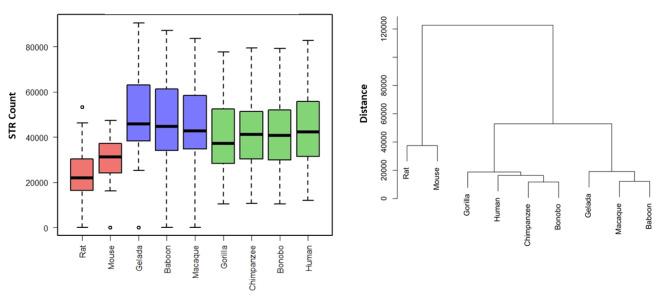
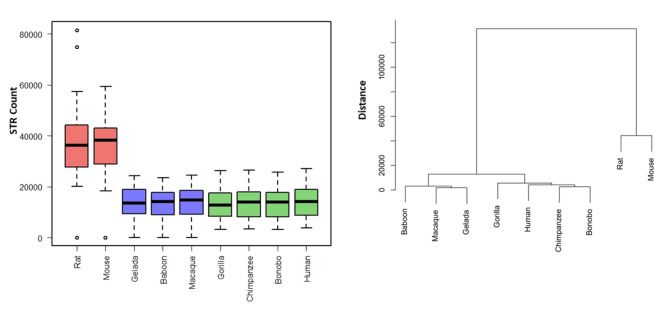
While of predominant abundance across vertebrate genomes and significant biological implications, the relevance of short tandem repeats (STRs) (also known as microsatellites) to speciation remains largely elusive and attributed to random coincidence for the most part. Here we collected data on the whole-genome abundance of mono-, di-, and trinucleotide STRs in nine species, encompassing rodents and primates, including rat, mouse, olive baboon, gelada, macaque, gorilla, chimpanzee, bonobo, and human. The collected data were used to analyze hierarchical clustering of the STR abundances in the selected species.
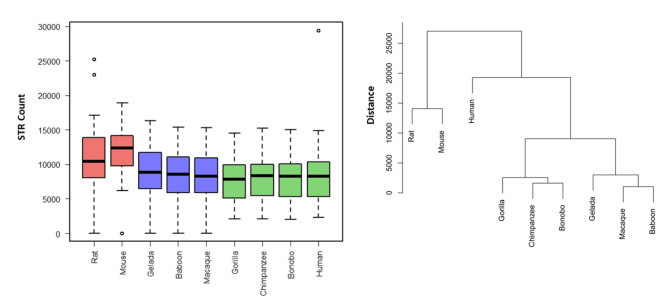
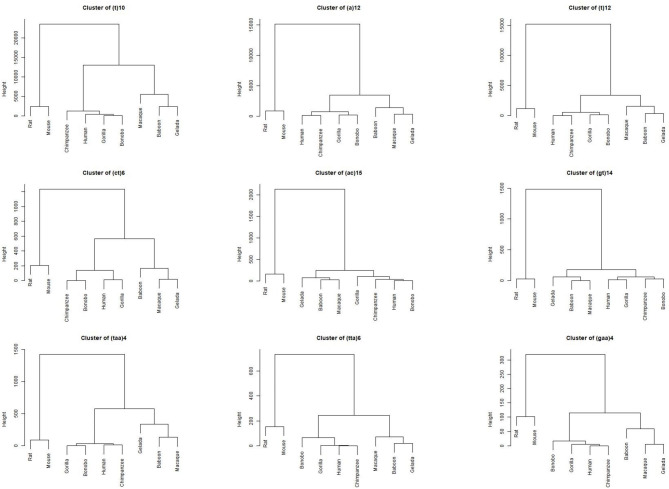
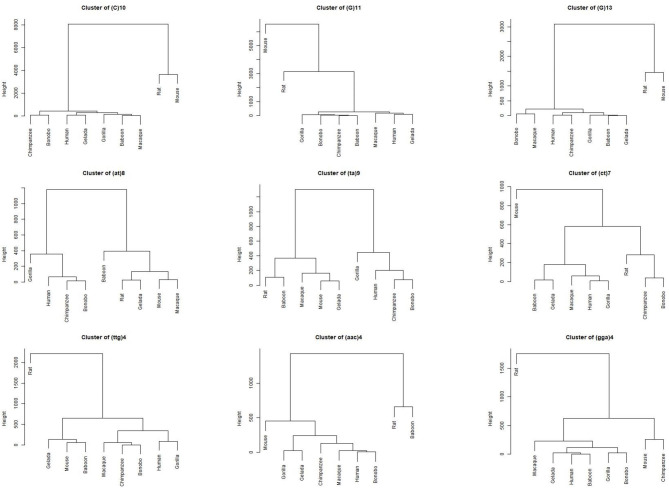
We found massive differential STR abundances between the rodent and primate orders. In addition, while numerous STRs had random abundance across the nine selected species, the global abundance conformed to three consistent < clusters>, as follows: <rat, mouse>, <gelada, macaque, olive baboon>, and <gorilla, chimpanzee, bonobo, human>, which coincided with the phylogenetic distances of the selected species (p < 4E-05). Exceptionally, in the trinucleotide STR compartment, human was significantly distant from all other species.
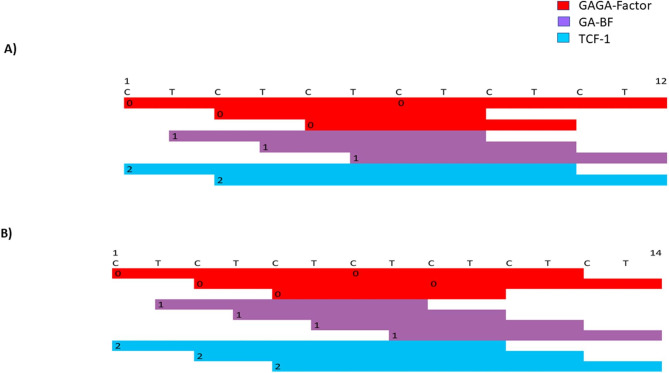
Based on hierarchical clustering, we propose that the global abundance of STRs is non-random in rodents and primates, and probably had a determining impact on the speciation of the two orders. We also propose the STRs and STR lengths, which predominantly conformed to the phylogeny of the selected species, exemplified by (t)10, (ct)6, and (taa4). Phylogenetic and experimental platforms are warranted to further examine the observed patterns and the biological mechanisms associated with those STRs.
短串联重复序列(STRs)(也称为微卫星)在脊椎动物基因组中大量存在,具有重要的生物学意义,但它们在物种形成中的相关性在很大程度上仍然难以捉摸,在很大程度上归因于随机巧合。在这里,我们收集了涵盖啮齿动物和灵长类动物的 9 个物种的单核苷酸、二核苷酸和三核苷酸 STR 全基因组丰度的数据,包括大鼠、小鼠、橄榄狒狒、山魈、猕猴、大猩猩、黑猩猩、倭黑猩猩和人类。所收集的数据用于分析所选物种中 STR 丰度的层次聚类。
我们发现啮齿动物和灵长类动物之间存在大量的 STR 丰度差异。此外,虽然许多 STR 在九个选定物种中具有随机丰度,但全球丰度符合三个一致的<簇>,如下所示:<大鼠、小鼠>、<山魈、猕猴、橄榄狒狒>和<大猩猩、黑猩猩、倭黑猩猩、人类>,这与所选物种的系统发育距离一致(p < 4E-05)。例外的是,在三核苷酸 STR 区室中,人类与所有其他物种明显不同。
基于层次聚类,我们提出 STR 的全球丰度在啮齿动物和灵长类动物中是非随机的,可能对这两个目物种的形成有决定性的影响。我们还提出了 STR 和 STR 长度,它们主要符合所选物种的系统发育,例如(t)10、(ct)6 和(taa4)。需要进化和实验平台来进一步检查所观察到的模式以及与这些 STR 相关的生物学机制。