School of Human Nutrition, McGill University, Sainte-Anne-de-Bellevue, QC, Canada.
Douglas Mental Health University Institute, Bd LaSalle, QC, Canada.
Public Health Nutr. 2023 Nov;26(11):2294-2303. doi: 10.1017/S1368980022002373. Epub 2022 Nov 4.
The goal of the present study was to evaluate the association between depression and ultra-processed food (UPF) consumption as risk factors for developing type 2 diabetes (T2D).
A prospective community study.
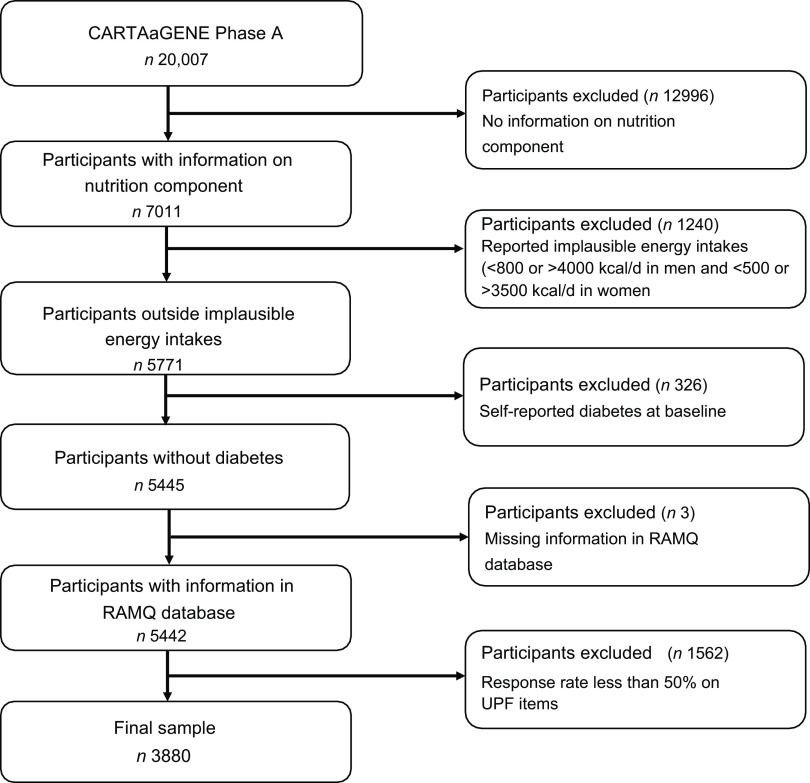
Baseline data (2009-2010) from CARTaGENE community health study from Quebec, Canada, were used. Food and drink consumption was assessed using the Canadian-Diet History Questionnaire II and grouped according to their degree of processing by the NOVA classification, and participants were categorised into tertiles of UPF (g/d). Depression was defined using either a validated cut-off score on the Patient Health Questionnaire-9 or antidepressant use. The outcome was the incidence of T2D, examined in 3880 participants by linking survey data with administrative health insurance data. Cox regression models estimated the associations between UPF, depression and incident T2D.
40-69-year-old individuals at baseline.
In total, 263 (6·8 %) individuals developed T2D. Participants with high depressive symptoms and high UPF consumption showed the highest risk for T2D (adjusted hazard ratios (aHR) = 1·58, 95 % CI (0·98, 2·68)), compared to those with low depressive symptoms and low UPF consumption. The risk for T2D was similar when high depressive symptoms and antidepressant use were combined with high UPF (aHR 1·62, 95 % CI (1·02, 2·57)).
This study shows that co-occurring depression and high UPF consumption were associated with a higher risk for T2D. Early management and monitoring of both risk factors might be essential for diabetes prevention.
本研究旨在评估抑郁和超加工食品(UPF)消费作为 2 型糖尿病(T2D)发病风险因素之间的关联。
前瞻性社区研究。
加拿大魁北克省 CARTaGENE 社区健康研究的基线数据(2009-2010 年)被使用。使用加拿大饮食史问卷 II 评估食物和饮料的消费情况,并根据 NOVA 分类对其加工程度进行分组,参与者根据 UPF(g/d)的三分位数进行分类。抑郁使用患者健康问卷-9 的验证截断分数或抗抑郁药使用来定义。通过将调查数据与行政健康保险数据相链接,在 3880 名参与者中检查 T2D 的发生率,以此作为结局。Cox 回归模型估计 UPF、抑郁与 T2D 发病之间的关联。
基线时年龄为 40-69 岁的个体。
共有 263 名(6.8%)个体发生了 T2D。与低抑郁症状和低 UPF 消费的参与者相比,具有高抑郁症状和高 UPF 消费的参与者发生 T2D 的风险最高(调整后的危害比(aHR)=1.58,95%CI(0.98,2.68))。当高抑郁症状和抗抑郁药使用与高 UPF 联合使用时,发生 T2D 的风险相似(aHR 1.62,95%CI(1.02,2.57))。
本研究表明,抑郁和高 UPF 消费同时存在与 T2D 的发病风险增加相关。早期管理和监测这两种风险因素对于预防糖尿病可能至关重要。