
原位肝移植大鼠模型中预致敏相关急性抗体介导排斥反应的特征
Characteristics of pre-sensitization-related acute antibody-mediated rejection in a rat model of orthotopic liver transplantation.
作者信息
Mang Yuanyi, Zhang Shengning, Zhao Jiaojiao, Ran Jianghua, Zhao Yingpeng, Li Laibang, Gao Yang, Li Wang, Chen Guoyu, Ma Jun, Li Li, Bao Fukai
机构信息
Department of Hepato-Biliary-Pancreatic Surgery and Liver Transplantation Center, the Calmette Affiliated Hospital of Kunming Medical University, the First People's Hospital of Kunming, Clinical Medical Center for Organ Transplantation of Yunnan Province, Kunming, China.
Department of Pathogen Biology and Immunology, Faculty of Basic Medical Science, Kunming Medical University, Kunming, China.
出版信息
Ann Transl Med. 2022 Oct;10(19):1066. doi: 10.21037/atm-22-4311.
BACKGROUND
To establish an animal model of pre-sensitization following liver transplantation either with or without immunosuppressors. To study whether accelerated liver rejection or acute antibody-mediated rejection (AMR) occurred and study the characteristics and potential mechanism in the animal model.
METHODS
Lewis (LEW) rats were subjected to liver [liver graft of Brown Norway (BN) rat] transplantation 2 weeks after lymphocyte injection (lymphocytes of BN rat; pre-sensitization). At 2 weeks after transplantation, serum samples of recipients were collected for antibody analysis to identify donor-specific alloantibody (DSA) level. The recipients were treated with or without a low dose of immunosuppressor (2 mg/kg). The liver grafts of each group were analyzed by hematoxylin and eosin (HE) stain, Masson stain, CK19, C4d, and CD20 immunohistochemical (IHC) stain, CD3, CD68, and CD86 immunofluorescence and transmission electron microscope (TEM) to study the characteristics of liver rejection. Moreover, cytotoxin-associated genes, M1 macrophages conversion-related proteins, and interleukin-6 (IL-6) signaling pathway proteins were detected by western blotting.
RESULTS
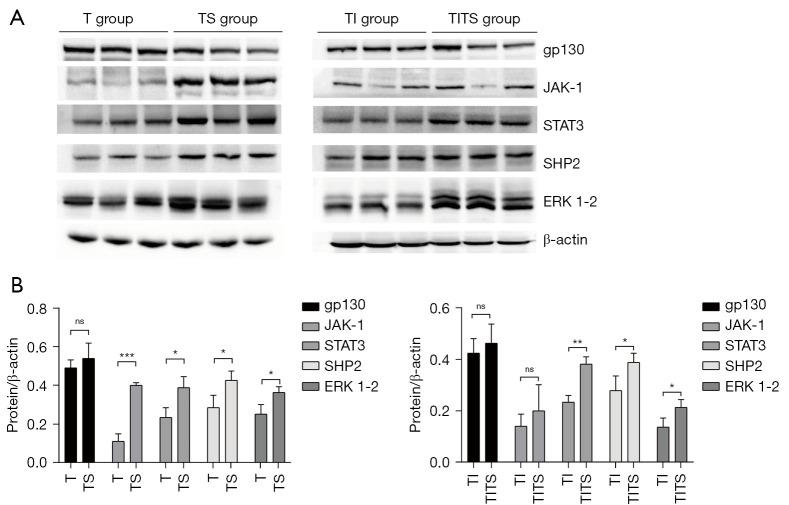
High level of DSA and accelerated liver rejection occurred in the pre-sensitized rat models following liver transplant. Accelerated liver graft rejection occurred in the pre-sensitized, post liver transplant rats regardless of whether a low dose immunosuppressor had been applied. Severe injury of the interlobular bile ducts and accelerated fibrosis could be observed. Moreover, evidence of endothelial injury, such as capillary inflammation, was found in the pre-sensitized, post-transplant rats. In addition, C4d deposition and M1 macrophages recruitment were also found in this sensitized followed transplant model, indicating that complement activation might occur in this model. The levels of IL-6, JAK1, STAT3, SHP2, and ERK1-2 were increased in the pre-sensitized, post-transplant rats.
CONCLUSIONS
Pre-sensitized post liver transplant rats might be potential AMR models for further study.
背景
建立肝移植后致敏或未致敏且使用或不使用免疫抑制剂的动物模型。研究是否发生加速性肝排斥反应或急性抗体介导的排斥反应(AMR),并研究该动物模型中的特征及潜在机制。
方法
Lewis(LEW)大鼠在注射淋巴细胞(BN大鼠的淋巴细胞;致敏)2周后接受肝脏移植(Brown Norway(BN)大鼠的肝脏移植物)。移植后2周,收集受体血清样本进行抗体分析,以确定供体特异性同种抗体(DSA)水平。受体接受或不接受低剂量免疫抑制剂(2mg/kg)治疗。通过苏木精-伊红(HE)染色、Masson染色、CK19、C4d和CD20免疫组织化学(IHC)染色、CD3、CD68和CD86免疫荧光以及透射电子显微镜(TEM)对每组的肝移植物进行分析,以研究肝排斥反应的特征。此外,通过蛋白质免疫印迹法检测细胞毒素相关基因、M1巨噬细胞转化相关蛋白和白细胞介素-6(IL-6)信号通路蛋白。
结果
肝移植后致敏大鼠模型中出现高水平的DSA和加速性肝排斥反应。无论是否应用低剂量免疫抑制剂,肝移植后致敏大鼠均发生加速性肝移植物排斥反应。可观察到小叶间胆管严重损伤和加速纤维化。此外,在移植后致敏大鼠中发现了内皮损伤的证据,如毛细血管炎症。此外,在该致敏后移植模型中还发现了C4d沉积和M1巨噬细胞募集,表明该模型可能发生补体激活。移植后致敏大鼠中IL-6、JAK1、STAT3、SHP2和ERK1-2的水平升高。
结论
肝移植后致敏大鼠可能是进一步研究的潜在AMR模型。


 Zotero 插件