Department of Clinical Pharmacology, School of Medicine, Muhimbili University of Health and Allied Sciences, Dar es Salaam, Tanzania, United Republic of
Department of Clinical Pharmacology, School of Medicine, Muhimbili University of Health and Allied Sciences, Dar es Salaam, Tanzania, United Republic of.
BMJ Open. 2022 Nov 4;12(11):e062147. doi: 10.1136/bmjopen-2022-062147.
There are limited data on factors influencing antibiotic prescription among insured patients. We assessed for correlates of an antibiotic prescription among insured patients.
A cross-sectional study.
The study was conducted at the National Health Insurance Fund offices, Dar es Salaam, Tanzania.
We captured data from the claim forms, containing inpatient and outpatient treatment information for insured patients, for the month of September 2019.
Receipt of an antibiotic prescription.
Age, sex, diagnosis, prescriber qualification, health facility level, ownership and department were exposure variables. Predictors of receipt of an antibiotic prescription were determined by Poisson regression analysis.
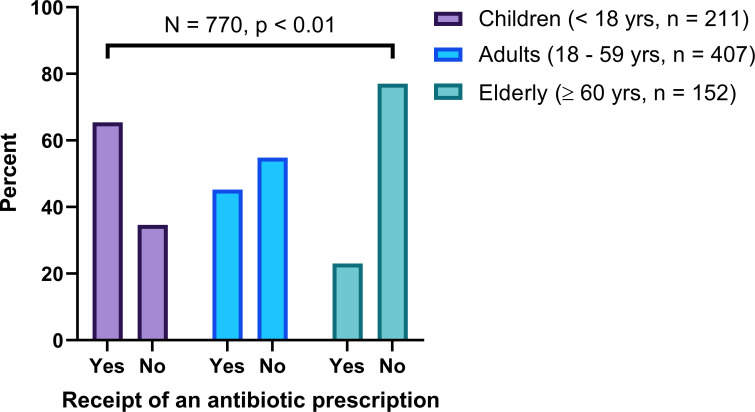
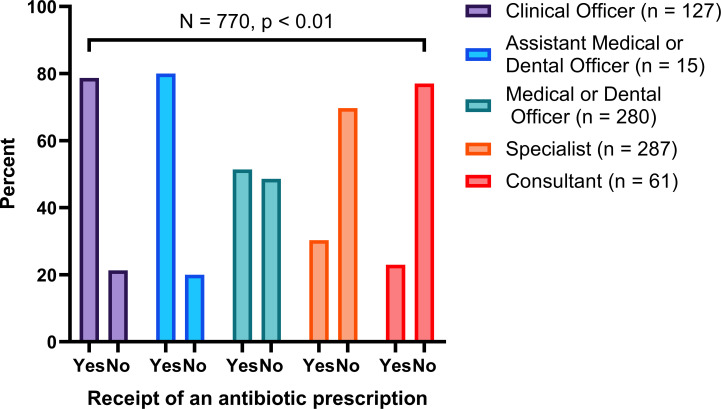
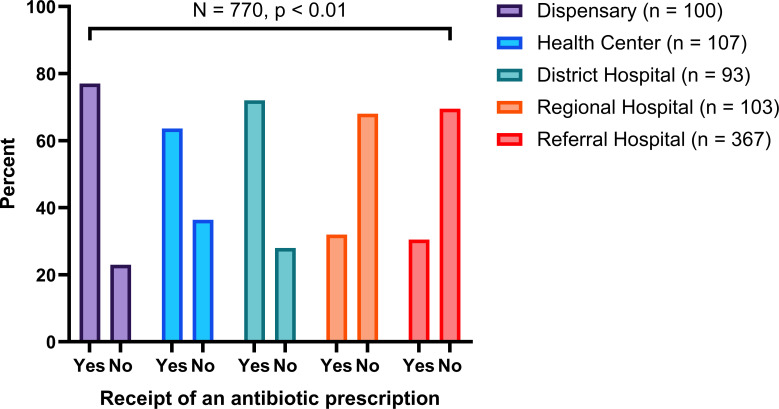
Of 993 analysed patients, the mean (±SD) age was 36.3 (±23.2) years, 581 (58.5%) were females and 535 (53.9%) were adults. The prevalence of antibiotic prescription was 46.4% (95% CI 42.8% to 50.0%). Strong predictors of an antibiotic prescription were being a child (1.7, 95% CI 1.3 to 2.2); acute upper respiratory tract infection (URTI) of multiple and unspecified sites (1.6, 95% CI 1.3 to 1.4); chronic rhinitis, nasopharyngitis and pharyngitis (4.0, 95% CI 2.4 to 6.4); being attended by a clinical officer (1.9, 95% CI 1.2 to 3.0); attending a health centre (1.5, 95% CI 1.1 to 2.0); attending a public facility (1.2, 95% CI 1.0 to 1.4) and visiting an inpatient department (2.0, 95% CI 1.2 to 3.4).
Among insured patients, being a child, acute URTI, being attended by a clinical officer or dental therapist, being attended by an assistant medical/dental officer, attending a health centre or a district hospital, attending a public health facility and visiting an inpatient department predicted an antibiotic prescription. Incorporation of these findings in revisions or establishment of targeted antimicrobial stewardship programmes may lead to better antibiotic prescribing practices that are critical for combating antibiotic resistance.
关于影响参保患者抗生素处方的因素,相关数据有限。本研究评估了参保患者抗生素处方的相关因素。
横断面研究。
坦桑尼亚达累斯萨拉姆的国家健康保险基金办公室。
我们从参保患者的 2019 年 9 月的住院和门诊治疗信息的理赔表中提取数据。
收到抗生素处方。
年龄、性别、诊断、处方医生资质、医疗机构级别、所有制和科室是暴露变量。通过泊松回归分析确定接受抗生素处方的预测因素。
在 993 名接受分析的患者中,平均(±SD)年龄为 36.3(±23.2)岁,581 名(58.5%)为女性,535 名(53.9%)为成年人。抗生素处方的患病率为 46.4%(95%CI 42.8%至 50.0%)。抗生素处方的强烈预测因素包括儿童(1.7,95%CI 1.3 至 2.2);急性上呼吸道感染(URTI)多发且部位不明(1.6,95%CI 1.3 至 1.4);慢性鼻炎、鼻咽炎和咽炎(4.0,95%CI 2.4 至 6.4);由临床医生(1.9,95%CI 1.2 至 3.0)就诊;在卫生中心就诊(1.5,95%CI 1.1 至 2.0);在公立医疗机构就诊(1.2,95%CI 1.0 至 1.4)和在住院部就诊(2.0,95%CI 1.2 至 3.4)。
在参保患者中,儿童、急性 URTI、由临床医生或牙医治疗、由助理医疗/牙医治疗、在卫生中心或地区医院就诊、在公立医疗机构就诊和在住院部就诊预测了抗生素处方。将这些发现纳入修订或建立有针对性的抗菌药物管理计划中,可能会导致更好的抗生素处方实践,这对于对抗抗生素耐药性至关重要。