Kohsaka Shinji, Tada Yuichiro, Ando Mizuo, Nakaguro Masato, Shirai Yukina, Ueno Toshihide, Kojima Shinya, Hirai Hideaki, Saigusa Natsuki, Kano Satoshi, Tsukahara Kiyoaki, Togashi Takafumi, Ozawa Hiroyuki, Kondo Takahito, Okami Kenji, Takahashi Hideaki, Kawakita Daisuke, Fushimi Chihiro, Suzuki Takayoshi, Shimizu Akira, Okamoto Isaku, Okada Takuro, Sato Yuichiro, Imanishi Yorihisa, Watanabe Yoshihiro, Sakai Akihiro, Ebisumoto Koji, Sato Yukiko, Urano Makoto, Honma Yoshitaka, Yamazaki Keisuke, Ueki Yushi, Hanazawa Toyoyuki, Saito Yuki, Shimura Tomotaka, Nagao Toshitaka, Mano Hiroyuki
Division of Cellular Signaling, National Cancer Center Research Institute, 5-1-1 Tsukiji, Chuo-ku, Tokyo, 104-0045, Japan.
Department of Head and Neck Oncology and Surgery, International University of Health and Welfare, Mita Hospital, Tokyo, Japan.
NPJ Precis Oncol. 2022 Nov 4;6(1):82. doi: 10.1038/s41698-022-00324-1.
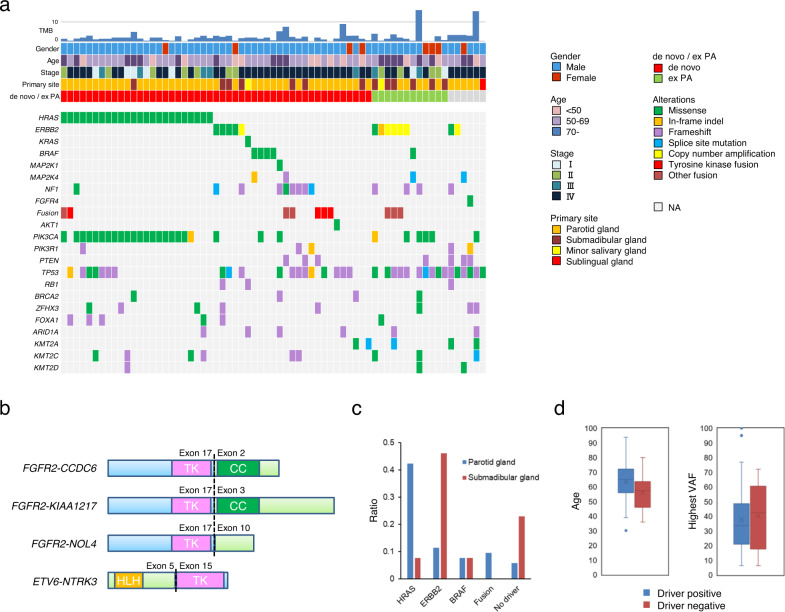
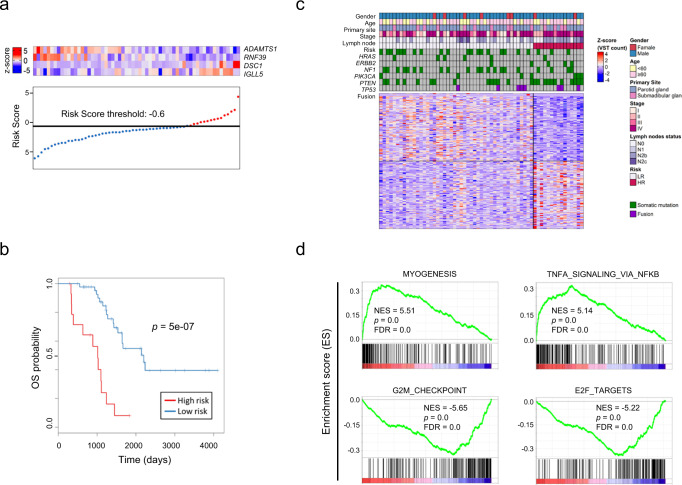
Molecular targets and predictive biomarkers for prognosis in salivary duct carcinoma (SDC) have not been fully identified. We conducted comprehensive molecular profiling to discover novel biomarkers for SDC. A total of 67 SDC samples were examined with DNA sequencing of 464 genes and transcriptome analysis in combination with the clinicopathological characteristics of the individuals. Prognostic biomarkers associated with response to combined androgen blockade (CAB) treatment were explored using mRNA expression data from 27 cases. Oncogenic mutations in receptor tyrosine kinase (RTK) genes or genes in the MAPK pathway were identified in 55 cases (82.1%). Alterations in the phosphatidylinositol 3-kinase (PI3K)/AKT signaling pathway were identified in 38 cases (56.7%). Interestingly, patient prognosis could be predicted using mRNA expression profiles, but not genetic mutation profiles. The risk score generated from the expression data of a four-gene set that includes the ADAMTS1, DSC1, RNF39, and IGLL5 genes was a significant prognostic marker for overall survival in the cohort (HR = 5.99, 95% confidence interval (CI) = 2.73-13.1, p = 7.8 × 10). Another risk score constructed from the expression of CD3E and LDB3 was a strong prognostic marker for progression-free survival for CAB treatment (p = 0.03). Mutations in RTK genes, MAPK pathway genes, and PI3K/AKT pathway genes likely represent key mutations in SDC tumorigenesis. The gene expression profiles identified in this study may be useful for stratifying patients who are good candidates for CAB treatment and may benefit from additional systemic therapies.
涎腺导管癌(SDC)预后的分子靶点和预测性生物标志物尚未完全明确。我们进行了全面的分子分析,以发现SDC的新型生物标志物。对67例SDC样本进行了464个基因的DNA测序和转录组分析,并结合个体的临床病理特征。利用27例患者的mRNA表达数据,探索与联合雄激素阻断(CAB)治疗反应相关的预后生物标志物。在55例(82.1%)患者中发现了受体酪氨酸激酶(RTK)基因或MAPK通路基因的致癌突变。在38例(56.7%)患者中发现了磷脂酰肌醇3激酶(PI3K)/AKT信号通路的改变。有趣的是,可使用mRNA表达谱预测患者预后,但不能用基因突变谱进行预测。由包括ADAMTS1、DSC1、RNF39和IGLL5基因的四基因集表达数据生成的风险评分是该队列总生存的显著预后标志物(HR = 5.99,95%置信区间(CI)= 2.73 - 13.1,p = 7.8×10)。由CD3E和LDB3表达构建的另一个风险评分是CAB治疗无进展生存的强有力预后标志物(p = 0.03)。RTK基因、MAPK通路基因和PI3K/AKT通路基因的突变可能代表SDC肿瘤发生中的关键突变。本研究中确定的基因表达谱可能有助于对适合CAB治疗且可能从额外全身治疗中获益的患者进行分层。