Department of Obstetrics and Gynecology, West China Second University Hospital, Sichuan University, Chengdu, Sichuan, China.
Key Laboratory of Birth Defects and Related Diseases of Women and Children (Sichuan University) Ministry of Education, Chengdu, 610041, Sichuan, China.
BMC Pregnancy Childbirth. 2022 Nov 5;22(1):820. doi: 10.1186/s12884-022-05160-6.
Intrahepatic cholestasis of pregnancy (ICP) is associated with an increased risk of adverse perinatal outcomes leading to high perinatal morbidity and mortality. However, few studies have examined twin pregnancies complicated by ICP. To assess the perinatal outcomes of twin pregnancies with ICP, a retrospective cohort study was conducted.
A total of 633 twin pregnancies and 1267 singleton pregnancies with ICP were included. In addition, a correlation study was performed on the matched total bile acid (TBA) levels from maternal serum, fetal umbilical venous blood, and amniotic fluid of 33 twin pregnancies from twin groups.
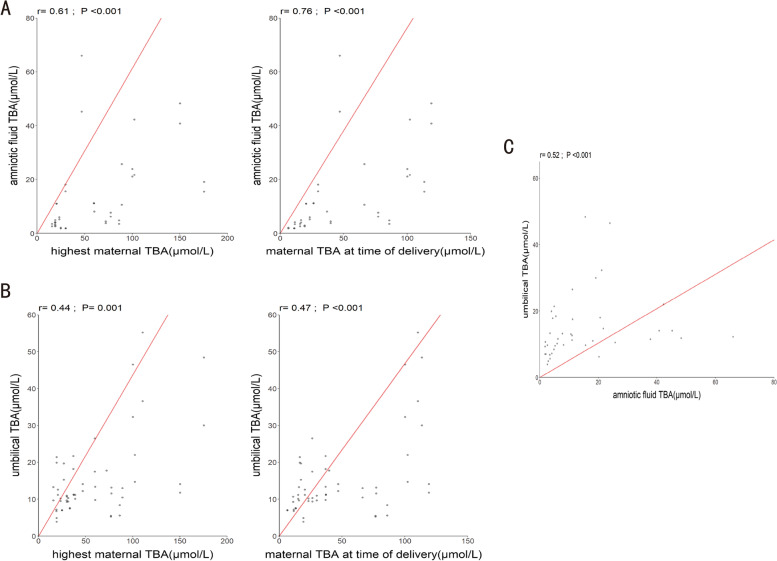
When compared to singletons, twin pregnancies with ICP had a higher risk of cesarean section (CS) (96.4% vs. 76.1%), preterm birth (PTB) (82.6% vs. 19.7%), fetal distress (2.0% vs. 1.3%), and neonatal intensive care unit (NICU) admission (23.6% vs. 5.1%), which was significantly related to increasing TBA levels (P < 0.05). In twin pregnancies with TBA ≥100 μmol/L, the incidences of CS, PTB, fetal distress, neonatal asphyxia, and meconium-stained amniotic fluid were 94.4, 100, 11.1, 5.6, and 36.1%, respectively. Furthermore, the maximum maternal TBA levels were positively correlated with TBA levels in the amniotic fluid (r = 0.61, P < 0.05) and umbilical cord blood (r = 0.44, P < 0.05), and a similar correlation was found for maternal TBA levels at delivery. TBA levels in umbilical cord blood and amniotic fluid also had a significant and positive correlation (r = 0.52, P < 0.05).
Twin pregnancies with ICP had a higher risk for adverse perinatal outcomes than singletons, which was associated with higher TBA levels. TBA can be transported through the placenta and is involved in uterus-placenta-fetal circulation.
妊娠肝内胆汁淤积症(ICP)与不良围产结局风险增加相关,导致围产儿发病率和死亡率升高。然而,很少有研究关注 ICP 合并双胎妊娠。为评估 ICP 合并双胎妊娠的围产结局,我们进行了一项回顾性队列研究。
共纳入 633 例 ICP 双胎妊娠和 1267 例 ICP 单胎妊娠。此外,还对来自双胎组的 33 例双胎妊娠的母血清、胎儿脐静脉血和羊水的总胆汁酸(TBA)水平进行了匹配相关性研究。
与单胎妊娠相比,ICP 双胎妊娠剖宫产率(96.4% vs. 76.1%)、早产率(82.6% vs. 19.7%)、胎儿窘迫率(2.0% vs. 1.3%)和新生儿重症监护病房(NICU)入住率(23.6% vs. 5.1%)更高,且均与 TBA 水平升高显著相关(P<0.05)。在 TBA≥100 μmol/L 的 ICP 双胎妊娠中,剖宫产、早产、胎儿窘迫、新生儿窒息和羊水胎粪污染的发生率分别为 94.4%、100%、11.1%、5.6%和 36.1%。此外,母体 TBA 水平的最大值与羊水(r=0.61,P<0.05)和脐静脉血(r=0.44,P<0.05)中的 TBA 水平呈正相关,分娩时母体 TBA 水平也呈类似的正相关。脐静脉血和羊水的 TBA 水平之间也存在显著正相关(r=0.52,P<0.05)。
ICP 双胎妊娠的不良围产结局风险高于单胎妊娠,这与较高的 TBA 水平有关。TBA 可以通过胎盘转运,并参与子宫胎盘胎儿循环。