Department of Health, Kinesiology and Applied Physiology, Concordia University, 7141 Sherbrooke Street West, Montreal, QC, H4B 1R6, Canada.
Montreal Behavioural Medicine Centre, CIUSSS-NIM, Montreal, Canada.
Eur J Epidemiol. 2022 Dec;37(12):1233-1250. doi: 10.1007/s10654-022-00932-y. Epub 2022 Nov 6.
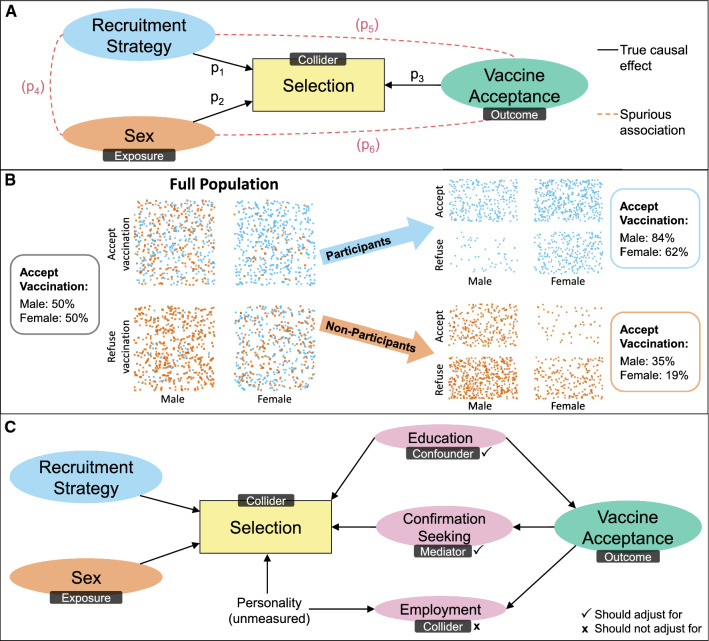
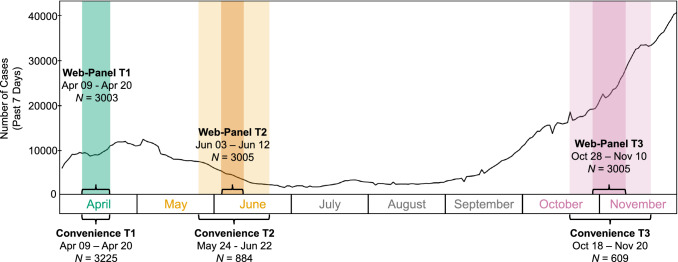
COVID-19 research has relied heavily on convenience-based samples, which-though often necessary-are susceptible to important sampling biases. We begin with a theoretical overview and introduction to the dynamics that underlie sampling bias. We then empirically examine sampling bias in online COVID-19 surveys and evaluate the degree to which common statistical adjustments for demographic covariates successfully attenuate such bias. This registered study analysed responses to identical questions from three convenience and three largely representative samples (total N = 13,731) collected online in Canada within the International COVID-19 Awareness and Responses Evaluation Study ( www.icarestudy.com ). We compared samples on 11 behavioural and psychological outcomes (e.g., adherence to COVID-19 prevention measures, vaccine intentions) across three time points and employed multiverse-style analyses to examine how 512 combinations of demographic covariates (e.g., sex, age, education, income, ethnicity) impacted sampling discrepancies on these outcomes. Significant discrepancies emerged between samples on 73% of outcomes. Participants in the convenience samples held more positive thoughts towards and engaged in more COVID-19 prevention behaviours. Covariates attenuated sampling differences in only 55% of cases and increased differences in 45%. No covariate performed reliably well. Our results suggest that online convenience samples may display more positive dispositions towards COVID-19 prevention behaviours being studied than would samples drawn using more representative means. Adjusting results for demographic covariates frequently increased rather than decreased bias, suggesting that researchers should be cautious when interpreting adjusted findings. Using multiverse-style analyses as extended sensitivity analyses is recommended.
COVID-19 研究严重依赖基于便利性的样本,这些样本虽然通常是必要的,但容易受到重要的抽样偏差的影响。我们首先从理论上概述和介绍了导致抽样偏差的动态。然后,我们实证检验了在线 COVID-19 调查中的抽样偏差,并评估了常见的人口统计学协变量统计调整成功减轻这种偏差的程度。这项注册研究分析了在加拿大国际 COVID-19 意识和反应评估研究(www.icarestudy.com)中在线收集的三个便利样本和三个主要代表性样本(总 N=13731)对相同问题的回答。我们比较了三个时间点上 11 个行为和心理结果(例如,遵守 COVID-19 预防措施、疫苗接种意向)的样本,并采用多元宇宙式分析来检验 512 种人口统计学协变量(例如,性别、年龄、教育、收入、族裔)组合如何影响这些结果的抽样差异。在 73%的结果上,样本之间存在显著差异。便利样本中的参与者对 COVID-19 预防行为持有更积极的想法,并更积极地参与其中。协变量仅在 55%的情况下减轻了抽样差异,而在 45%的情况下增加了差异。没有一个协变量表现得可靠。我们的结果表明,与使用更具代表性的方法抽取的样本相比,在线便利样本可能对正在研究的 COVID-19 预防行为表现出更积极的倾向。为人口统计学协变量调整结果经常会增加而不是减少偏差,这表明研究人员在解释调整后的发现时应谨慎。建议使用多元宇宙式分析作为扩展敏感性分析。