Bioinformatics and Systems Biology Laboratory (GIBBS). Instituto de Genética, Universidad Nacional de Colombia, Colombia.
Departamento de Nutrición y Bioquímica. Pontificia Universidad Javeriana Bogotá, Colombia.
Chem Biol Interact. 2022 Dec 1;368:110244. doi: 10.1016/j.cbi.2022.110244. Epub 2022 Nov 3.
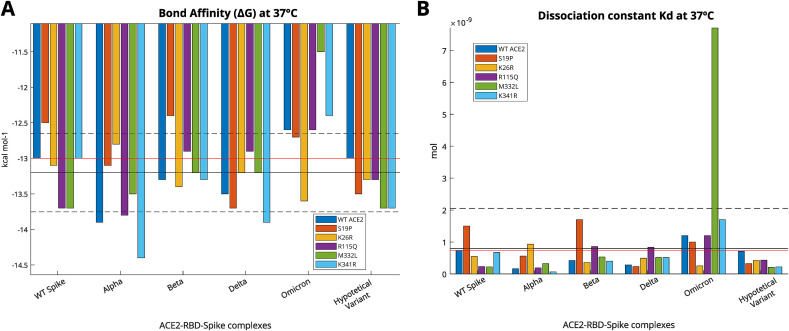
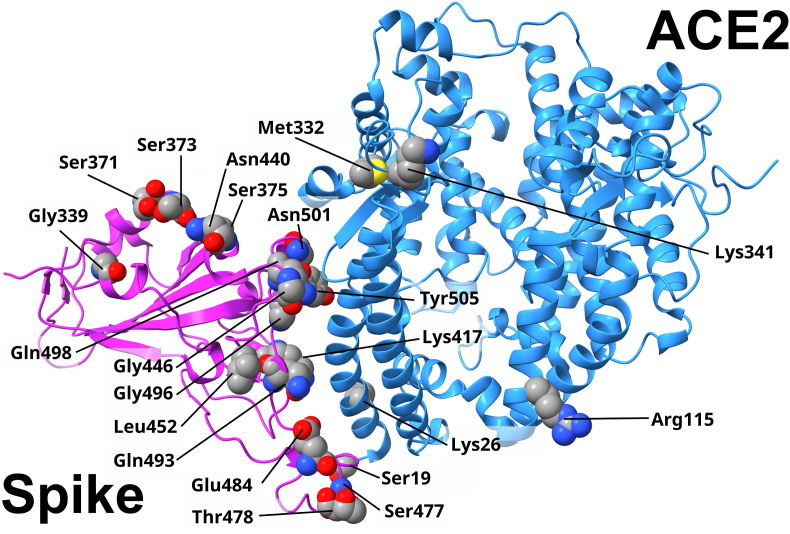
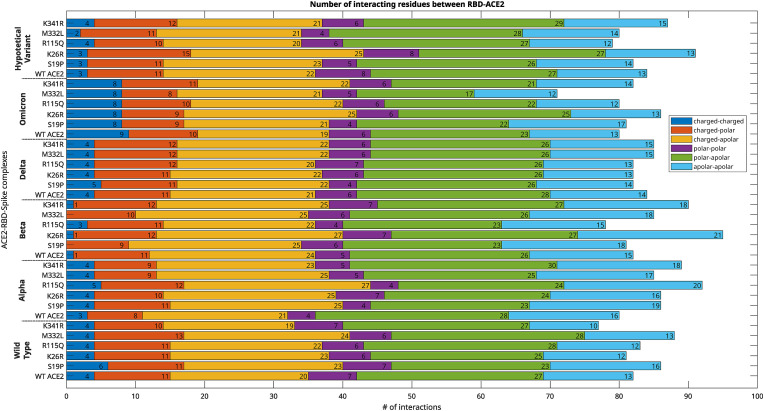
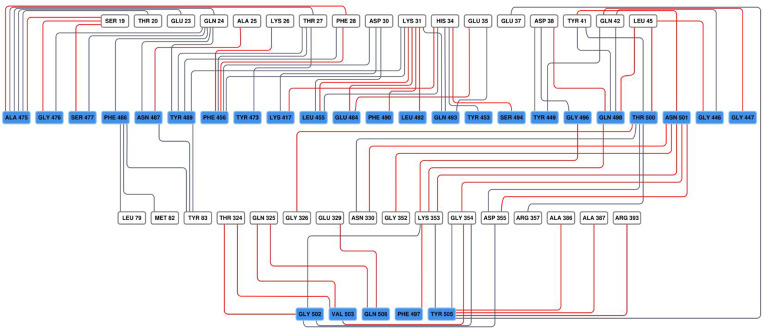
Interactions between the human angiotensin-converting enzyme 2 (ACE2) and the RBD region of the SARS-CoV-2 Spike protein are critical for virus entry into the host cell. The objective of this work was to identify some of the most relevant SARS-CoV-2 Spike variants that emerged during the pandemic and evaluate their binding affinity with human variants of ACE2 since some ACE2 variants can enhance or reduce the affinity of the interaction between the ACE2 and S proteins. However, no information has been sought to extrapolate to different variants of SARS-CoV-2. Therefore, to understand the impact on the affinity of the interaction between ACE2 protein variants and SARS-CoV-2 protein S variants, molecular docking was used in this study to predict the effects of five mutations of ACE2 when they interact with Alpha, Beta, Delta, Omicron variants and a hypothetical variant, which present mutations in the RBD region of the SARS-CoV-2 Spike protein. Our results suggest that these variants could alter the interaction of the Spike and the human ACE2 protein, losing or creating new inter-protein contacts, enhancing viral fitness by improving binding affinity, and leading to an increase in infectivity, virulence, and transmission. This investigation highlighted that the S19P mutation of ACE2 decreases the binding affinity between the ACE2 and Spike proteins in the presence of the Beta variant and the wild-type variant of SARS-CoV-2 isolated in Wuhan-2019. The R115Q mutation of ACE2 lowers the binding affinity of these two proteins in the presence of the Beta and Delta variants. Similarly, the K26R mutation lowers the affinity of the interaction between the ACE2 and Spike proteins in the presence of the Alpha variant. This decrease in binding affinity is probably due to the lack of interaction between some of the key residues of the interaction complex between the ACE2 protein and the RBD region of the SARS-CoV-2 Spike protein. Therefore, ACE2 mutations appear in the presence of these variants, they could suggest an intrinsic resistance to COVID-19 disease. On the other hand, our results suggested that the K26R, M332L, and K341R mutations of ACE2 expressively showed the affinity between the ACE2 and Spike proteins in the Alpha, Beta, and Delta variants. Consequently, these ACE2 mutations in the presence of the Alpha, Beta, and delta variants of SARS-CoV-2 could be more infectious and virulent in human cells compared to the SARS-CoV-2 isolated in Wuhan-2019 and it could have a negative prognosis of the disease. Finally, the Omicron variant in interaction with ACE2 WT, S19P, R115Q, M332L, and K341R mutations of ACE2 showed a significant decrease in binding affinity. This could be consistent that the Omicron variant causes less severe symptoms than previous variants. On the other hand, our results suggested Omicron in the complex with K26R, the binding affinity is increased between ACE2/RBD, which could indicate a negative prognosis of the disease in people with these allelic conditions.
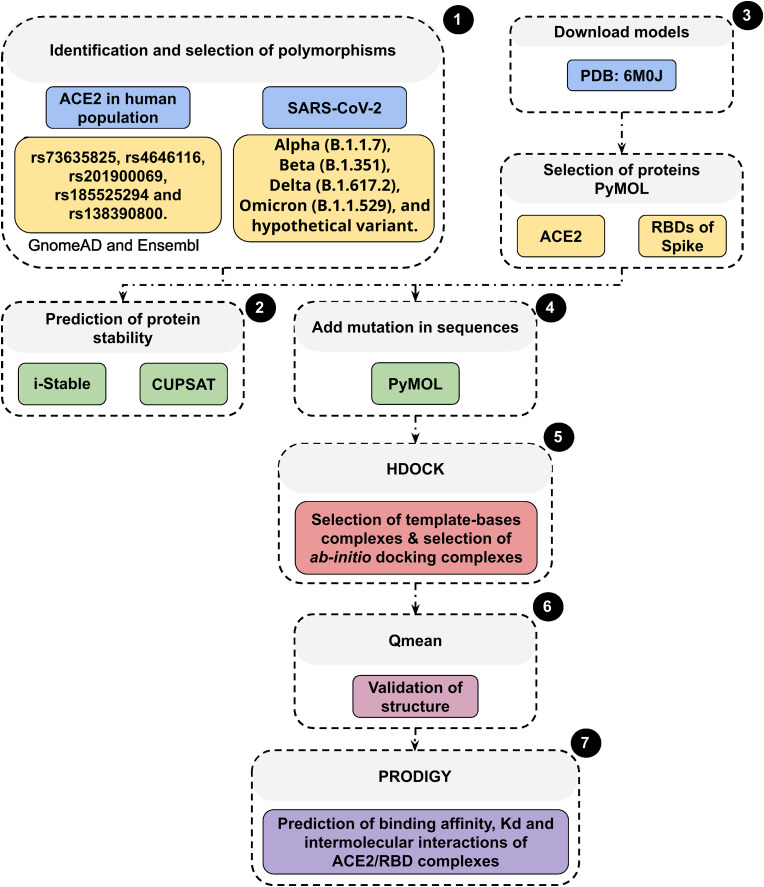
人类血管紧张素转换酶 2(ACE2)与 SARS-CoV-2 刺突蛋白的 RBD 区域之间的相互作用对于病毒进入宿主细胞至关重要。这项工作的目的是确定一些在大流行期间出现的最重要的 SARS-CoV-2 刺突变体,并评估它们与人 ACE2 变体的结合亲和力,因为一些 ACE2 变体可以增强或降低 ACE2 和 S 蛋白之间的相互作用亲和力。然而,没有信息可以推断到不同的 SARS-CoV-2 变体。因此,为了了解 ACE2 蛋白变体和 SARS-CoV-2 蛋白 S 变体之间相互作用亲和力的影响,本研究使用分子对接来预测 ACE2 的五个突变与 Alpha、Beta、Delta、Omicron 变体和一个假设变体相互作用时的影响,该变体在 SARS-CoV-2 刺突蛋白的 RBD 区域存在突变。我们的结果表明,这些变体可能会改变 Spike 和人类 ACE2 蛋白之间的相互作用,失去或创建新的蛋白间接触,通过提高结合亲和力提高病毒适应性,并导致感染性、毒力和传播性增加。这项研究强调,在存在 Beta 变体和武汉-2019 分离的 SARS-CoV-2 野生型变体的情况下,ACE2 的 S19P 突变降低了 ACE2 和 Spike 蛋白之间的结合亲和力。ACE2 的 R115Q 突变降低了这两种蛋白在 Beta 和 Delta 变体存在下的结合亲和力。同样,K26R 突变降低了 ACE2 和 Spike 蛋白之间相互作用的亲和力。这种结合亲和力的降低可能是由于 ACE2 蛋白与 SARS-CoV-2 Spike 蛋白的 RBD 区域之间的相互作用复合物的一些关键残基之间缺乏相互作用。因此,ACE2 突变在这些变体存在的情况下出现,可能表明对 COVID-19 疾病有内在的抵抗力。另一方面,我们的结果表明,ACE2 的 K26R、M332L 和 K341R 突变在 Alpha、Beta 和 Delta 变体中明显表达了 ACE2 和 Spike 蛋白之间的亲和力。因此,与武汉-2019 分离的 SARS-CoV-2 相比,ACE2 在存在 Alpha、Beta 和 delta 变体的情况下的这些突变可能更具传染性和毒性,并且可能对疾病有负面预后。最后,与 ACE2 WT、S19P、R115Q、M332L 和 K341R 突变的 ACE2 相互作用的 Omicron 变体显示出结合亲和力的显著降低。这可能与 Omicron 变体引起的症状比以前的变体更轻一致。另一方面,我们的结果表明,Omicron 与 K26R 形成复合物时,ACE2/RBD 之间的结合亲和力增加,这可能表明具有这些等位基因条件的人病情预后不良。