Laboratory of Protein Metabolism, International Institute of Molecular and Cell Biology in Warsaw, 02-109 Warsaw, Poland.
Department of Developmental Neurology, Medical University of Gdańsk, 80-952 Gdańsk, Poland.
Hum Mol Genet. 2023 Mar 20;32(7):1152-1161. doi: 10.1093/hmg/ddac276.
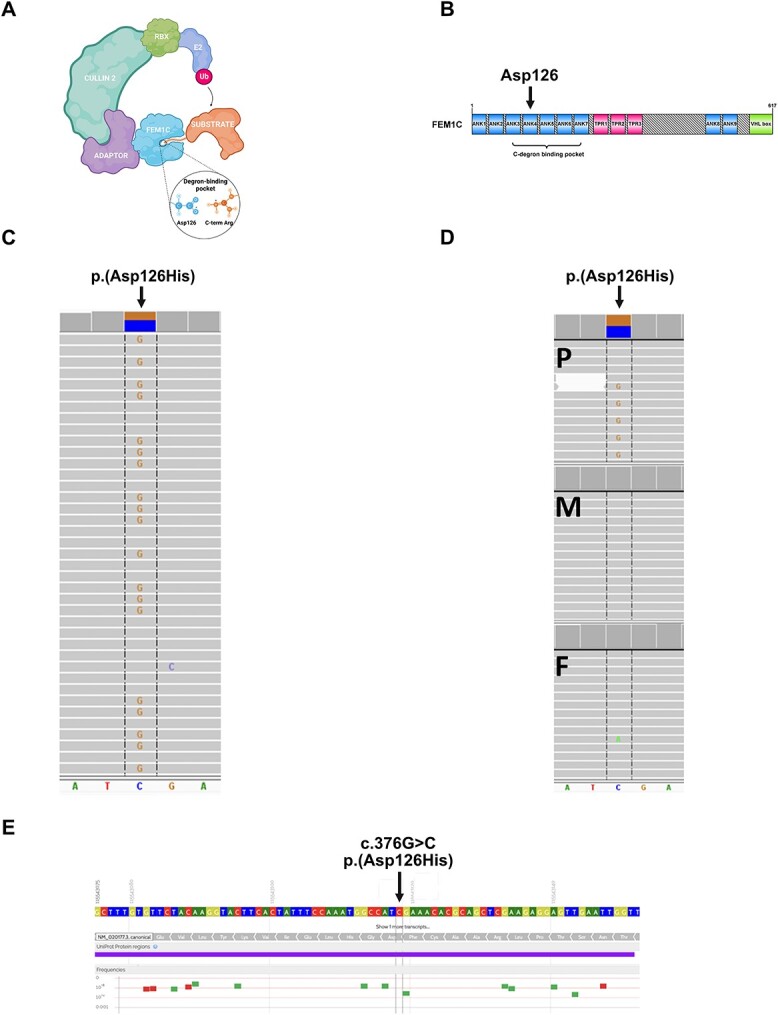
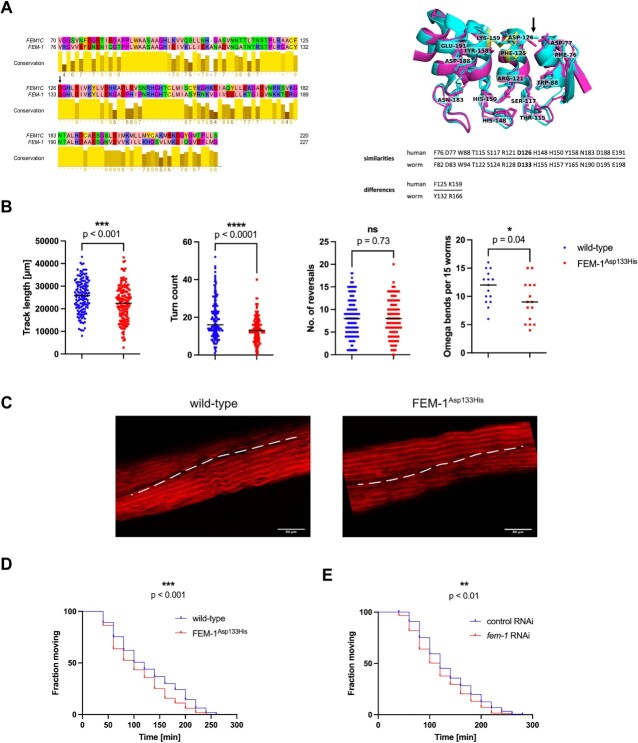
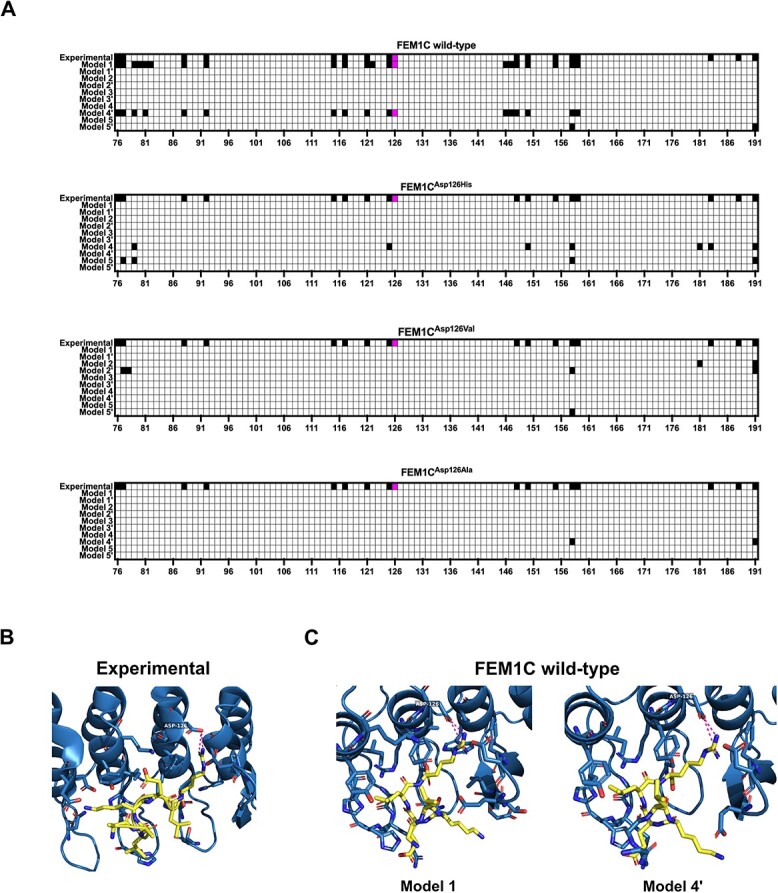
The principal component of the protein homeostasis network is the ubiquitin-proteasome system. Ubiquitination is mediated by an enzymatic cascade involving, i.e. E3 ubiquitin ligases, many of which belong to the cullin-RING ligases family. Genetic defects in the ubiquitin-proteasome system components, including cullin-RING ligases, are known causes of neurodevelopmental disorders. Using exome sequencing to diagnose a pediatric patient with developmental delay, pyramidal signs and limb ataxia, we identified a de novo missense variant c.376G>C; p.(Asp126His) in the FEM1C gene encoding a cullin-RING ligase substrate receptor. This variant alters a conserved amino acid located within a highly constrained coding region and is predicted as pathogenic by most in silico tools. In addition, a de novo FEM1C mutation of the same residue p.(Asp126Val) was associated with an undiagnosed developmental disorder, and the relevant variant (FEM1CAsp126Ala) was found to be functionally compromised in vitro. Our computational analysis showed that FEM1CAsp126His hampers protein substrate binding. To further assess its pathogenicity, we used the nematode Caenorhabditis elegans. We found that the FEM-1Asp133His animals (expressing variant homologous to the FEM1C p.(Asp126Val)) had normal muscle architecture yet impaired mobility. Mutant worms were sensitive to the acetylcholinesterase inhibitor aldicarb but not levamisole (acetylcholine receptor agonist), showing that their disabled locomotion is caused by synaptic abnormalities and not muscle dysfunction. In conclusion, we provide the first evidence from an animal model suggesting that a mutation in the evolutionarily conserved FEM1C Asp126 position causes a neurodevelopmental disorder in humans.
蛋白质平衡网络的主要组成部分是泛素-蛋白酶体系统。泛素化是由涉及 E3 泛素连接酶的酶级联介导的,其中许多 E3 泛素连接酶属于 Cullin-RING 连接酶家族。泛素-蛋白酶体系统成分(包括 Cullin-RING 连接酶)的遗传缺陷是神经发育障碍的已知原因。我们使用外显子组测序来诊断一名患有发育迟缓、锥体束征和肢体共济失调的儿科患者,发现了一个新的错义变异 c.376G>C;p.(Asp126His),该变异位于编码 Cullin-RING 连接酶底物受体的 FEM1C 基因中。该变异改变了高度受限编码区内的保守氨基酸,并且大多数计算工具预测为致病性变异。此外,同一残基的 FEM1C 突变(p.(Asp126Val))与未诊断的发育障碍相关,并且相关的变异(FEM1CAsp126Ala)在体外功能受损。我们的计算分析表明,FEM1CAsp126His 阻碍了蛋白质底物的结合。为了进一步评估其致病性,我们使用了线虫秀丽隐杆线虫。我们发现,FEM-1Asp133His 动物(表达与 FEM1C p.(Asp126Val)同源的变异)具有正常的肌肉结构,但运动能力受损。突变蠕虫对乙酰胆碱酯酶抑制剂 aldicarb 敏感,但对 levamisole(乙酰胆碱受体激动剂)不敏感,表明其运动障碍是由突触异常引起的,而不是肌肉功能障碍。总之,我们从动物模型中提供了第一个证据,表明进化上保守的 FEM1C Asp126 位置的突变会导致人类的神经发育障碍。