
心理韧性和积极应对方式影响中国本科护理专业学生适应不良完美主义与学业拖延之间的关系。
Resilience and positive coping style affect the relationship between maladaptive perfectionism and academic procrastination among Chinese undergraduate nursing students.
作者信息
Huang Haitao, Ding Yueming, Zhang Yiming, Peng Qianwen, Liang Yipei, Wan Xiao, Chen Chaoran
机构信息
School of Nursing and Health, Institute of Nursing and Health, Henan University, Kaifeng, China.
School of Business, Institute of Business Administration, Henan University, Kaifeng, China.
出版信息
Front Psychol. 2022 Oct 20;13:1014951. doi: 10.3389/fpsyg.2022.1014951. eCollection 2022.
BACKGROUND
Previous studies have not investigated the role of resilience and coping style on the association between maladaptive perfectionism and academic procrastination among nursing undergraduates. However, how to mobilize the learning enthusiasm of nursing students and reduce the incidence of academic procrastination is an important factor to reduce nursing loss and improve nursing quality.
OBJECTIVES
To investigate the influence of maladaptive perfectionism, resilience and coping style on academic procrastination among Chinese undergraduate nursing students.
METHODS
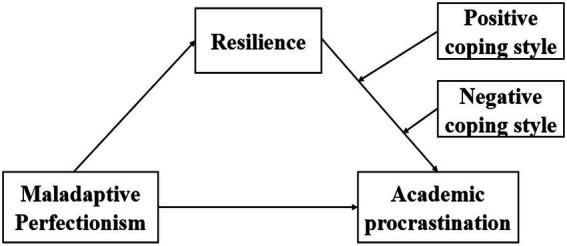
A cross-sectional study was conducted. A convenience sampling method was used to select 665 nursing undergraduates from March to May 2022 in China. Maladaptive perfectionism, coping style, resilience, and academic procrastination were measured using questionnaires. The descriptive analysis, Pearson's correlation analysis and the Hayes' PROCESS Macro in SPSS 25.0 were used to test the model.
RESULTS
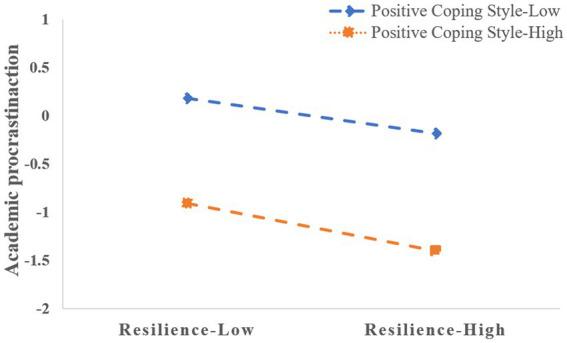
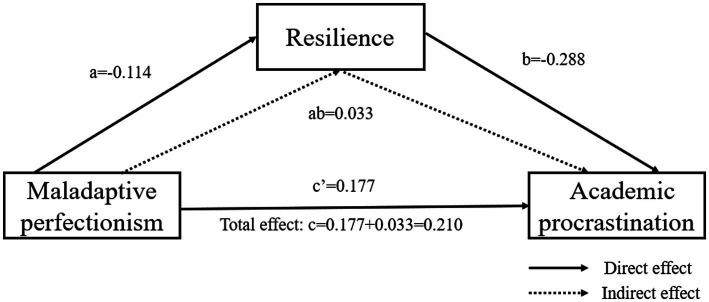
The results showed that nursing undergraduates' maladaptive perfectionism, resilience, positive coping style and academic procrastination were significantly correlated between every two variables, with coefficients ranging between -0.290 and 0.584. In addition, resilience played a partial mediating role in maladaptive perfectionism and academic procrastination, accounting for 15.70% of the total effect; in the meantime, this process was moderated by positive coping style.
CONCLUSION
Maladaptive perfectionism positively predicted nursing undergraduates' academic procrastination; as a mediating mechanism with moderating, resilience and positive coping style further explained how maladaptive perfectionism promoted the academic procrastination of nursing undergraduates. Understanding this mechanism is of great significance for nursing educators to reduce the risk of academic procrastination in nursing undergraduates.
背景
以往研究尚未探讨心理弹性和应对方式在护理专业本科生适应不良完美主义与学业拖延之间的关联中所起的作用。然而,如何调动护理专业学生的学习积极性并降低学业拖延的发生率,是减少护理人才流失和提高护理质量的重要因素。
目的
探讨适应不良完美主义、心理弹性和应对方式对中国护理专业本科学生学业拖延的影响。
方法
采用横断面研究。2022年3月至5月,在中国采用便利抽样法选取665名护理专业本科生。使用问卷测量适应不良完美主义、应对方式、心理弹性和学业拖延。采用描述性分析、Pearson相关分析以及SPSS 25.0中的Hayes' PROCESS宏程序对模型进行检验。
结果
结果显示,护理专业本科生的适应不良完美主义、心理弹性、积极应对方式和学业拖延在任意两个变量之间均显著相关,系数范围在-0.290至0.584之间。此外,心理弹性在适应不良完美主义与学业拖延之间起部分中介作用,占总效应的15.70%;同时,这一过程受到积极应对方式的调节。
结论
适应不良完美主义正向预测护理专业本科生的学业拖延;作为一种具有调节作用的中介机制,心理弹性和积极应对方式进一步解释了适应不良完美主义如何促进护理专业本科生的学业拖延。了解这一机制对于护理教育工作者降低护理专业本科生学业拖延风险具有重要意义。
 Zotero 插件