Lyu Tianqi, Lin Yuanbin, Wu Kerong, Cao Zhanglei, Zhang Qian, Zheng Jianping
Cixi Institute of Biomedical Engineering, Ningbo Institute of Materials Technology and Engineering, Chinese Academy of Science (CAS), Ningbo, China.
Department of Urology, Ningbo First Hospital, School of Medicine Ningbo University, Zhejiang University Ningbo Hospital, Ningbo, China.
Front Genet. 2022 Oct 19;13:1027909. doi: 10.3389/fgene.2022.1027909. eCollection 2022.
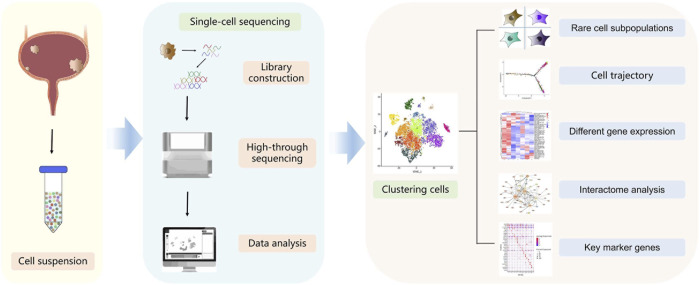
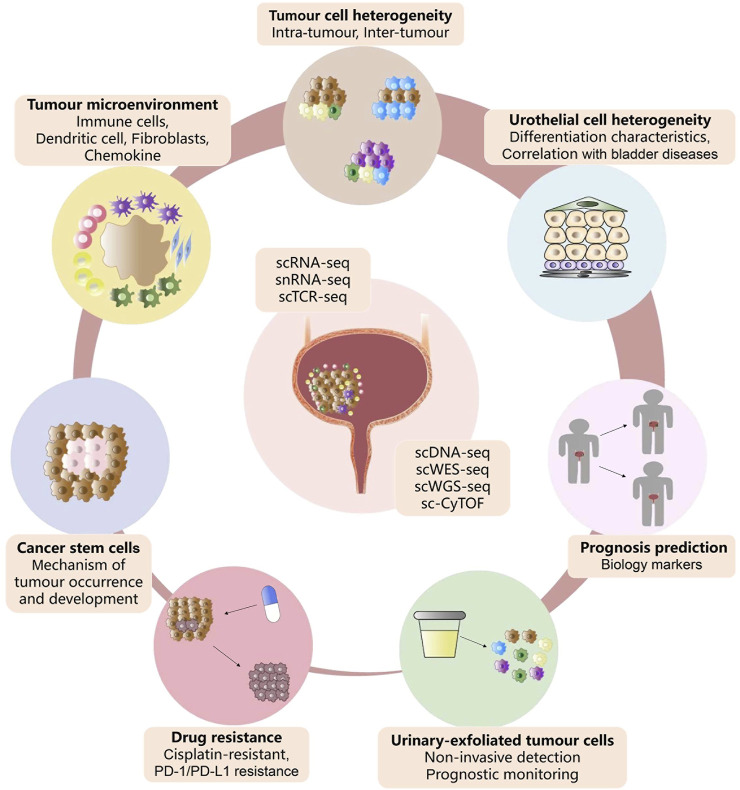
Bladder cancer is among the most common malignant tumors with highly heterogeneous molecular characteristics. Despite advancements of the available therapeutic options, several bladder cancer patients exhibit unsatisfactory clinical outcomes. The lack of specific biomarkers for effective targeted therapy or immunotherapy remains a major obstacle in treating bladder cancer. The rapid development of single-cell techniques is transforming our understanding of the intra-tumoral heterogeneity, thereby providing us with a powerful high-throughput sequencing tool that can reveal tumorigenesis, progression, and invasion in bladder tumors. In this review, we summarise and discuss how single-cell sequencing technologies have been applied in bladder cancer research, to advance our collective knowledge on the heterogeneity of bladder tumor cells, as well as to provide new insights into the complex ecosystem of the tumor microenvironment. The application of single-cell approaches also uncovers the therapeutic resistance mechanism in bladder cancer and facilitates the detection of urinary-exfoliated tumor cells. Moreover, benefiting from the powerful technical advantages of single-cell techniques, several key therapeutic targets and prognostic models of bladder cancer have been identified. It is hoped that this paper can provide novel insights into the precision medicine of bladder cancer.
膀胱癌是最常见的恶性肿瘤之一,具有高度异质性的分子特征。尽管现有治疗方案取得了进展,但仍有部分膀胱癌患者的临床疗效不尽人意。缺乏用于有效靶向治疗或免疫治疗的特异性生物标志物仍然是治疗膀胱癌的主要障碍。单细胞技术的迅速发展正在改变我们对肿瘤内异质性的理解,从而为我们提供了一种强大的高通量测序工具,能够揭示膀胱肿瘤的发生、发展和侵袭过程。在这篇综述中,我们总结并讨论了单细胞测序技术如何应用于膀胱癌研究,以增进我们对膀胱肿瘤细胞异质性的共同认识,并为肿瘤微环境的复杂生态系统提供新的见解。单细胞方法的应用还揭示了膀胱癌的治疗耐药机制,并有助于检测尿液脱落的肿瘤细胞。此外,受益于单细胞技术强大的技术优势,已经确定了几个膀胱癌的关键治疗靶点和预后模型。希望本文能为膀胱癌的精准医学提供新的见解。