De Biase Alessandro, Paparella Giulia, Angelini Luca, Cannavacciuolo Antonio, Colella Donato, Cerulli Irelli Emanuele, Giallonardo Anna Teresa, Di Bonaventura Carlo, Berardelli Alfredo, Bologna Matteo
Department of Human Neurosciences Sapienza University of Rome Rome Italy.
IRCCS Neuromed Pozzilli (IS) Italy.
Mov Disord Clin Pract. 2022 Sep 25;9(8):1062-1073. doi: 10.1002/mdc3.13560. eCollection 2022 Nov.
To date, only a few clinical and neurophysiological studies have assessed the features of valproate-induced tremor (VIT), and whether valproate (VPA) affects voluntary movements is underinvestigated.
To better characterize the clinical and neurophysiological features of VIT in patients with epilepsy and the effect of VPA on the execution of voluntary movement.
We tested 29 patients with VIT (13 taking VPA alone and 16 taking VPA plus other antiepileptics). Patients underwent a neurological examination, video recordings and kinematic assessments of postural, kinetic, and resting upper limb tremor using a motion analysis system. Movement execution was tested by kinematic assessment of finger tapping. Data of patients with VIT were compared with those of 13 patients with epilepsy taking VPA but without tremor, 13 patients with epilepsy who were not on VPA treatment, 20 patients with Parkinson's disease (PD), and 20 healthy controls (HCs).
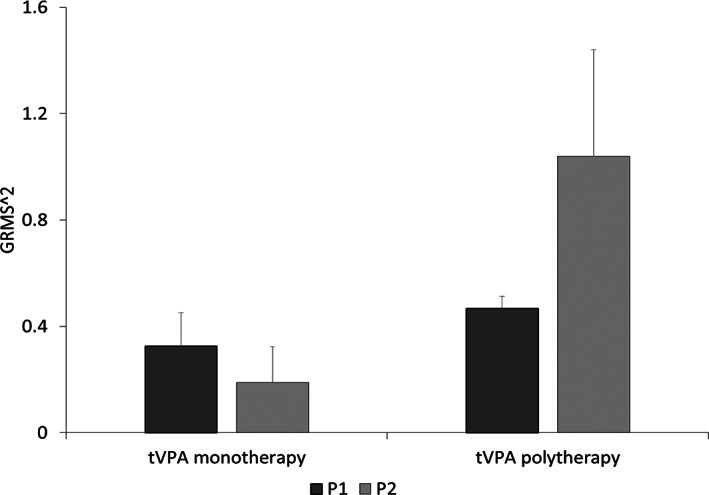
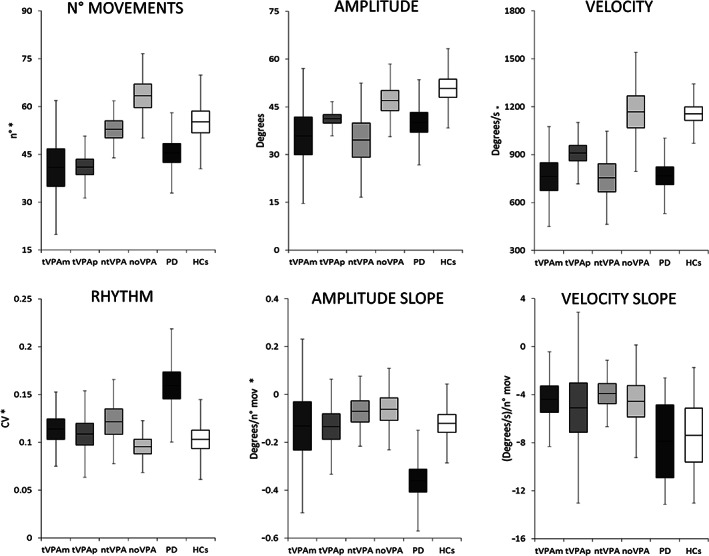
Clinical and kinematic evaluations showed that tremor in patients taking VPA alone was less severe than tremor in patients taking VPA plus other antiepileptics. All patients taking VPA, regardless of the presence of tremor, performed slower finger tapping compared with HCs, similar to what was observed in PD, although with no sequence effect. Patients with epilepsy without VPA showed a normal motor performance.
Tremor and movement slowness are motor signs induced by VPA. VIT severity is exacerbated when VPA is taken in combination with other antiepileptics. VPA-induced slowness occurs regardless of tremor, may precede tremor development, and is not attributed to epilepsy.
迄今为止,仅有少数临床和神经生理学研究评估了丙戊酸盐诱发震颤(VIT)的特征,而丙戊酸盐(VPA)是否影响自主运动尚未得到充分研究。
更好地描述癫痫患者中VIT的临床和神经生理学特征以及VPA对自主运动执行的影响。
我们测试了29例VIT患者(13例仅服用VPA,16例服用VPA加其他抗癫痫药物)。患者接受了神经系统检查、视频记录,并使用运动分析系统对姿势性、运动性和静止性上肢震颤进行了运动学评估。通过对手指敲击的运动学评估来测试运动执行情况。将VIT患者的数据与13例服用VPA但无震颤的癫痫患者、13例未接受VPA治疗的癫痫患者、20例帕金森病(PD)患者和20例健康对照(HCs)的数据进行比较。
临床和运动学评估显示,仅服用VPA的患者的震颤比服用VPA加其他抗癫痫药物的患者的震颤轻。所有服用VPA的患者,无论是否存在震颤,与HCs相比,手指敲击速度都较慢,这与在PD中观察到的情况相似,尽管没有序列效应。未服用VPA的癫痫患者表现出正常的运动性能。
震颤和运动迟缓是VPA诱发的运动体征。当VPA与其他抗癫痫药物联合使用时,VIT的严重程度会加剧。VPA诱发的运动迟缓与震颤无关,可能在震颤发生之前出现,且并非由癫痫引起。