Peng Jing, Wang Hui, Liu Zhen, Xu Zhen-Liang, Wang Mei-Xia, Chen Qi-Miao, Wu Ming-Li, Ren Xiao-Lei, Liang Qiu-Hua, Liu Fu-Peng, Ban Bo
Department of Pharmacy, Affiliated Hospital of Jining Medical University, Jining, Shandong, China.
Pharmacy Intravenous Admixture Services, Affiliated Hospital of Jining Medical University, Jining, Shandong, China.
Front Pharmacol. 2022 Oct 19;13:1017391. doi: 10.3389/fphar.2022.1017391. eCollection 2022.
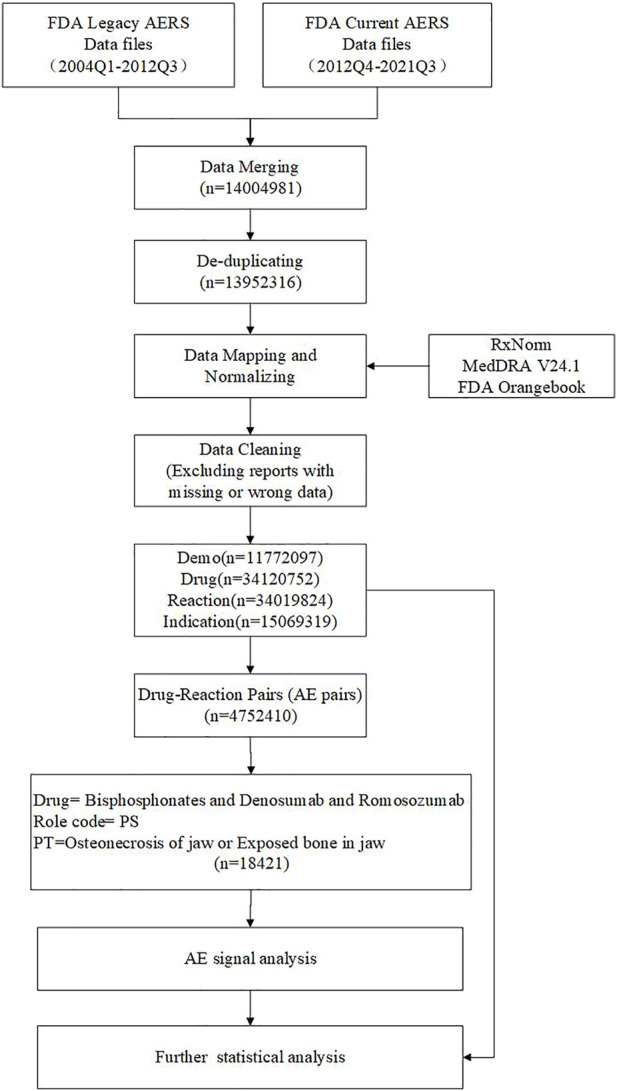
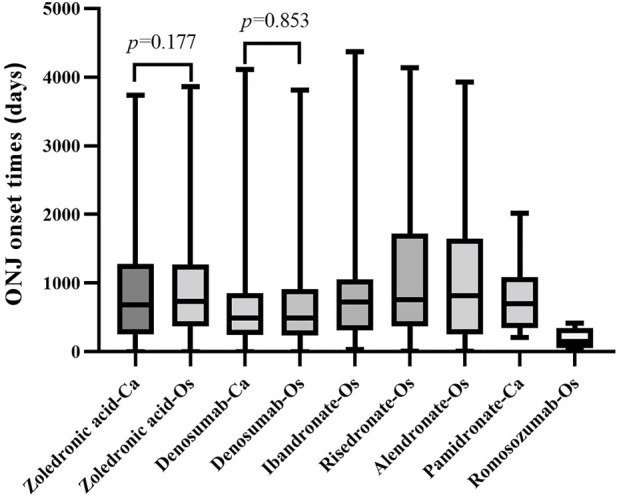
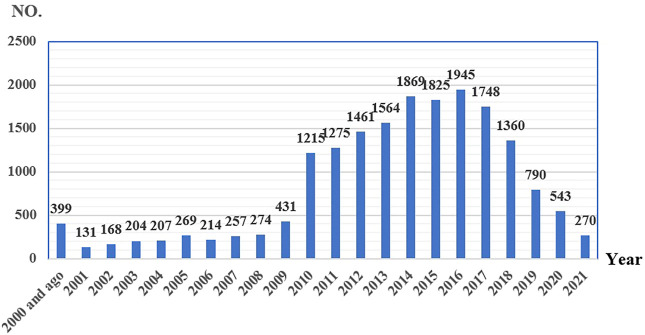
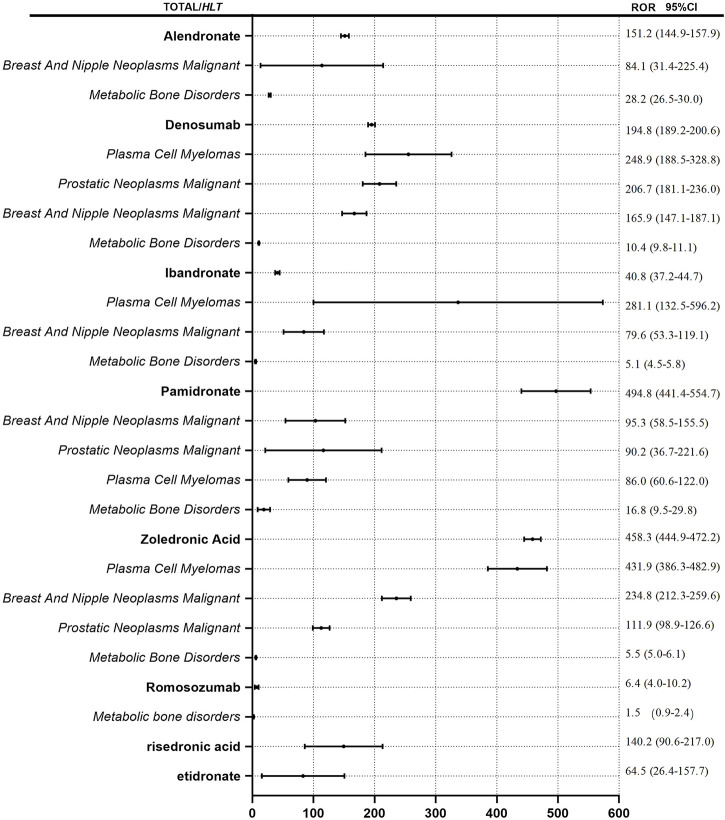
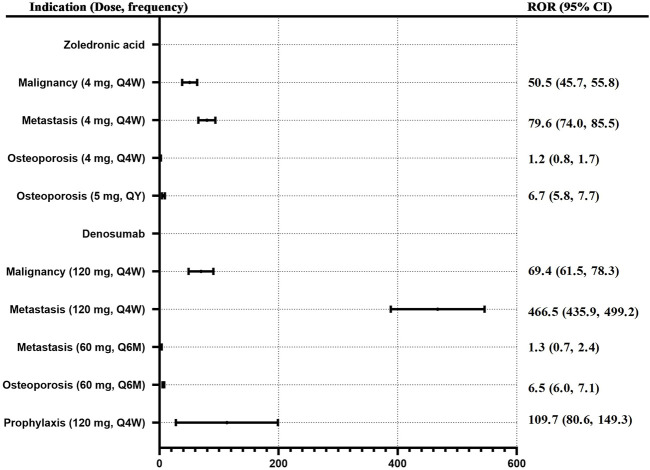
This study aims to explore the risk signals of osteonecrosis of the jaw induced by antiresorptive drugs and provide references for the clinical safety application. According to the FDA's Adverse Event Reporting System (FAERS), from January 2004 to September 2021, we chose "Osteonecrosis of the jaw (10064658)" and "Exposed bone in jaw (10071014)" as preferred terms, "antiresorptive drugs" as the target drugs, and primary suspect drug as the drug role code in the dataset. We evaluated the association between drugs and adverse events by using reporting odds ratio (ROR) based on disproportionality analysis. We took the High-Level Terms (HLT) of MedDRA as the classification level of indications to calculate ROR to compare the signal difference of ONJ in different indications. In addition, patients with antiresorptive-induced osteonecrosis of the jaw and the time of onset of the condition following different antiresorptive medications were collected for the study. The FAERS contained 18,421 reports relating to jaw osteonecrosis from January 2004 to September 2021. A total of eight antiresorptive agents were included in the analysis. From high to low, the ROR of ONJ induced by antiresorptive agents (regardless of indication) is pamidronate (ROR = 494.8), zoledronic acid (ROR = 431.9), denosumab (ROR = 194.8), alendronate (ROR = 151.2), risedronate (ROR = 140.2), etidronic acid (ROR = 64.5), ibandronate (ROR = 40.8), and romosozumab (ROR = 6.4). HLT ROR values for "metabolic bone disorders" were the lowest for each drug, while HLT ROR values were high for "tumor-related indications," including breast and nipple neoplasms malignant, plasma cell myelomas, and prostatic neoplasms malignant. The onset time for osteonecrosis of the jaw as median (Q1, Q3), osteoporosis-related indications, and the onset time for ONJ were 730 (368, 1268), 489.5 (236.3, 909.8), 722.5 (314, 1055), 761 (368, 1720), and 153 (50, 346) for zoledronic acid, denosumab, ibandronate, risedronate, and romosozumab, respectively. Cancer-related indications: the onset time for ONJ were 680.5 (255.3, 1283), 488 (245, 851), and 696.5 (347, 1087) for zoledronic acid, denosumab, and pamidronate, respectively. When antiresorptive drugs are used for metastasis, they have the largest risk signal, followed by malignancy, and the smallest is osteoporosis. The onset time of ONJ may not be related to the indications. The onset time of ONJ for BPs was about 2 years, denosumab about 1.3 years, and romosozumab less than 1 year, which may be related to sequential treatment. When used according to the instructions, the risk of ONJ caused by denosumab was higher than that of zoledronic acid, regardless of the indication. Based on these findings, researchers will continue to monitor and identify risk factors.
本研究旨在探索抗吸收药物诱发颌骨坏死的风险信号,为临床安全用药提供参考。根据美国食品药品监督管理局(FDA)的不良事件报告系统(FAERS),我们选取2004年1月至2021年9月期间,将“颌骨坏死(10064658)”和“颌骨暴露骨(10071014)”作为首选术语,“抗吸收药物”作为目标药物,并将数据集中的主要怀疑药物作为药物角色代码。我们通过基于不成比例分析的报告比值比(ROR)评估药物与不良事件之间的关联。我们将MedDRA的高级术语(HLT)作为适应症的分类级别来计算ROR,以比较不同适应症中颌骨坏死的信号差异。此外,收集使用抗吸收药物诱发颌骨坏死的患者以及不同抗吸收药物治疗后该病的发病时间进行研究。FAERS包含2004年1月至2021年9月期间18421份与颌骨坏死相关的报告。分析共纳入8种抗吸收药物。抗吸收药物诱发颌骨坏死(无论适应症)的ROR从高到低依次为:帕米膦酸(ROR = 494.8)、唑来膦酸(ROR = 431.9)、地诺单抗(ROR = 194.8)、阿仑膦酸钠(ROR = 151.2)、利塞膦酸(ROR = 140.2)、依替膦酸(ROR = 64.5)、伊班膦酸钠(ROR = 40.8)和罗莫单抗(ROR = 6.4)。每种药物在“代谢性骨病”的HLT ROR值最低,而在“肿瘤相关适应症”(包括乳腺和乳头恶性肿瘤、浆细胞骨髓瘤和前列腺恶性肿瘤)中的HLT ROR值较高。颌骨坏死的发病时间以中位数(四分位数间距)表示,与骨质疏松相关的适应症以及唑来膦酸、地诺单抗、伊班膦酸钠、利塞膦酸和罗莫单抗诱发颌骨坏死的发病时间分别为730(368,1268)、489.5(236.3,909.8)、722.5(314,1055)、761(368,1720)和153(50,346)。癌症相关适应症:唑来膦酸、地诺单抗和帕米膦酸诱发颌骨坏死的发病时间分别为680.5(255.3,1283)、488(245,851)和696.5(347,1087)。抗吸收药物用于转移时,风险信号最大,其次是恶性肿瘤,最小的是骨质疏松。颌骨坏死的发病时间可能与适应症无关。双膦酸盐类药物诱发颌骨坏死的发病时间约为2年,地诺单抗约为1.3年,罗莫单抗少于1年,这可能与序贯治疗有关。按说明使用时,无论适应症如何,地诺单抗诱发颌骨坏死的风险高于唑来膦酸。基于这些发现,研究人员将继续监测并识别风险因素。