Department of Biotechnology and Biosciences, University of Milano-Bicocca, P.zza della Scienza 2, 20126 Milan, Italy.
Department of Medicine and Surgery, University of Milano Bicocca, via Cadore 48, 20900 Monza, Italy.
Clin Chim Acta. 2022 Dec 1;537:140-145. doi: 10.1016/j.cca.2022.10.013. Epub 2022 Oct 29.
Surfactant protein-D (SP-D) is a lung-resident protein that has emerged as a potential biomarker for COVID-19. Previous investigations on acute respiratory distress syndrome patients demonstrated a significant increment of SP-D serum levels in pathological conditions. Since SP-D is not physiologically permeable to alveoli-capillary membrane and poorly expressed by other tissues, this enhancement is likely due to an impairment of the pulmonary barrier caused by prolonged inflammation.
A retrospective study on a relatively large cohort of patients of Hospital Pio XI of Desio was conducted to assess differences of the hematic SP-D concentrations among COVID-19 patients and healthy donors and if SP-D levels resulted a risk factor for disease severity and mortality.
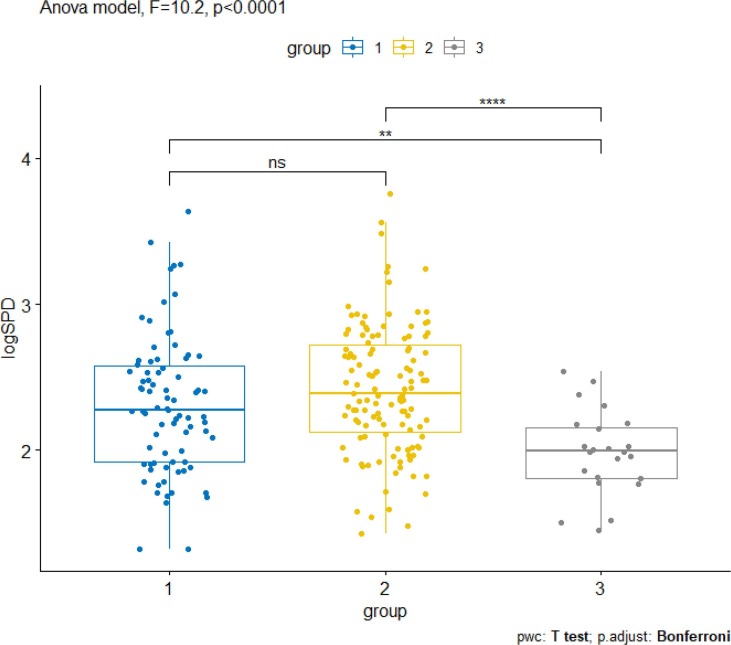
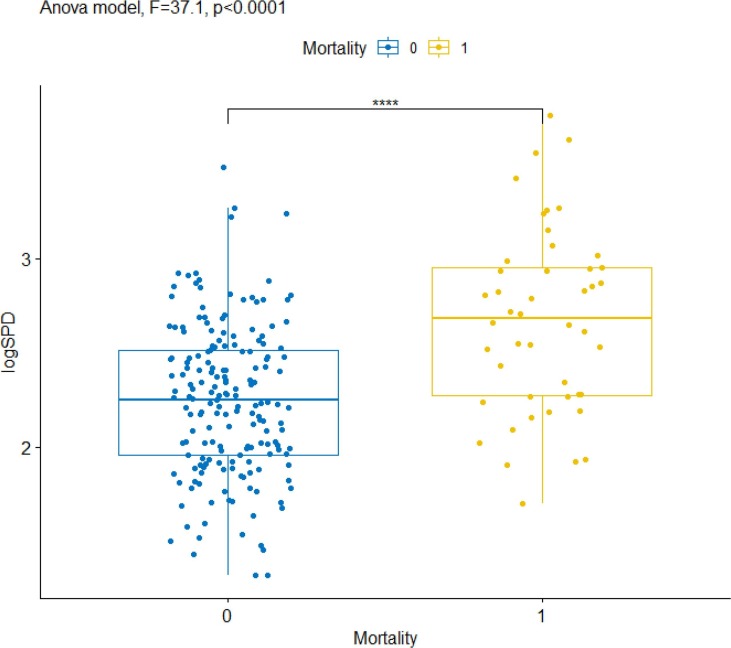
The first analysis, using an ANOVA-model, showed a significant difference in the mean of log SP-D levels between COVID-19 patients and healthy donors. Significant variations were also found between dead vs survived patients. Results confirm that SP-D concentrations were significantly higher for both hospitalized COVID-19 and dead patients, with threshold values of 150 and 250 ng/mL, respectively. Further analysis conducted with Logistic Mixed models, highlighted that higher SP-D levels at admission and increasing differences among follow-up and admission values resulted the strongest significant risk factors of mortality (model predictive accuracy, AUC = 0.844).
The results indicate that SP-D can be a predictive marker of COVID-19 disease and its outcome. Considering its prognostic value in terms of mortality, the early detection of SP-D levels and its follow-up in hospitalized patients should be considered to direct the therapeutic intervention.
表面活性蛋白-D(SP-D)是一种肺驻留蛋白,已成为 COVID-19 的潜在生物标志物。先前对急性呼吸窘迫综合征患者的研究表明,在病理条件下 SP-D 血清水平显著升高。由于 SP-D 在生理上不能穿透肺泡-毛细血管膜,并且在其他组织中表达不佳,因此这种增加很可能是由于长期炎症导致肺屏障受损。
对迪索的皮奥十一医院的一个相对较大的患者队列进行了回顾性研究,以评估 COVID-19 患者和健康供体之间血液 SP-D 浓度的差异,以及 SP-D 水平是否是疾病严重程度和死亡率的危险因素。
首次使用 ANOVA 模型进行的分析表明,COVID-19 患者和健康供体之间 log SP-D 水平的平均值存在显著差异。死亡与存活患者之间也存在显着差异。结果证实,住院 COVID-19 患者和死亡患者的 SP-D 浓度均显着升高,阈值分别为 150 和 250ng/mL。使用 Logistic 混合模型进行的进一步分析强调,入院时更高的 SP-D 水平以及随访和入院值之间的差异增加是死亡率的最强显著危险因素(模型预测准确性,AUC=0.844)。
研究结果表明,SP-D 可以作为 COVID-19 疾病及其结果的预测标志物。鉴于其在死亡率方面的预后价值,应考虑在住院患者中早期检测 SP-D 水平并进行随访,以指导治疗干预。