
回忆偏倚影响膝骨关节炎的疼痛评估:一项初步研究。
Recall Bias Affects Pain Assessment in Knee Osteoarthritis: A Pilot Study.
机构信息
Service of Orthopaedics and Traumatology, Department of Surgery, EOC, Lugano, Switzerland.
Applied and Translational Research Center, IRCCS Istituto Ortopedico Rizzoli, Bologna, Italy.
出版信息
Cartilage. 2022 Dec;13(4):50-58. doi: 10.1177/19476035221118417. Epub 2022 Nov 8.
OBJECTIVE
The objective of this study was to evaluate the recall bias of symptoms evaluation in knee osteoarthritis (OA).
DESIGN
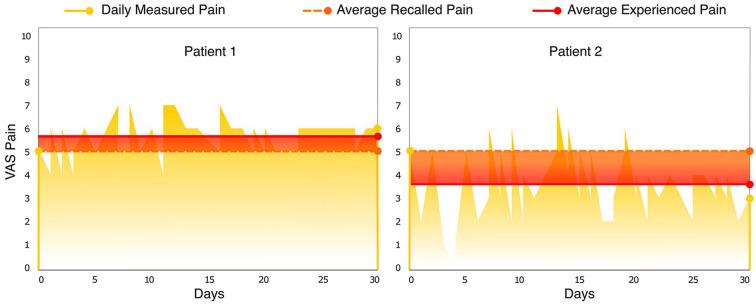
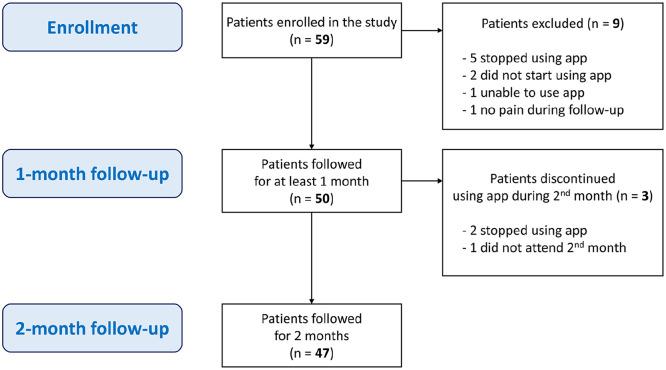
In this multicentric pilot study, 50 patients with knee OA used a mobile App (Ecological Momentary Assessment [EMA]) to collect pain and function on two 0 to 10 numerical rating scales (NRS) 2 times a day for 2 months. At the 1-month and at the 2-month follow-up visits, patients retrospectively evaluated the mean level of pain/function of the last month. Recall bias was computed as the difference between the mean level of pain/function reported using the App and the level reported with the retrospective assessment. The correlation between the recall bias and patients' characteristics, as well as pain/function trajectories, was analyzed.
RESULTS
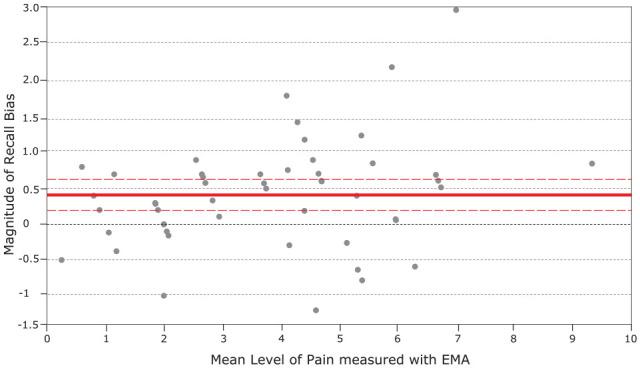
A statistically significant recall bias was documented with higher pain reported at 1-month with the retrospective assessment ( < 0.001). These results were confirmed also at the 2-month follow-up ( = 0.002). For function, no significant recall bias was documented. During the first and second months, 47 and 31 patients showed pain peaks, respectively. The number of pain peaks during the first month was correlated with the magnitude of the recall bias ( = 0.02).
CONCLUSIONS
The recall bias influences the retrospective self-assessment of pain at the follow-up visits and the presence of pain peaks, a common event in the patients with OA, increases the magnitude of recall bias. The EMA performed with a mobile App is a useful tool to limit the influence of recall bias in the clinical and research setting evaluation of knee OA.
目的
本研究旨在评估膝关节骨关节炎(OA)症状评估的回忆偏倚。
设计
在这项多中心试点研究中,50 名膝关节 OA 患者使用移动应用程序(生态瞬时评估[EMA])每天两次在两个 0 到 10 的数字评定量表(NRS)上收集疼痛和功能,持续 2 个月。在 1 个月和 2 个月的随访中,患者回顾性评估上个月的平均疼痛/功能水平。回忆偏倚计算为使用应用程序报告的平均疼痛/功能水平与使用回顾性评估报告的水平之间的差异。分析了回忆偏倚与患者特征以及疼痛/功能轨迹之间的相关性。
结果
通过回顾性评估记录到疼痛在 1 个月时的统计学显著回忆偏倚(<0.001)。这些结果在 2 个月的随访中也得到了证实(=0.002)。对于功能,未记录到显著的回忆偏倚。在第一个和第二个月中,分别有 47 名和 31 名患者出现疼痛高峰。第一个月疼痛高峰的次数与回忆偏倚的幅度相关(=0.02)。
结论
回忆偏倚会影响随访时对疼痛的回顾性自我评估,疼痛高峰是 OA 患者常见的事件,会增加回忆偏倚的幅度。使用移动应用程序进行的 EMA 是一种有用的工具,可以在膝关节 OA 的临床和研究评估中限制回忆偏倚的影响。


 Zotero 插件