Ling Huijuan, Wu Gege, Li Shuang, Zhou Qian, Li Chunxin, Ma Jiping
School of Environmental and Municipal Engineering, Qingdao University of Technology, Qingdao 266033, China.
Everbright Qingdao Institute of Environmental Technology, Qingdao 266033, China.
Se Pu. 2022 Apr;40(4):323-332. doi: 10.3724/SP.J.1123.2021.07014.
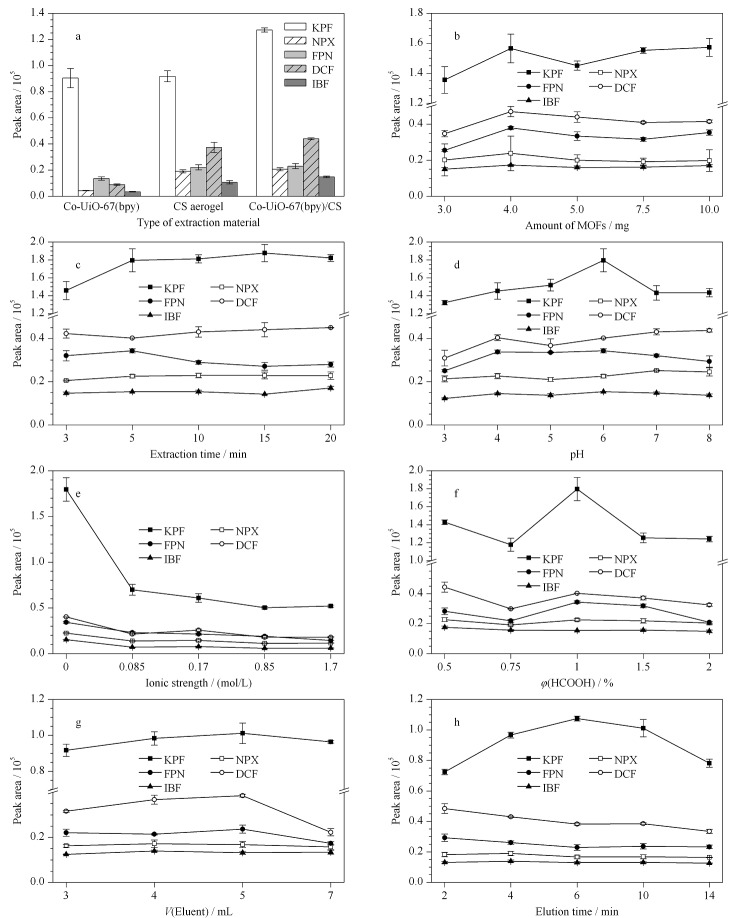
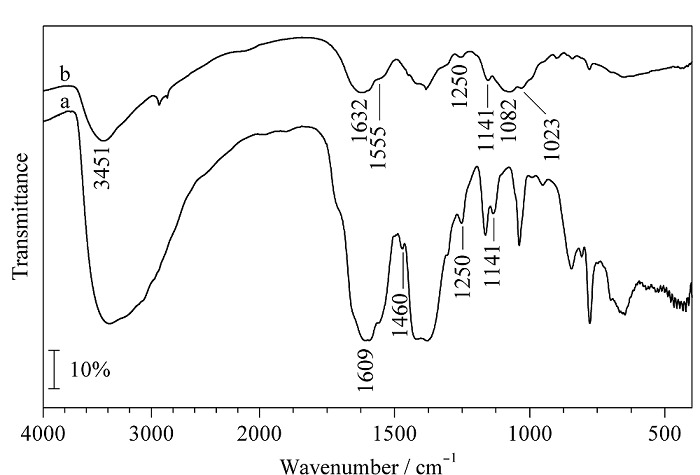
Nonsteroidal anti-inflammatory drugs (NSAIDs) are a class of synthetic drugs that do not contain glucocorticoids. NSAIDs are widely used for their analgesic, antipyretic, and anti-inflammatory effects. Due to their low adsorption coefficients and recalcitrance to biodegradation, NSAIDs readily enter environmental water through sewage discharge and exist stably for long periods. The long-term presence of trace amounts of NSAIDs in environmental water has adverse health effects on humans and animals. Therefore, it is important to establish an appropriately sensitive and reliable method for the determination of NSAIDs in environmental water, where their concentrations are low. Ultra performance liquid chromatography-tandem mass spectrometry (UPLC-MS/MS) is highly selective and sensitive, and so is especially suitable for detection of NSAIDs. Solid phase extraction is one of the most commonly used pretreatment methods. The extraction efficiency depends mainly on the adsorbents used. Metal-organic framework (MOF) aerogel SPE materials combine the attributes of highly selective adsorption property and high affinity. Moreover, the monolithic structure of the MOF aerogel composite simplifies the solid-liquid separation process. In this work, a novel MOF/chitosan (CS) composite designated Co-UiO-67(bpy)/CS, was prepared as the adsorbent material to enrich ketoprofen (KPF), naproxen (NPX), flurbiprofen (FPN), diclofenac (DCF), and ibuprofen (IBF) in water. This facilitated the detection of these compounds by UPLC-MS/MS. Co-UiO-67(bpy) was synthesized by a solvothermal method by mixing zirconium chloride, cobalt chloride, and the organic ligand 2,2-bipyridine-5,5 dicarboxylic acid. A CS suspension was used to prepared the hydrogel, which was freeze-dried to obtain the Co-UiO-67(bpy)/CS aerogel. The prepared material was characterized by Fourier transform-infrared spectroscopy (FT-IR) and scanning electron microscopy (SEM). Co-UiO-67 (bpy) was embedded into chitosan. A layered porous MOF composite aerogel was observed. The extraction efficiency of the five NSAIDs was investigated and optimized by assessing type of extraction material, MOF amount, extraction time, sample pH, ionic strength, formic acid concentration in eluent, elution time, and elution volume. The optimized results showed that the target compounds could be completely adsorbed within 5 min. In the UPLC-MS/MS experiment, NSAIDs were analyzed in the negative ionization multiple radiation monitoring (MRM) mode. Gradient elution was carried out with 0.01% formic acid aqueous solution and methanol as the mobile phases. The analytical method was established in the optimized extraction conditions. The five NSAIDs displayed good linearity with linear correlation coefficients greater than 0.9937. The limits of detection (LODs) and limits of quantification (LOQs) of this developed method were 0.32-2.06 ng/L and 1.05-6.78 ng/L, respectively. Satisfactory recoveries of the five analytes were achieved within 74.5%-114.1% at three spiked concentrations of 40, 250, and 1500 ng/L, as well as good precision with relative standard deviations of 1.3%-12.3% (intra-day) and 1.3%-11.5% (inter-day). The method was then used to test real-world water samples. Trace amounts of ketoprofen and flurbiprofen were detected in municipal wastewater (14.52 ng/L and 10.05 ng/L, respectively). The method exhibited good sensitivity, accuracy, and precision, and the operation process was convenient. The present study thus presents a novel method for the detection of the trace NSAIDs in environmental waters.
非甾体抗炎药(NSAIDs)是一类不含糖皮质激素的合成药物。NSAIDs因其镇痛、解热和抗炎作用而被广泛使用。由于其吸附系数低且难生物降解,NSAIDs容易通过污水排放进入环境水体,并长期稳定存在。环境水体中痕量NSAIDs的长期存在对人类和动物的健康有不利影响。因此,建立一种适当灵敏且可靠的方法来测定环境水体中低浓度的NSAIDs很重要。超高效液相色谱-串联质谱(UPLC-MS/MS)具有高选择性和高灵敏度,特别适合检测NSAIDs。固相萃取是最常用的预处理方法之一。萃取效率主要取决于所使用的吸附剂。金属有机框架(MOF)气凝胶固相萃取材料兼具高选择性吸附性能和高亲和力的特性。此外,MOF气凝胶复合材料的整体结构简化了固液分离过程。在本研究中,制备了一种新型的MOF/壳聚糖(CS)复合材料,即Co-UiO-67(bpy)/CS,作为吸附材料用于富集水中的酮洛芬(KPF)、萘普生(NPX)、氟比洛芬(FPN)、双氯芬酸(DCF)和布洛芬(IBF),以便通过UPLC-MS/MS检测这些化合物。Co-UiO-67(bpy)通过溶剂热法合成,将氯化锆、氯化钴与有机配体2,2-联吡啶-5,5-二羧酸混合。使用CS悬浮液制备水凝胶,然后冻干得到Co-UiO-67(bpy)/CS气凝胶。通过傅里叶变换红外光谱(FT-IR)和扫描电子显微镜(SEM)对制备的材料进行表征。Co-UiO-67(bpy)嵌入到壳聚糖中,观察到一种层状多孔MOF复合气凝胶。通过评估萃取材料类型、MOF用量、萃取时间、样品pH值、离子强度、洗脱液中甲酸浓度、洗脱时间和洗脱体积,对五种NSAIDs的萃取效率进行了研究和优化。优化结果表明,目标化合物在5分钟内可被完全吸附。在UPLC-MS/MS实验中,NSAIDs在负离子多反应监测(MRM)模式下进行分析。以0.01%甲酸水溶液和甲醇作为流动相进行梯度洗脱。在优化的萃取条件下建立了分析方法。五种NSAIDs表现出良好的线性,线性相关系数大于0.9937。该方法的检测限(LOD)和定量限(LOQ)分别为0.32 - 2.06 ng/L和1.05 - 6.78 ng/L。在40、250和1500 ng/L三个加标浓度下,五种分析物的回收率在74.5% - 114.1%之间,日内相对标准偏差为1.3% - 12.3%,日间相对标准偏差为1.3% - 11.5%,精密度良好。然后该方法用于检测实际水样。在城市污水中检测到痕量的酮洛芬和氟比洛芬(分别为14.52 ng/L和10.05 ng/L)。该方法具有良好的灵敏度、准确度和精密度,且操作过程简便。因此,本研究提出了一种检测环境水体中痕量NSAIDs的新方法。