
USP1 抑制通过使复发/难治性 B 细胞淋巴瘤中的 MAX 不稳定来逆转化疗耐药性。
Inhibition of USP1 reverses the chemotherapy resistance through destabilization of MAX in the relapsed/refractory B-cell lymphoma.
机构信息
CAS Key Laboratory of Tissue Microenvironment and Tumor, Shanghai Institute of Nutrition and Health, University of Chinese Academy of Sciences, Shanghai Jiao Tong University School of Medicine (SJTUSM) & Chinese Academy of Sciences, Shanghai, China.
Shanghai Institute of Hematology, State Key Laboratory of Medical Genomics, National Research Center for Translational Medicine at Shanghai, Ruijin Hospital Affiliated to Shanghai Jiao Tong University School of Medicine, Shanghai, China.
出版信息
Leukemia. 2023 Jan;37(1):164-177. doi: 10.1038/s41375-022-01747-2. Epub 2022 Nov 9.
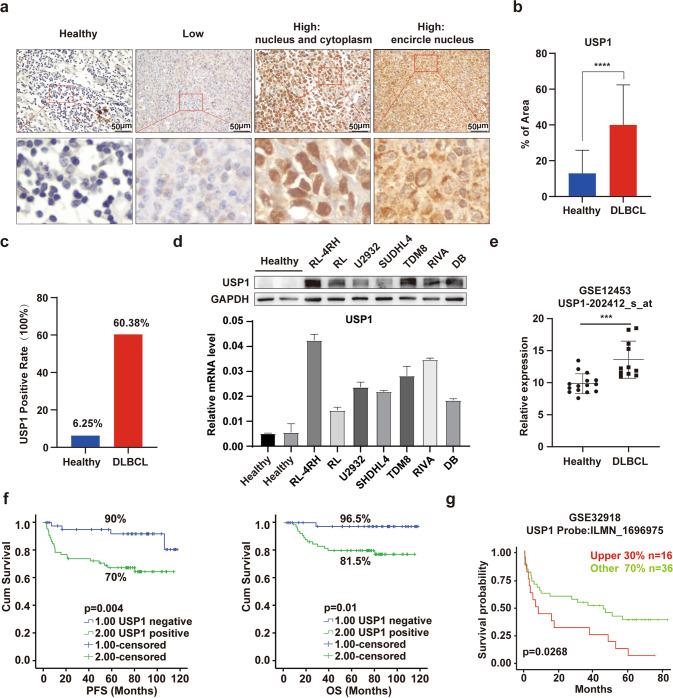
The patients with relapsed and refractory diffuse large B-cell lymphoma (DLBCL) have poor prognosis, and a novel and effective therapeutic strategy for these patients is urgently needed. Although ubiquitin-specific protease 1 (USP1) plays a key role in cancer, the carcinogenic effect of USP1 in B-cell lymphoma remains elusive. Here we found that USP1 is highly expressed in DLBCL patients, and high expression of USP1 predicts poor prognosis. Knocking down USP1 or a specific inhibitor of USP1, pimozide, induced cell growth inhibition, cell cycle arrest and autophagy in DLBCL cells. Targeting USP1 by shRNA or pimozide significantly reduced tumor burden of a mouse model established with engraftment of rituximab/chemotherapy resistant DLBCL cells. Pimozide significantly retarded the growth of lymphoma in a DLBCL patient-derived xenograft (PDX) model. USP1 directly interacted with MAX, a MYC binding protein, and maintained the stability of MAX through deubiquitination, which promoted the transcription of MYC target genes. Moreover, pimozide showed a synergetic effect with etoposide, a chemotherapy drug, in cell and mouse models of rituximab/chemotherapy resistant DLBCL. Our study highlights the critical role of USP1 in the rituximab/chemotherapy resistance of DLBCL through deubiquitylating MAX, and provides a novel therapeutic strategy for rituximab/chemotherapy resistant DLBCL.
复发/难治弥漫性大 B 细胞淋巴瘤(DLBCL)患者预后较差,迫切需要为这些患者提供新颖有效的治疗策略。尽管泛素特异性蛋白酶 1(USP1)在癌症中发挥着关键作用,但 USP1 在 B 细胞淋巴瘤中的致癌作用仍不清楚。在这里,我们发现 USP1 在 DLBCL 患者中高表达,且 USP1 的高表达预示着不良预后。敲低 USP1 或 USP1 的特异性抑制剂匹莫齐特可诱导 DLBCL 细胞生长抑制、细胞周期停滞和自噬。通过 shRNA 或匹莫齐特靶向 USP1 可显著减少用利妥昔单抗/化疗耐药的 DLBCL 细胞移植建立的小鼠模型中的肿瘤负担。匹莫齐特显著延缓了 DLBCL 患者来源异种移植(PDX)模型中淋巴瘤的生长。USP1 与 MAX 直接相互作用,MAX 是 MYC 结合蛋白,通过去泛素化维持 MAX 的稳定性,从而促进 MYC 靶基因的转录。此外,匹莫齐特在利妥昔单抗/化疗耐药的 DLBCL 的细胞和小鼠模型中与依托泊苷(一种化疗药物)表现出协同作用。我们的研究通过去泛素化 MAX 强调了 USP1 在利妥昔单抗/化疗耐药的 DLBCL 中的关键作用,并为利妥昔单抗/化疗耐药的 DLBCL 提供了一种新的治疗策略。



 Zotero 插件