Department of Biostatistics, School of Public Health, and The Key Laboratory of Public Health Safety of Ministry of Education, Fudan University, Shanghai, China.
Shanghai Minhang Center for Disease Control and Prevention, Shanghai, China.
J Diabetes. 2022 Nov;14(11):727-738. doi: 10.1111/1753-0407.13329. Epub 2022 Nov 9.
Fasting blood glucose (FBG) variability may make an impact on adverse events in patients with diabetes mellitus. However, the association between long-term changes in FBG and cancer remains unclear. We aimed to investigate this association in a large-scale longitudinal study.
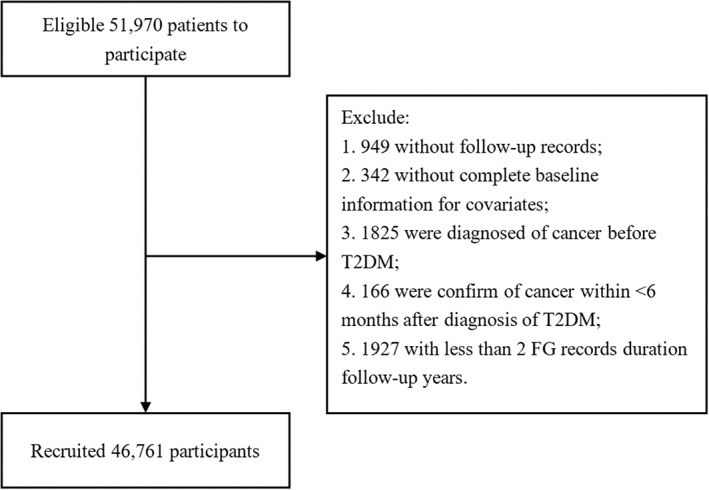
Data were collected from 46 761 patients with type 2 diabetes mellitus aged 20-80 years who participated in the Diabetes Standardized Management Program in Shanghai, China. We adopted four indicators, including standard deviation (SD), coefficient of variation (CV), variation independent of the mean (VIM), and average real variability (ARV) to describe FBG variability. Adjusted multivariable Cox regression analyses and restricted cubic splines were used to investigate the association between long-term FBG variability and cancer risk. We also determined the interactive effect of FBG variability with hypertension and FBG-mean with hypertension on cancer risk, respectively.
In this study, we confirmed 2218 cancer cases (51.1% male) over a median follow-up of 2.86 years. In the multivariable-adjusted models, participants in the highest quartile of FBG variability had an increased risk of cancer compared with those in the lowest quartile. The nonlinear association was found when using FBG-VIM, FBG-ARV, and FBG-SD in restricted cubic spline plots. There was a significant interaction effect of FBG variability with hypertension on cancer, whereas the effect of FBG-mean with hypertension did not attain significance.
Our retrospective cohort study demonstrated a positive association between the long-term changes in FBG and cancer risk in patients with type 2 diabetes mellitus. FBG variability may independently predict cancer incidence.
空腹血糖(FBG)变异性可能对糖尿病患者的不良事件产生影响。然而,长期 FBG 变化与癌症之间的关联尚不清楚。我们旨在一项大规模的纵向研究中探讨这种关联。
数据来自参加中国上海糖尿病标准化管理计划的 46761 名年龄在 20-80 岁的 2 型糖尿病患者。我们采用标准差(SD)、变异系数(CV)、均值独立变异(VIM)和平均真实变异(ARV)四个指标来描述 FBG 变异性。采用调整后的多变量 Cox 回归分析和限制立方样条来探讨长期 FBG 变异性与癌症风险之间的关系。我们还分别确定了 FBG 变异性与高血压之间以及 FBG-均值与高血压之间的交互作用对癌症风险的影响。
在这项研究中,我们在中位随访 2.86 年期间确认了 2218 例癌症病例(51.1%为男性)。在多变量调整模型中,与最低四分位组相比,FBG 变异性最高四分位组的癌症发病风险增加。在限制立方样条图中,使用 FBG-VIM、FBG-ARV 和 FBG-SD 时发现了非线性关联。FBG 变异性与高血压之间存在显著的交互作用,而 FBG-均值与高血压之间的交互作用没有达到显著水平。
我们的回顾性队列研究表明,2 型糖尿病患者长期 FBG 变化与癌症风险之间存在正相关。FBG 变异性可能独立预测癌症发病率。