Xu Xi, Zhang Li, Yang Xilang, Shen Guijin, Wang Shuo, Teng Haolin, Yang Chunbo, Liu Xueyan, Wang Xiangjing, Zhao Junwei, Xiang Wensheng
Key Laboratory of Agricultural Microbiology of Heilongjiang Province, Northeast Agricultural University, No. 600 Changjiang Road, Xiangfang District, Harbin 150030, China.
State Key Laboratory for Biology of Plant Diseases and Insect Pests, Institute of Plant Protection, Chinese Academy of Agricultural Sciences, Beijing 100097, China.
J Fungi (Basel). 2022 Nov 6;8(11):1170. doi: 10.3390/jof8111170.
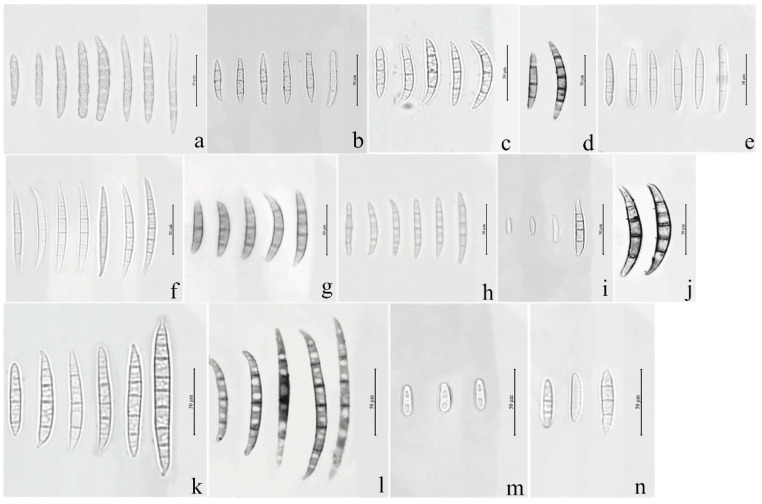
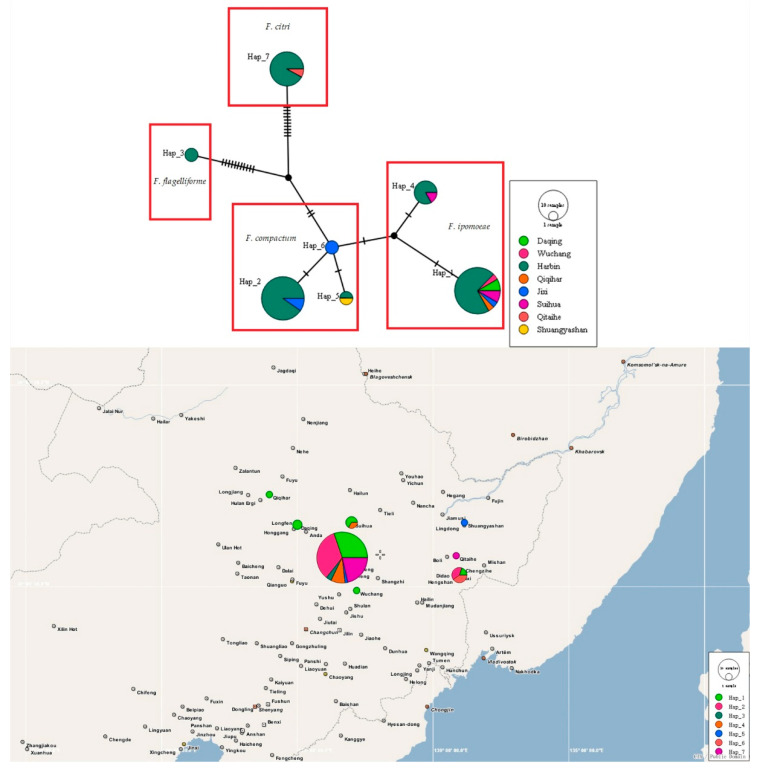
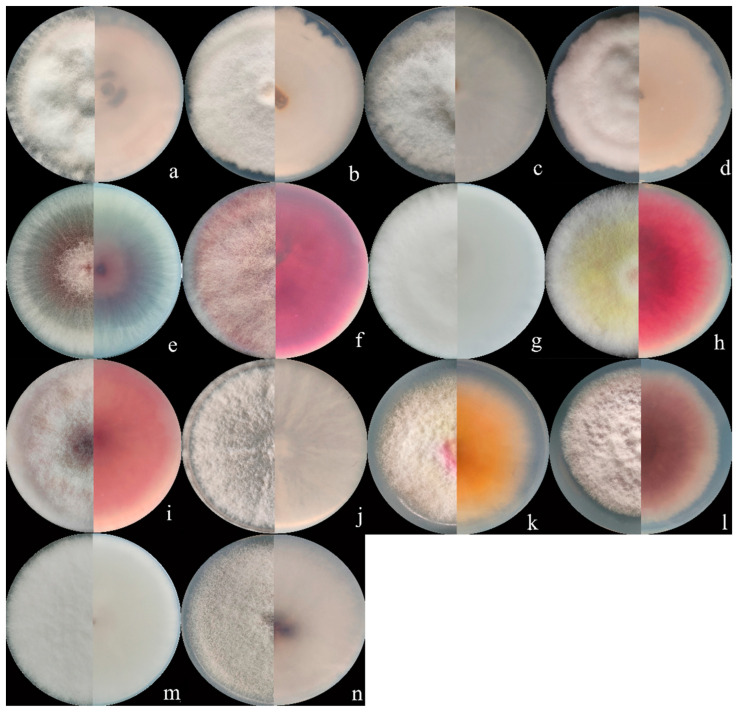
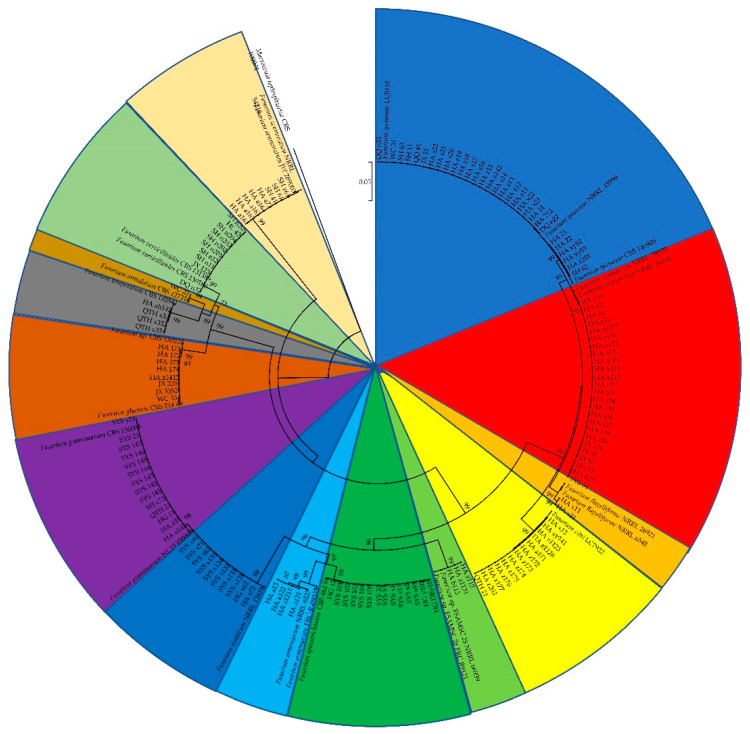
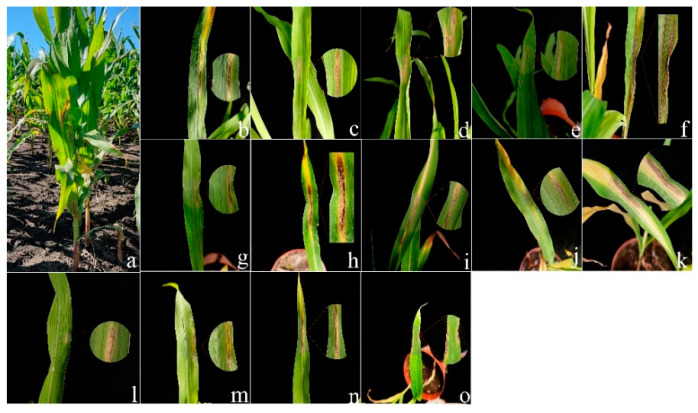
spp. are among the most important plant pathogens in the world. A survey on maize leaf blight was carried out in Heilongjiang province from 2019 to 2021. Based on morphological characteristics and a phylogenetic analysis on translation elongation factor () and second-largest subunit of RNA polymerase II () genes, 146 isolates were obtained and grouped into 14 species, including (20.5%), (17.1%), (9.59%), (9.59%), (8.9%), (6.85%), (6.85%), (5.48%), (5.48%), (2.74%), (2.74%), sp. (2.05%), (1.4%), and (0.68%). The species complex (FIESC, including , , , and ) was the most prevalent, indicating an evolving occurrence of the Fusarium species causing maize leaf blight. The typical symptoms observed on the maize leaves were oval to long strip lesions, with a gray to dark gray or brownish red coloration in the center and a chlorotic area at the edges. Based on the gene, seven haplotypes of FIESC were identified in Heilongjiang province, suggesting a population expansion. This is the first report of , , , , , , , , , , ., and causing maize leaf blight in Heilongjiang province, China. The current research is informative for managing disease, exploring the phylogenetic relationship among species, and clarifying the diversity of Fusarium species associated with maize leaf blight.
镰刀菌属是世界上最重要的植物病原体之一。2019年至2021年在黑龙江省开展了玉米叶枯病调查。基于形态特征以及对翻译延伸因子()和RNA聚合酶II第二大亚基()基因的系统发育分析,获得了146个分离株,并将其分为14个种,包括(20.5%)、(17.1%)、(9.59%)、(9.59%)、(8.9%)、(6.85%)、(6.85%)、(5.48%)、(5.48%)、(2.74%)、(2.74%)、镰刀菌属sp.(2.05%)、(1.4%)和(0.68%)。镰刀菌属物种复合体(FIESC,包括、、、和)最为普遍,表明引起玉米叶枯病的镰刀菌属物种正在不断演变。在玉米叶片上观察到的典型症状为椭圆形至长条状病斑,中央为灰色至深灰色或棕红色,边缘有褪绿区域。基于基因,在黑龙江省鉴定出了FIESC的7个单倍型,表明种群扩张。这是、、、、、、、、、、和引起中国黑龙江省玉米叶枯病的首次报道。当前的研究对于病害管理、探索镰刀菌属物种间的系统发育关系以及阐明与玉米叶枯病相关的镰刀菌属物种多样性具有参考价值。