Department of Gastroenterological Surgery, Tokai University School of Medicine, 143 Shimokasuya, Isehara, Kanagawa, 259-1193, Japan.
Department of Diagnostic Pathology, Faculty of Medicine, University of Toyama, 2630, Sugitani, Toyama, 930-0194, Japan.
World J Surg. 2023 Mar;47(3):729-739. doi: 10.1007/s00268-022-06818-0. Epub 2022 Nov 10.
The prognostic impact of positive peritoneal lavage cytology on pancreatic cancer is unclear. Therefore, this study aimed to evaluate its impact in resectable pancreatic body and tail cancer.
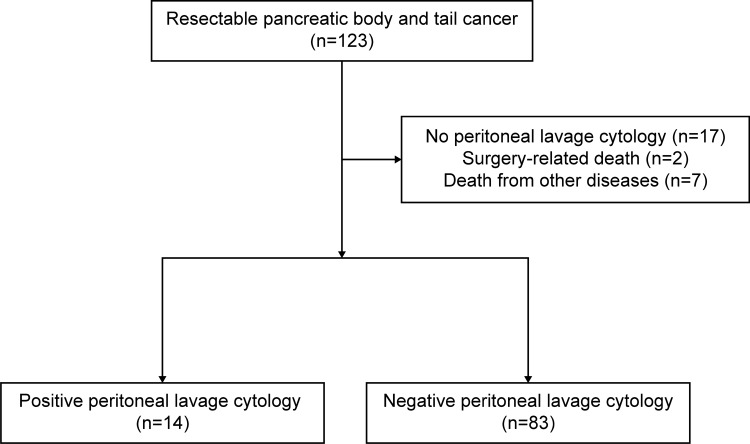
Between January 2006 and December 2019, 97 patients with pancreatic body and tail cancer underwent peritoneal lavage cytology and curative resection at our institution. We analyzed the impact of positive peritoneal lavage cytology on clinicopathological factors and on the prognosis of pancreatic body and tail cancer.
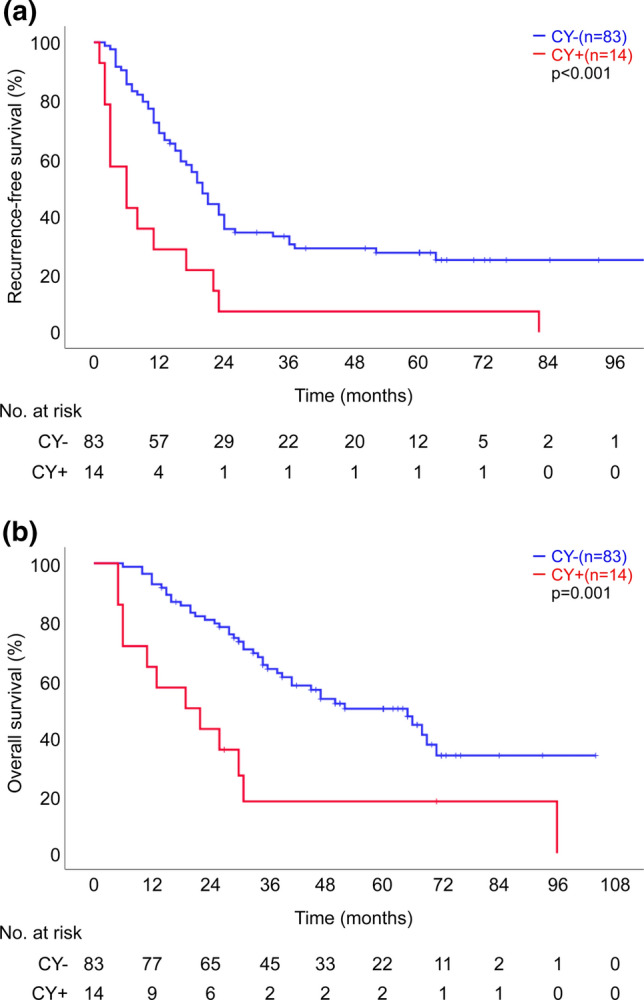
Malignant cells were detected in 14 patients (14.4%) using peritoneal lavage cytology. In these patients, the tumor diameter was significantly larger (p < 0.001) and anterior serosal invasion (p = 0.034), splenic artery invasion (p = 0.013), lympho-vessel invasion (p = 0.025), and perineural invasion (p = 0.008) were significantly more frequent. The R1 resection rate was also significantly higher in patients with positive peritoneal lavage cytology than in negative patients (p = 0.015). Positive peritoneal lavage cytology had a significantly poor impact on overall survival (p = 0.001) and recurrence-free survival (p < 0.001). This cytology was also an independent poor prognostic factor for recurrence (p = 0.022) and was associated with peritoneal dissemination and liver metastasis.
Positive peritoneal lavage cytology is considered to be indicative of more systemic disease in patients with resectable pancreatic body and tail cancer than in patients with negative peritoneal lavage cytology. Early detection of pancreatic cancer before it develops micrometastases is important to improve prognosis, and CY+ patients require more intensive multimodality treatment than standard treatment for resectable pancreatic cancer.
阳性腹膜灌洗细胞学对胰腺癌的预后影响尚不清楚。因此,本研究旨在评估其在可切除胰体尾癌中的影响。
2006 年 1 月至 2019 年 12 月,我院 97 例胰体尾癌患者行腹膜灌洗细胞学检查和根治性切除术。我们分析了阳性腹膜灌洗细胞学对胰体尾癌临床病理因素和预后的影响。
腹膜灌洗细胞学检查发现 14 例(14.4%)患者存在恶性细胞。这些患者的肿瘤直径明显更大(p<0.001),前腹膜侵犯(p=0.034)、脾动脉侵犯(p=0.013)、淋巴管侵犯(p=0.025)和神经侵犯(p=0.008)更为频繁。阳性腹膜灌洗细胞学患者的 R1 切除率也明显高于阴性患者(p=0.015)。阳性腹膜灌洗细胞学对总生存(p=0.001)和无复发生存(p<0.001)有显著不良影响。这种细胞学也是复发的独立不良预后因素(p=0.022),与腹膜扩散和肝转移有关。
与阴性腹膜灌洗细胞学患者相比,可切除胰体尾癌患者阳性腹膜灌洗细胞学提示全身性疾病更为严重。在癌症发展为微转移之前早期发现胰腺癌,对改善预后很重要,CY+患者需要比标准的可切除胰腺癌治疗更强化的多模式治疗。