Argirion Ilona, Brown Jalen, Jackson Sarah, Pfeiffer Ruth M, Lam Tram Kim, O'Brien Thomas R, Yu Kelly J, McGlynn Katherine A, Petrick Jessica L, Pinto Ligia A, Chen Chien-Jen, Hildesheim Allan, Yang Hwai-I, Lee Mei-Hsuan, Koshiol Jill
Division of Cancer Epidemiology and Genetics, National Cancer Institute, Rockville, MD 20850, USA.
Division of Cancer Control and Population Sciences, National Cancer Institute, Rockville, MD 20814, USA.
Cancers (Basel). 2022 Oct 27;14(21):5280. doi: 10.3390/cancers14215280.
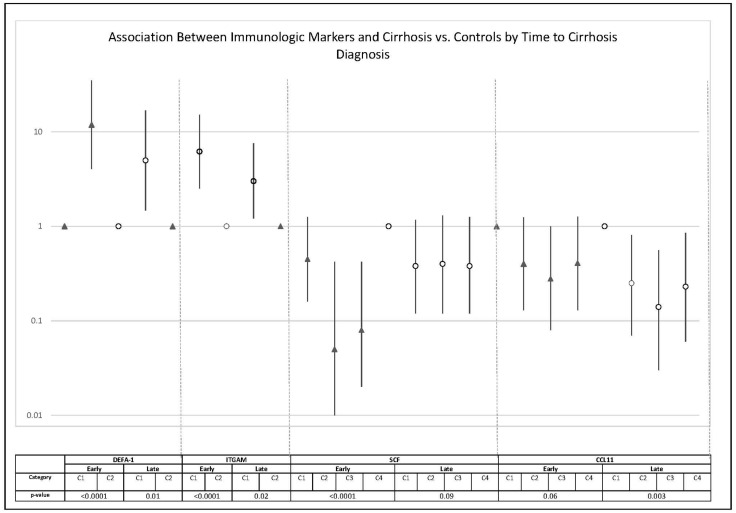
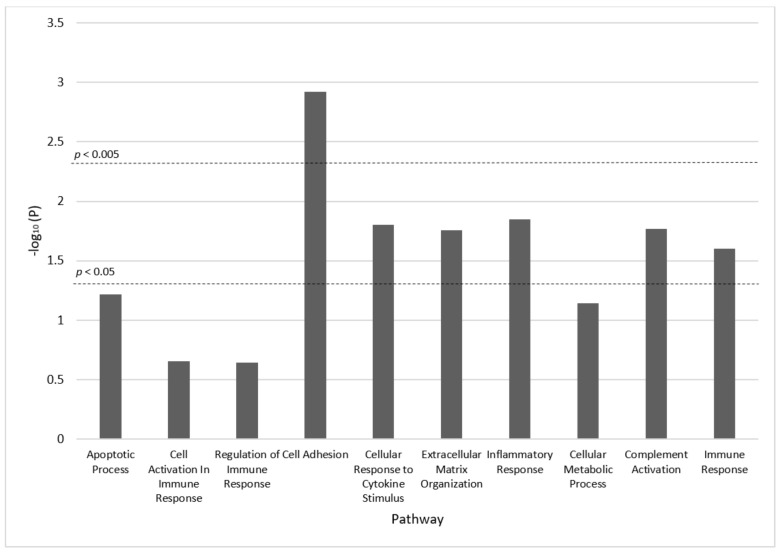
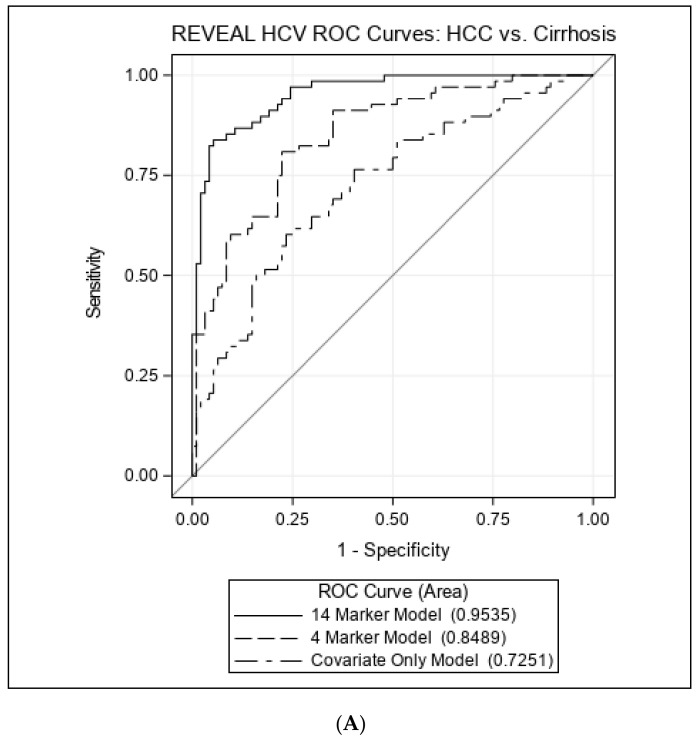
Background: Chronic hepatitis C virus (HCV) infection can affect immune response and inflammatory pathways, leading to severe liver diseases such as cirrhosis and hepatocellular carcinoma (HCC). Methods: In a prospective cohort of chronically HCV-infected individuals, we sampled 68 individuals who developed cirrhosis, 91 controls who did not develop cirrhosis, and 94 individuals who developed HCC. Unconditional odds ratios (ORs) from polytomous logistic regression models and canonical discriminant analyses (CDAs) were used to compare categorical (C) baseline plasma levels for 102 markers in individuals who developed cirrhosis vs. controls and those who developed HCC vs. cirrhosis. Leave-one-out cross validation was used to produce receiver operating characteristic curves to assess predictive ability of markers. Lastly, biological pathways were assessed in association with cirrhotic development compared to controls. Results: After multivariable adjustment, DEFA-1 (OR: C2v.C1 = 7.73; p < 0.0001), ITGAM (OR: C2v.C1 = 4.03; p = 0.0002), SCF (OR: C4v.C1 = 0.19; p-trend = 0.0001), and CCL11 (OR: C4v.C1 = 0.31; p-trend= 0.002) were all associated with development of cirrhosis compared to controls; these markers, together with clinical/demographics variables, improved prediction of cirrhosis from 55.7% (in clinical/demographic-only model) to 74.9% accuracy. A twelve-marker model based on CDA results further increased prediction of cirrhosis to 88.0%. While six biological pathways were found to be associated with cirrhosis, cell adhesion was the only pathway associated with cirrhosis after Bonferroni correction. In contrast to cirrhosis, DEFA-1 and ITGAM levels were inversely associated with HCC risk. Conclusions: Pending validation, these findings highlight the important role of immunological markers in predicting HCV-related cirrhosis even 11 years post-enrollment.
慢性丙型肝炎病毒(HCV)感染可影响免疫反应和炎症途径,导致严重的肝脏疾病,如肝硬化和肝细胞癌(HCC)。方法:在一个慢性HCV感染个体的前瞻性队列中,我们选取了68例发生肝硬化的个体、91例未发生肝硬化的对照以及94例发生HCC的个体。使用多分类逻辑回归模型和典型判别分析(CDA)的无条件优势比(OR)来比较发生肝硬化的个体与对照以及发生HCC的个体与肝硬化个体中102种标志物的分类(C)基线血浆水平。采用留一法交叉验证来生成受试者操作特征曲线,以评估标志物的预测能力。最后,与对照相比,评估与肝硬化发展相关的生物学途径。结果:经过多变量调整后,与对照相比,防御素-1(DEFA-1)(OR:C2v.C1 = 7.73;p < 0.0001)、整合素αM(ITGAM)(OR:C2v.C1 = 4.03;p = 0.0002)、干细胞因子(SCF)(OR:C4v.C1 = 0.19;p趋势 = 0.0001)和嗜酸粒细胞趋化因子11(CCL11)(OR:C4v.C = 0.31;p趋势 = 0.002)均与肝硬化的发生相关;这些标志物与临床/人口统计学变量一起,将肝硬化的预测准确率从55.7%(仅临床/人口统计学模型)提高到74.9%。基于CDA结果的12种标志物模型进一步将肝硬化的预测率提高到88.0%。虽然发现有6条生物学途径与肝硬化相关,但在Bonferroni校正后,细胞黏附是唯一与肝硬化相关的途径。与肝硬化相反,DEFA-1和ITGAM水平与HCC风险呈负相关。结论:在有待验证的情况下,这些发现突出了免疫标志物在预测HCV相关肝硬化中的重要作用,即使在入组11年后亦是如此。