Tang Xi-Yang, Luo Zhong-Lin, Xiong Yan-Lu, Yang Jie, Shi An-Ping, Zheng Kai-Fu, Liu Yu-Jian, Shu Chen, Ma Nan, Lu Qiang, Zhao Jin-Bo
Department of Thoracic Surgery, Tangdu Hospital, Air Force Medical University, 569 Xinsi Road, Xi'an 710038, China.
Department of Cardiothoracic Surgery, Peace Hospital, Changzhi Medical College, 161 Jiefang East Street, Changzhi 046000, China.
Cancers (Basel). 2022 Oct 31;14(21):5374. doi: 10.3390/cancers14215374.
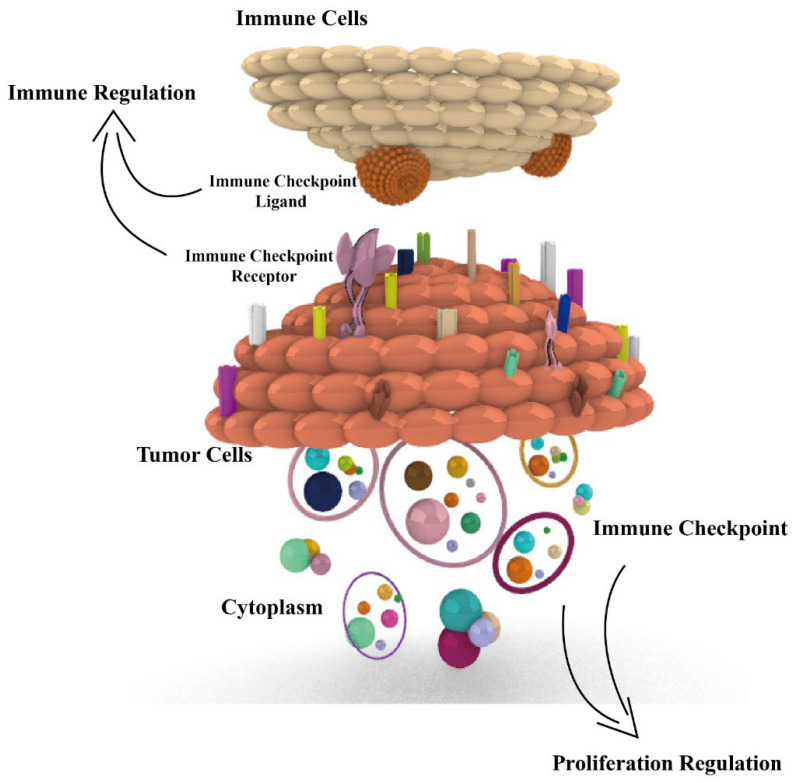
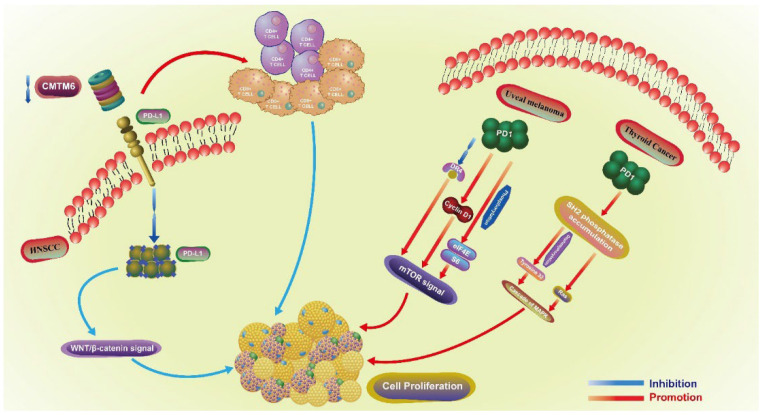
Cancer remains a serious social health problem, and immunotherapy has become the major treatments in tumor treatment. Additionally, improving the efficiency and safety of treatment is necessary. Further, more therapy targets are warranted for future tumor treatments. In this review, in addition to examining the currently recognized role of immune regulation, we focus on the proliferative role of 15 immune checkpoints in various tumors, including PD1, PD-L1, FGL1, CD155, CD47, SIRPα, CD276, IDO1, SIGLEC-15, TIM3, Galectin-9, CD70, CD27, 4-1BBL, and HVEM. We managed to conclude that various immune checkpoints such as PD1/PD-L1, FGL1, CD155, CD47/SIRPα, CD276, and SIGLEC-15 all regulate the cell cycle, and specifically through Cyclin D1 regulation. Furthermore, a variety of signal pathways engage in proliferation regulation, such as P13K, AKT, mTOR, and NK-κB, which are also the most common pathways involved in the regulation of immune checkpoint proliferation. Currently, only PD1/PD-L1, CD47/SIRPα, TIM3/Galectin-9, and CD70/CD27 checkpoints have been shown to interact with each other to regulate tumor proliferation in pairs. However, for other immune checkpoints, the role of their receptors or ligands in tumor proliferation regulation is still unknown, and we consider the enormous potential in this area. An increasing number of studies have validated the various role of immune checkpoints in tumors, and based on this literature review, we found that most of the immune checkpoints play a dual regulatory role in immunity and proliferation. Therefore, the related pathways in proliferation regulation can served the role of therapy targets in tumor therapy. Further, great potential is displayed by IDO1, SIGLEC-15, 4-1BBL, and HVEM in tumor proliferation regulation, which may become novel therapy targets in tumor treatment.
癌症仍然是一个严重的社会健康问题,免疫疗法已成为肿瘤治疗的主要手段。此外,提高治疗的效率和安全性是必要的。再者,未来的肿瘤治疗需要更多的治疗靶点。在本综述中,除了研究目前公认的免疫调节作用外,我们还关注15种免疫检查点在各种肿瘤中的增殖作用,包括PD1、PD-L1、FGL1、CD155、CD47、SIRPα、CD276、IDO1、SIGLEC-15、TIM3、Galectin-9、CD70、CD27、4-1BBL和HVEM。我们得出结论,诸如PD1/PD-L1、FGL1、CD155、CD47/SIRPα、CD276和SIGLEC-15等各种免疫检查点均调节细胞周期,且具体是通过细胞周期蛋白D1调节。此外,多种信号通路参与增殖调节,如P13K、AKT、mTOR和NK-κB,它们也是参与免疫检查点增殖调节的最常见通路。目前,仅PD1/PD-L1、CD47/SIRPα、TIM3/Galectin-9和CD70/CD27检查点已被证明相互作用以成对调节肿瘤增殖。然而,对于其他免疫检查点,其受体或配体在肿瘤增殖调节中的作用仍然未知,我们认为该领域具有巨大潜力。越来越多的研究证实了免疫检查点在肿瘤中的各种作用,基于此文献综述,我们发现大多数免疫检查点在免疫和增殖中发挥双重调节作用。因此,增殖调节中的相关通路可作为肿瘤治疗的治疗靶点。此外,IDO1、SIGLEC-15、4-1BBL和HVEM在肿瘤增殖调节中显示出巨大潜力,它们可能成为肿瘤治疗中的新型治疗靶点。