Department of Ophthalmology, Shanghai General Hospital (Shanghai First People's Hospital), School of Medicine, Shanghai Jiao Tong University, 100 Haining Road, Hongkou District, Shanghai 200080, China.
National Clinical Research Center for Eye Diseases, Shanghai 200080, China.
Cells. 2022 Oct 25;11(21):3362. doi: 10.3390/cells11213362.
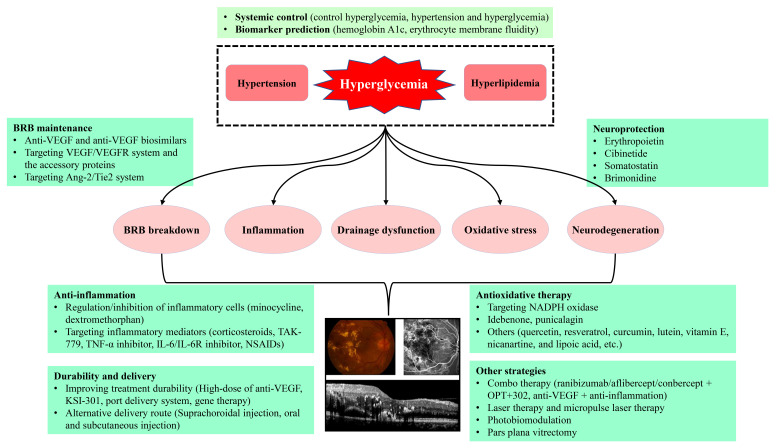
Diabetic retinopathy (DR), with increasing incidence, is the major cause of vision loss and blindness worldwide in working-age adults. Diabetic macular edema (DME) remains the main cause of vision impairment in diabetic patients, with its pathogenesis still not completely elucidated. Vascular endothelial growth factor (VEGF) plays a pivotal role in the pathogenesis of DR and DME. Currently, intravitreal injection of anti-VEGF agents remains as the first-line therapy in DME treatment due to the superior anatomic and functional outcomes. However, some patients do not respond satisfactorily to anti-VEGF injections. More than 30% patients still exist with persistent DME even after regular intravitreal injection for at least 4 injections within 24 weeks, suggesting other pathogenic factors, beyond VEGF, might contribute to the pathogenesis of DME. Recent advances showed nearly all the retinal cells are involved in DR and DME, including breakdown of blood-retinal barrier (BRB), drainage dysfunction of Müller glia and retinal pigment epithelium (RPE), involvement of inflammation, oxidative stress, and neurodegeneration, all complicating the pathogenesis of DME. The profound understanding of the changes in proteomics and metabolomics helps improve the elucidation of the pathogenesis of DR and DME and leads to the identification of novel targets, biomarkers and potential therapeutic strategies for DME treatment. The present review aimed to summarize the current understanding of DME, the involved molecular mechanisms, and the changes in proteomics and metabolomics, thus to propose the potential therapeutic recommendations for personalized treatment of DME.
糖尿病视网膜病变(DR)的发病率不断上升,是全球工作年龄成年人视力丧失和失明的主要原因。糖尿病性黄斑水肿(DME)仍然是糖尿病患者视力损害的主要原因,其发病机制尚未完全阐明。血管内皮生长因子(VEGF)在 DR 和 DME 的发病机制中起关键作用。目前,由于其优越的解剖和功能结果,玻璃体内注射抗 VEGF 药物仍然是 DME 治疗的一线疗法。然而,一些患者对抗 VEGF 注射的反应并不满意。超过 30%的患者在 24 周内至少接受 4 次常规玻璃体内注射后仍存在持续性 DME,表明除了 VEGF 之外,其他致病因素可能参与了 DME 的发病机制。最近的研究进展表明,几乎所有的视网膜细胞都参与了 DR 和 DME,包括血视网膜屏障(BRB)的破坏、Müller 胶质细胞和视网膜色素上皮(RPE)的引流功能障碍、炎症、氧化应激和神经退行性变的参与,所有这些都使 DME 的发病机制复杂化。对蛋白质组学和代谢组学变化的深入了解有助于阐明 DR 和 DME 的发病机制,并为 DME 的治疗确定新的靶点、生物标志物和潜在的治疗策略。本综述旨在总结 DME 的当前认识、涉及的分子机制以及蛋白质组学和代谢组学的变化,从而为 DME 的个体化治疗提出潜在的治疗建议。