Thoracic and GI Malignancies Branch, Center for Cancer Research, National Cancer Institute, Bethesda, MD 20892, USA.
School of Medicine, The University of Missouri-Kansas City, Kansas City, MO 64018, USA.
Genes (Basel). 2022 Nov 2;13(11):2013. doi: 10.3390/genes13112013.
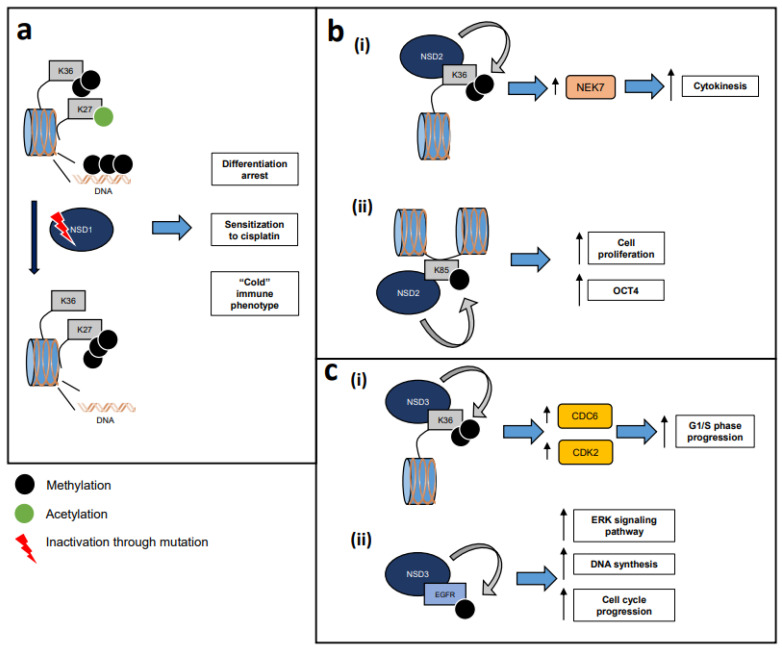
Head and neck squamous cell carcinoma (HNSCC) is the sixth most prevalent non-skin cancer in the world. While immunotherapy has revolutionized the standard of care treatment in patients with recurrent/metastatic HNSCC, more than 70% of patients do not respond to this treatment, making the identification of novel therapeutic targets urgent. Recently, research endeavors have focused on how epigenetic modifications may affect tumor initiation and progression of HNSCC. The nuclear receptor binding SET domain (NSD) family of protein methyltransferases NSD1-NSD3 is of particular interest for HNSCC, with NSD1 and NSD3 being amongst the most commonly mutated or amplified genes respectively in HNSCC. Preclinical studies have identified both oncogenic and tumor-suppressing properties across NSD1, NSD2, and NSD3 within the context of HNSCC. The purpose of this review is to provide a better understanding of the contribution of the NSD family of protein methyltransferases to the pathogenesis of HNSCC, underscoring their promise as novel therapeutic targets in this devastating disease.
头颈部鳞状细胞癌(HNSCC)是世界上第六种最常见的非皮肤癌。免疫疗法已经彻底改变了复发性/转移性 HNSCC 患者的治疗标准,但超过 70%的患者对此治疗没有反应,因此迫切需要确定新的治疗靶点。最近,研究人员致力于研究表观遗传修饰如何影响 HNSCC 的肿瘤发生和进展。核受体结合 SET 域(NSD)家族蛋白甲基转移酶 NSD1-NSD3 是 HNSCC 的研究重点,其中 NSD1 和 NSD3 分别是 HNSCC 中突变或扩增最常见的基因之一。临床前研究已经在 HNSCC 背景下确定了 NSD1、NSD2 和 NSD3 的致癌和肿瘤抑制特性。本综述的目的是更好地了解 NSD 家族蛋白甲基转移酶在 HNSCC 发病机制中的作用,强调它们作为这种毁灭性疾病的新型治疗靶点的潜力。