Degtyarenko Alena Yu, Karateev Igor A, Ovcharov Alexey V, Vlasenko Vladimir A, Pervakov Kirill S
V.L. Ginzburg Centre for High-Temperature Superconductivity and Quantum Materials, P.N. Lebedev Physical Institute of the Russian Academy of Sciences, 53, Leninsky Ave., Moscow 119991, Russia.
National Research Centre "Kurchatov Institute", 1, Kurchatov Sq, Moscow 123182, Russia.
Nanomaterials (Basel). 2022 Oct 28;12(21):3801. doi: 10.3390/nano12213801.
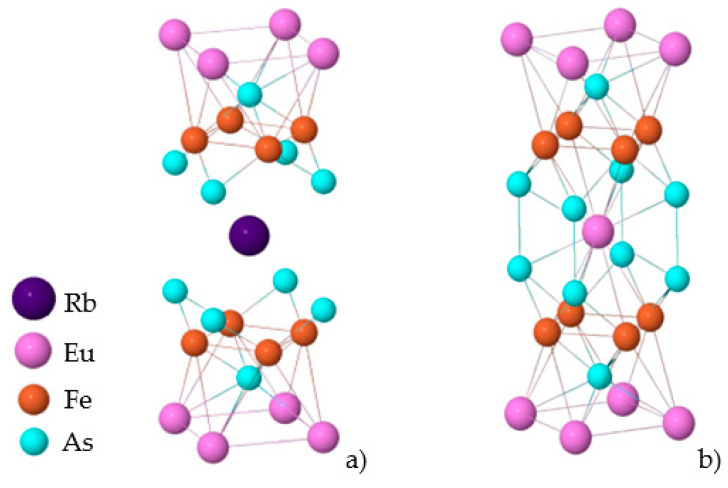
In the stoichiometric iron-based superconductor EuRbFeAs, superconductivity coexists with a long-range magnetic ordering in Eu layers. Using high-resolution transmission electron microscopy (HRTEM), we observed an atomic structure of as-grown EuRbFeAs crystals. HRTEM shows that crystals have two-dimensional intrinsic nanoinclusions established to be the RbFeAs (122) phase with a volume fraction of ~5.6%. In contrast with the CaKFeAs compound, similar inclusions are not superconducting down to 2 K, and no second magnetization peak was observed in the magnetization measurements at low temperature with B ‖ ab. We show that the non-superconducting 122 phase nanoinclusions could act as 2D pinning centers.
在化学计量比的铁基超导体EuRbFeAs中,超导性与Eu层中的长程磁有序共存。利用高分辨率透射电子显微镜(HRTEM),我们观察了生长态EuRbFeAs晶体的原子结构。HRTEM显示,晶体具有二维本征纳米夹杂物,确定其为RbFeAs(122)相,体积分数约为5.6%。与CaKFeAs化合物不同,类似的夹杂物在2 K以下不具有超导性,并且在低温下B‖ab的磁化测量中未观察到第二个磁化峰。我们表明,非超导的122相纳米夹杂物可以作为二维钉扎中心。