Department of Automatic Control and Robotics, Faculty of Electrical Engineering, Automatics, Computer Science and Biomedical Engineering, AGH University of Science and Technology, al. A. Mickiewicza 30, 30-059 Kraków, Poland.
Sensors (Basel). 2022 Nov 5;22(21):8537. doi: 10.3390/s22218537.
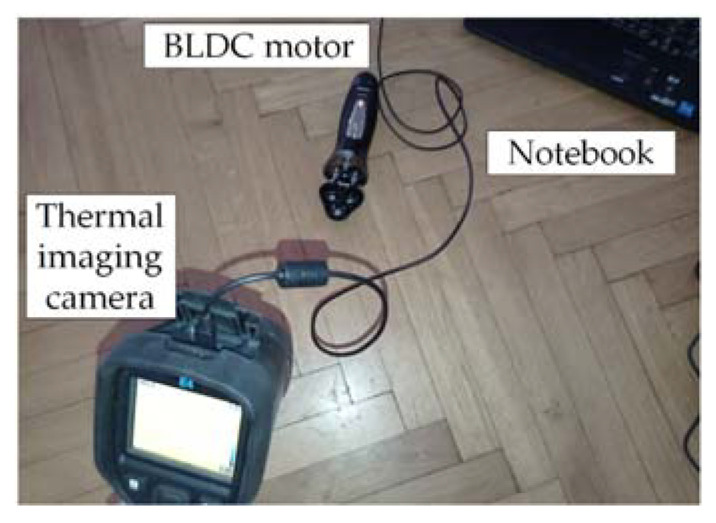
A technique of thermographic fault diagnosis of the shaft of a BLDC (Brushless Direct Current Electric) motor is presented in this article. The technique works for the shivering of the thermal imaging camera in the range of 0-1.5 [m/s]. An electric shaver was used as the source of the BLDC motor. The following states of the BLDC motor were analyzed: Healthy BLDC motor (HB), BLDC motor with one faulty shaft (1FSB), BLDC motor with two faulty shafts (2FSB), and BLDC motor with three faulty shafts (3FSB). A new method of feature extraction named PNID (power of normalized image difference) was presented. Deep neural networks were used for the analysis of thermal images of the faulty shaft of the BLDC motor: GoogLeNet, ResNet50, and EfficientNet-b0. The results of the proposed technique were very good. PNID, GoogLeNet, ResNet50, and EfficientNet-b0 have an efficiency of recognition equal to 100% for four classes.
本文提出了一种 BLDC(无刷直流电机)电机轴的热成像故障诊断技术。该技术适用于热成像相机在 0-1.5 [m/s]范围内的抖动。电动剃须刀被用作 BLDC 电机的源。分析了 BLDC 电机的以下状态:健康的 BLDC 电机 (HB)、一个故障轴的 BLDC 电机 (1FSB)、两个故障轴的 BLDC 电机 (2FSB) 和三个故障轴的 BLDC 电机 (3FSB)。提出了一种名为 PNID(归一化图像差的功率)的新特征提取方法。深度神经网络用于分析 BLDC 电机故障轴的热图像:GoogLeNet、ResNet50 和 EfficientNet-b0。所提出的技术的结果非常好。PNID、GoogLeNet、ResNet50 和 EfficientNet-b0 对于四个类别具有 100%的识别效率。