Williams Katherine V, Krauland Mary G, Harrison Lee H, Williams John V, Roberts Mark S, Zimmerman Richard K
Department of Family Medicine, School of Medicine, University of Pittsburgh, Schenley Place, 5th Floor, Suite 520, Pittsburgh, PA 15260, USA.
Department of Health Policy and Management, School of Public Health, University of Pittsburgh, Pittsburgh, PA 15261, USA.
Vaccines (Basel). 2022 Oct 26;10(11):1799. doi: 10.3390/vaccines10111799.
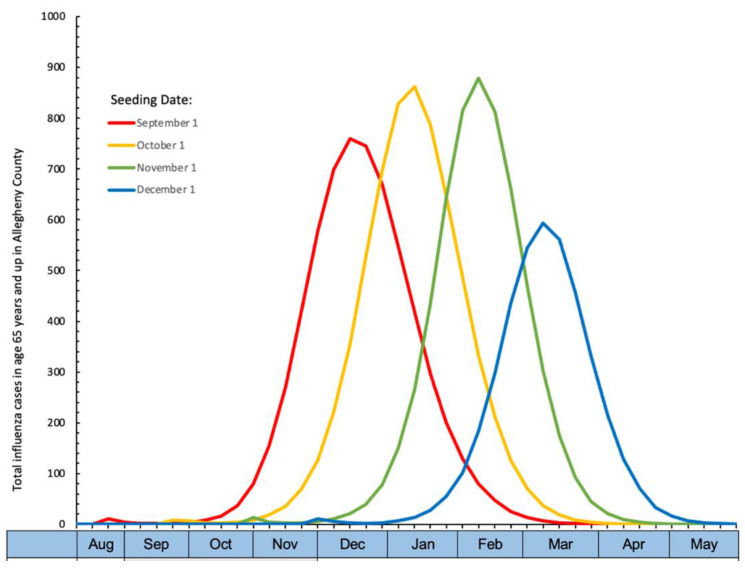
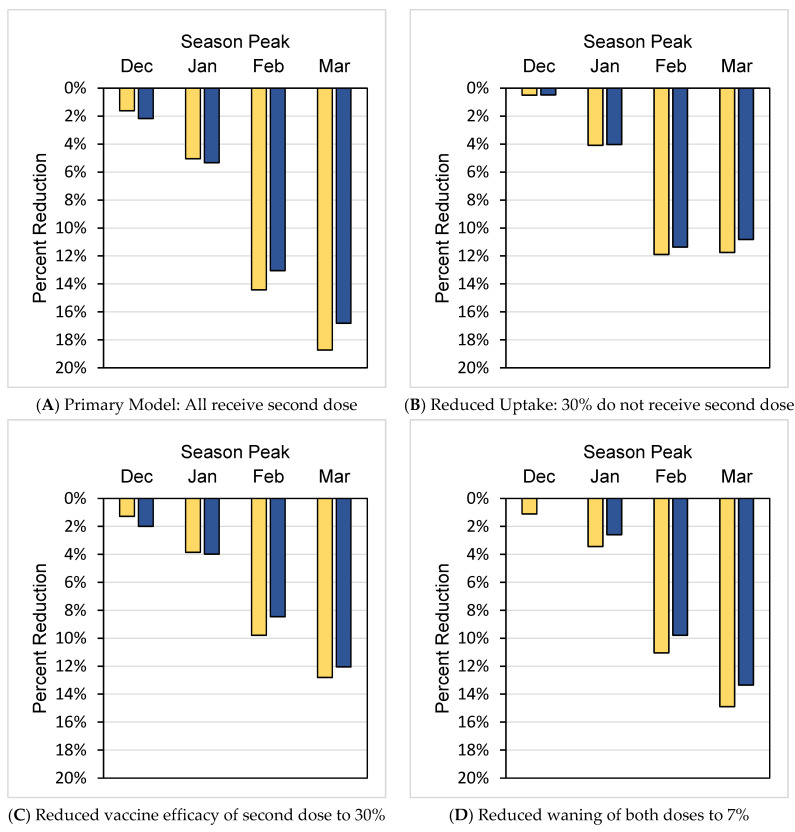
Older adults (age ≥ 65) are at high risk of influenza morbidity and mortality. This study evaluated the impact of a hypothetical two-dose influenza vaccine regimen per season to reduce symptomatic flu cases by providing preseason (first dose) and mid-season (second dose) protection to offset waning vaccine effectiveness (VE). The Framework for Reconstructing Epidemiological Dynamics (FRED), an agent-based modeling platform, was used to compare typical one-dose vaccination to a two-dose vaccination strategy. Primary models incorporated waning VE of 10% per month and varied influenza season timing (December through March) to estimate cases and hospitalizations in older adults. Additional scenarios modeled reductions in uptake and VE of the second dose, and overall waning. In seasons with later peaks, two vaccine doses had the largest potential to reduce cases (14.4% with February peak, 18.7% with March peak) and hospitalizations (13.1% with February peak, 16.8% with March peak). Reductions in cases and hospitalizations still resulted but decreased when 30% of individuals failed to receive a second dose, second dose VE was reduced, or overall waning was reduced to 7% per month. Agent-based modeling indicates that two influenza vaccine doses could decrease cases and hospitalizations in older individuals. The highest impact occurred in the more frequently observed late-peak seasons. The beneficial impact of the two-dose regimen persisted despite model scenarios of reduced uptake of the second dose, decreased VE of the second dose, or overall VE waning.
老年人(年龄≥65岁)患流感后发病和死亡风险较高。本研究评估了假设的每季度两剂流感疫苗接种方案的影响,通过提供季前(第一剂)和季中(第二剂)保护来抵消疫苗效力(VE)的下降,以减少有症状流感病例。基于主体的建模平台——重建流行病学动力学框架(FRED),被用于比较典型的单剂疫苗接种和两剂疫苗接种策略。主要模型纳入了每月10%的疫苗效力下降以及不同的流感季节时间(12月至3月),以估计老年人中的病例数和住院数。其他情景模拟了第二剂疫苗接种率和效力的降低以及总体效力下降情况。在流感高峰较晚的季节,两剂疫苗在减少病例数方面潜力最大(2月达到高峰时为14.4%,3月达到高峰时为18.7%),住院数方面也是如此(2月达到高峰时为13.1%,3月达到高峰时为16.8%)。当30%的个体未接种第二剂、第二剂疫苗效力降低或总体效力下降降至每月7%时,病例数和住院数仍会减少,但降幅减小。基于主体的建模表明,两剂流感疫苗可减少老年人中的病例数和住院数。在更常见的晚高峰季节,影响最大。尽管存在第二剂疫苗接种率降低、第二剂疫苗效力下降或总体疫苗效力下降等模型情景,但两剂接种方案的有益影响仍然存在。