Wei Yunhua, Wang Yan, Liu Jian, Zha Yan, Yang Yuqi, Li Ni, Zhou Yalin, Roberts Jinli Zhu Neil, Liu Lin, Li Yaying
Department of Nuclear Medicine, Guizhou Provincial People's Hospital, Affiliated Hospital of Guizhou University, Guiyang 550002, China.
Department of Obstetrics and Gynecology, Guizhou Provincial Staff Hospital, Huaxi Branch Affiliated to Guizhou Provincial People's Hospital, Guiyang 550003, China.
Vaccines (Basel). 2022 Nov 4;10(11):1869. doi: 10.3390/vaccines10111869.
A comparative analysis was performed to investigate the potential risk factors of Adverse Events Following Immunization (AEFI) after receiving different booster vaccines.
From 18 January 2021 to 21 January 2022, the Health Care Workers (HCWs) of Guizhou Provincial Staff Hospital (Guizhou Province, China) who received a third Booster vaccine, that was either homologous (i.e., (i) a total of three doses of Vero cell CHO cell vaccine) or (iii) heterologous with two first doses of Vero cell vaccine, being either CHO cell vaccine or adenovirus type-5 (Ad5) vectored COVID-19 vaccine, were asked to complete a self-report questionnaire form to provide information on any AEFI that may have occurred in the first 3 days after vaccination with the booster. The frequency of AEFI corresponding to the three different booster vaccines was compared, and the risk factors for predicting AEFI were determined by multivariate logistic regression analysis.
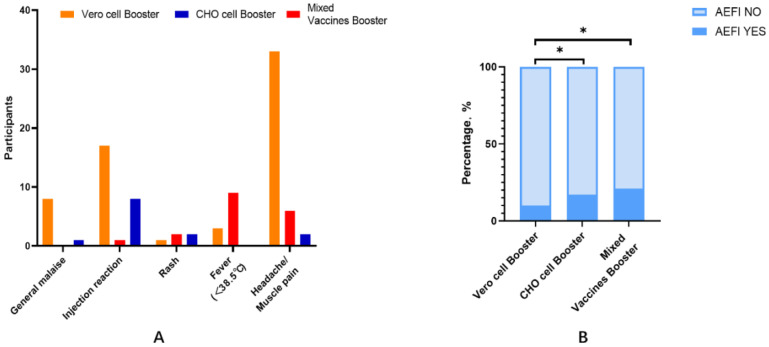
Of the 904 HCWs who completed the survey, 792 met the inclusion criteria. The rates of AEFI were 9.8% (62/635) in the homologous Vero cell booster group, 17.3% (13/75) in the homologous CHO cell booster group, and 20.7% (17/82) in the heterologous mixed vaccines booster group, and the rates were significantly different (c = 11.5, = 0.004) between the three groups of vaccines. Multivariate logistic regression analysis showed that: (1) compared to the homologous Vero cell booster group, the risk of AEFI was about 2.1 times higher (OR = 2.095, 95% CI: 1.056-4.157, = 0.034) in the CHO cell booster group and 2.5 times higher (OR = 2.476, 95% CI: 1.352-4.533, = 0.003) in the mixed vaccines group; (2) the odds for women experiencing AEFI were about 2.8 times higher (OR = 2.792, 95% CI: 1.407-5.543, = 0.003) than men; and (3) compared to the non-frontline HCWs, the risk of AEFI was about 2.6 times higher (OR = 2.648, 95% CI: 1.473-4.760, = 0.001) in the doctors.
The AEFI in all three booster groups are acceptable, and serious adverse events are rare. The risk of AEFI was higher in doctors, which may be related to the high stress during the COVID-19 epidemic. Support from government and non-governmental agencies is important for ensuring the physical and mental health of HCWs.
进行一项比较分析,以调查接种不同加强疫苗后免疫接种后不良事件(AEFI)的潜在风险因素。
2021年1月18日至2022年1月21日,贵州省职工医院(中国贵州省)接种第三剂加强疫苗的医护人员,接种的加强疫苗为同源疫苗(即(i)共三剂的Vero细胞/CHO细胞疫苗)或(iii)与两剂首剂Vero细胞疫苗异源的疫苗,即CHO细胞疫苗或5型腺病毒(Ad5)载体新冠疫苗,被要求填写一份自我报告问卷,以提供接种加强疫苗后前3天可能发生的任何AEFI的信息。比较了三种不同加强疫苗对应的AEFI发生频率,并通过多因素逻辑回归分析确定预测AEFI的风险因素。
在完成调查的904名医护人员中,792名符合纳入标准。同源Vero细胞加强疫苗组的AEFI发生率为9.8%(62/635),同源CHO细胞加强疫苗组为17.3%(13/75),异源混合疫苗加强疫苗组为20.7%(17/82),三组疫苗的发生率差异有统计学意义(c = 11.5,P = 0.004)。多因素逻辑回归分析显示:(1)与同源Vero细胞加强疫苗组相比,CHO细胞加强疫苗组发生AEFI的风险高约2.1倍(OR = 2.095,95%CI:1.056 - 4.157,P = 0.034),混合疫苗组高2.5倍(OR = 2.476,95%CI:1.352 - 4.533,P = 0.003);(2)女性发生AEFI的几率约为男性的2.8倍(OR = 2.792,95%CI:1.407 - 5.543,P = 0.003);(3)与非一线医护人员相比,医生发生AEFI的风险高约2.6倍(OR = 2.648,95%CI:1.473 - 4.760,P = 0.001)。
所有三个加强疫苗组的AEFI均可接受,严重不良事件罕见。医生发生AEFI的风险较高,这可能与新冠疫情期间的高压力有关。政府和非政府机构的支持对于确保医护人员的身心健康很重要。