Animal Demography and Ecology Unit, GEDA - IMEDEA (CSIC/UIB), Esporles, Spain.
MUSE - Science Museum, Corso del Lavoro e della Scienza, Trento, Italy.
J Anim Ecol. 2023 Jan;92(1):183-194. doi: 10.1111/1365-2656.13842. Epub 2022 Nov 17.
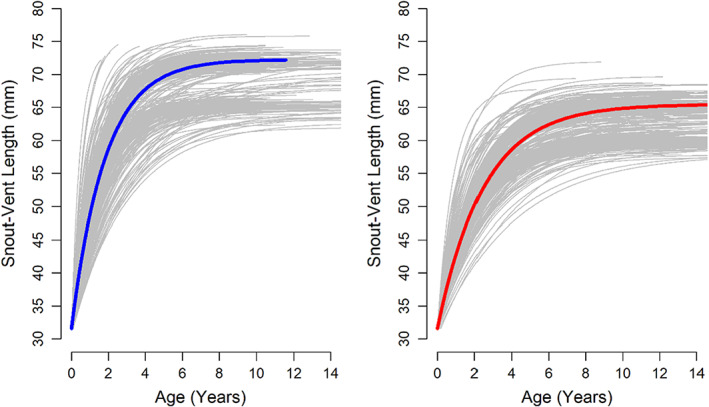
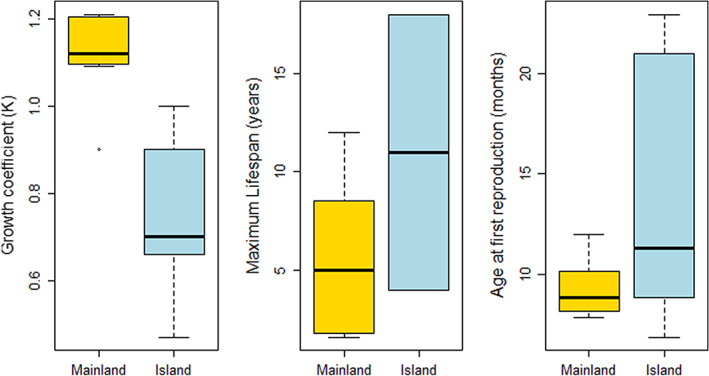
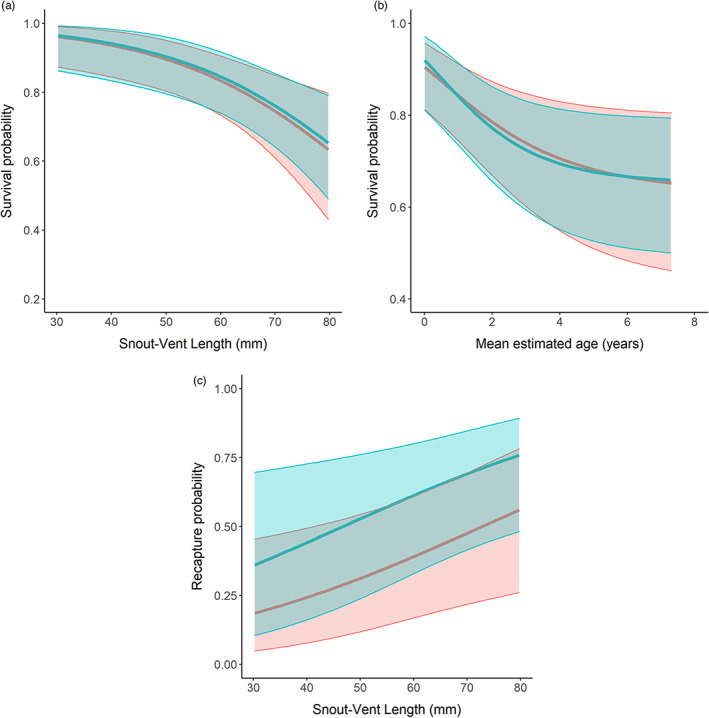
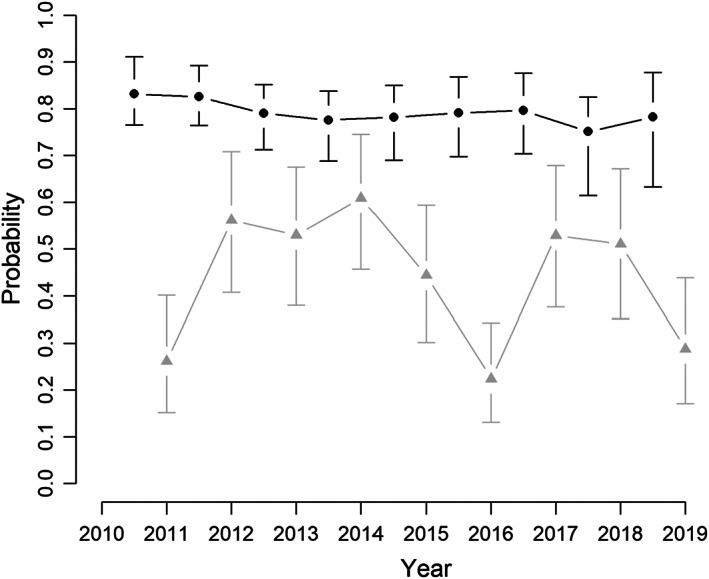
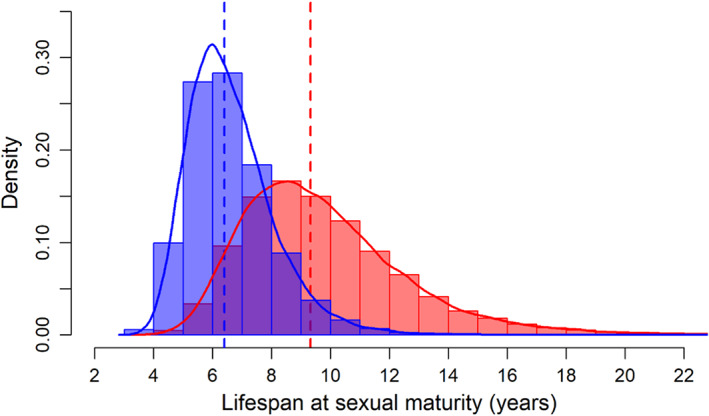
Small vertebrates on islands are expected to attain a larger body size, and a greater survival than their mainland counterparts. Comparative studies have questioned whether lizards exhibit this set of adaptations, referred to as the 'island syndrome'. We collected data on 730 individuals the endemic Lilford's lizard Podarcis lilfordi throughout a 10-year period on a small island of the Balearic archipelago (Spain). We coupled a growth function with a capture-mark-recapture model to simultaneously estimate size- and sex-dependent growth rate and survival. To put our results into a wider context, we conducted a systematic review of growth, life span and age at maturity in different Podarcis species comparing insular and mainland populations. We found a low average growth coefficient (0.56 and 0.41 year for males and females to reach an asymptotic size of 72.3 and 65.6 mm respectively), a high annual survival probability of 0.81 and 0.79 in males and females, and a large variability between individuals in growth parameters. Survival probability decreased with body size in both sexes, indicating a senescence pattern typical of long-lived species or in populations with a low extrinsic mortality. Assuming a constant survival after sexual maturity, at about 2 years old, the average life span was 6.18 years in males and 8.99 in females. The oldest animal was a male last captured at an estimated age of ≥13 years and still alive at the end of the study. Our results agree with the predictions of the 'island syndrome' for survival, life span and growth parameters. A comparative analysis of these values across 29 populations of 16 different species of Podarcis indicated that insular lizards grow slower and live longer than their mainland counterparts. However, our data differed from other island populations of the same species, suggesting that island-specific characteristics play an additional role to isolation. Within this study we developed an analytical approach to study the body size-dependent survival of small reptiles. We discuss its applicability to contrast hypotheses on senescence in different sexes of this species, and provide the code used to integrate the growth and capture-mark-recapture models.
岛屿上的小型脊椎动物预计会比它们的大陆同类体型更大,存活率更高。比较研究质疑蜥蜴是否表现出这种被称为“岛屿综合征”的适应性。我们在十年间收集了巴利阿里群岛(西班牙)一个小岛上的特有蜥蜴 Lilford 的蜥蜴 Podarcis lilfordi 的 730 个人的数据。我们将生长函数与捕获-标记-再捕获模型相结合,同时估计大小和性别依赖性的生长率和存活率。为了将我们的结果置于更广泛的背景下,我们对不同 Podarcis 物种的生长、寿命和成熟年龄进行了系统回顾,比较了岛屿和大陆种群。我们发现平均生长系数较低(雄性和雌性分别为 0.56 和 0.41 年,达到 72.3 和 65.6 毫米的渐近大小),雄性和雌性的年存活率分别为 0.81 和 0.79,个体之间的生长参数差异较大。在两性中,存活率随着体型的增加而降低,表明存在典型的长寿物种或低外源性死亡率种群的衰老模式。假设性成熟后存活率保持不变,大约在 2 岁左右,雄性的平均寿命为 6.18 年,雌性为 8.99 年。最老的动物是一只雄性,最后一次被捕是在估计年龄≥13 岁时,在研究结束时仍活着。我们的结果与“岛屿综合征”对生存、寿命和生长参数的预测一致。对 29 个种群的 16 个不同 Podarcis 物种的这些值进行比较分析表明,岛屿蜥蜴比它们的大陆同类生长缓慢,寿命更长。然而,我们的数据与同一物种的其他岛屿种群不同,这表明岛屿特有的特征除了隔离之外还起到了额外的作用。在本研究中,我们开发了一种分析方法来研究小型爬行动物的体型相关存活率。我们讨论了它在对比该物种不同性别的衰老假设方面的适用性,并提供了用于整合生长和捕获-标记-再捕获模型的代码。