Cognitive and Clinical Neuroimaging Core and McLean Hospital Imaging Center, Belmont, Massachusetts, USA.
Marijuana Investigations for Neuroscientific Discovery (MIND) Program, McLean Hospital Imaging Center, Belmont, Massachusetts, USA.
Cannabis Cannabinoid Res. 2022 Dec;7(6):827-839. doi: 10.1089/can.2022.0097. Epub 2022 Nov 11.
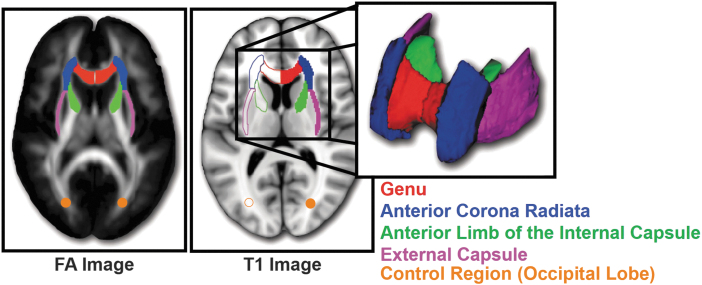
Previous studies have demonstrated abnormal white matter (WM) microstructure in recreational cannabis consumers; however, the long-term impact of medical cannabis (MC) use on WM coherence is unknown. Accordingly, this study assessed the longitudinal impact of MC treatment on WM coherence. Given results from preclinical studies, we hypothesized that MC treatment would be associated with increased fractional anisotropy (FA) and reduced mean diffusivity (MD). As part of a larger, longitudinal investigation, patients interested in treating at least one medical condition with commercially available MC products of their choosing were assessed MC use (baseline =37; female=25, male=12) and following three (=31) and six (=22) months of treatment. WM coherence was assessed via diffusion tensor imaging for bilateral regions of interest including the genu of the corpus callosum, anterior limb of the internal capsule, external capsule, and anterior corona radiata, as well as an occipital control region not expected to change over time. In MC patients, FA values significantly increased bilaterally in several callosal regions relative to baseline following both 3 and 6 months of treatment; MD values significantly decreased in all callosal regions but only following 6 months of treatment. No significant changes in WM coherence were observed in the control region or in a pilot sample of treatment-as-usual patients (baseline =14), suggesting that increased WM coherence observed in MC patients may be attributed to MC treatment as opposed to confounding factors. Interestingly, significant reductions in MD values correlated with higher cannabidiol (CBD) exposure but not Δ-9-tetrahydrocannabinol exposure. Overall, MC treatment was associated with increased WM coherence, which contrasts with prior research examining recreational cannabis consumers, likely related to inherent differences between recreational consumers and MC patients (e.g., product choice, age of onset). In addition, increased CBD exposure was associated with reduced MD following 6 months of treatment, extending evidence from preclinical research indicating that CBD may be neuroprotective against demyelination. However, additional research is needed to elucidate the clinical efficacy of MC treatment and the risks and benefits of long-term MC use.
先前的研究已经证明了娱乐性大麻使用者的脑白质(WM)微观结构异常;然而,医用大麻(MC)使用对 WM 连贯性的长期影响尚不清楚。因此,本研究评估了 MC 治疗对 WM 连贯性的纵向影响。鉴于临床前研究的结果,我们假设 MC 治疗与增加的分数各向异性(FA)和降低的平均扩散系数(MD)有关。作为一项更大的纵向研究的一部分,对有兴趣用他们选择的商业上可用的 MC 产品治疗至少一种医学病症的患者进行了 MC 使用评估(基线=37;女性=25,男性=12),并在治疗后 3 个月(=31)和 6 个月(=22)进行了评估。通过扩散张量成像对双侧感兴趣区域的 WM 连贯性进行了评估,包括胼胝体的膝部、内囊前肢、外囊和前冠状辐射,以及一个预计不会随时间变化的枕叶对照区域。在 MC 患者中,与基线相比,在治疗 3 个月和 6 个月后,几个胼胝体区域的 FA 值均显著增加;在所有胼胝体区域,MD 值均显著降低,但仅在治疗 6 个月后才降低。在对照区域或治疗常规患者的试点样本(基线=14)中未观察到 WM 连贯性的显著变化,这表明在 MC 患者中观察到的 WM 连贯性增加可能归因于 MC 治疗,而不是混杂因素。有趣的是,MD 值的显著降低与更高的大麻二酚(CBD)暴露相关,但与 Δ-9-四氢大麻酚暴露无关。总的来说,MC 治疗与 WM 连贯性增加有关,这与之前研究娱乐性大麻使用者的研究结果形成对比,这可能与娱乐性大麻使用者和 MC 患者之间的固有差异有关(例如,产品选择、发病年龄)。此外,在治疗 6 个月后,CBD 暴露增加与 MD 值降低相关,这扩展了临床前研究的证据,表明 CBD 可能对脱髓鞘具有神经保护作用。然而,需要进一步研究来阐明 MC 治疗的临床疗效以及长期 MC 使用的风险和益处。