Cleveland Clinic, Cleveland, USA.
Eli Lilly and Company, 893 S. Delaware Street, Indianapolis, IN, 46225, USA.
Adv Ther. 2023 Feb;40(2):474-488. doi: 10.1007/s12325-022-02364-2. Epub 2022 Nov 12.
To assess the prevalence of fatigue and its association with disease activity and patient-reported outcomes among patients with ulcerative colitis (UC) or Crohn's disease (CD).
Data from a cross-sectional survey conducted with gastroenterologists and their consulting adult patients with UC or CD were analyzed. Data were collected via gastroenterologist-completed patient record forms and patient-self completion forms. Patient demographics, clinical characteristics, disease activity and medication use were reported by the gastroenterologist, while current symptoms (fatigue, rectal urgency, abdominal pain, sleep disturbance), work productivity and the Short Inflammatory Bowel Disease Questionnaire (SIBDQ) were reported by the patient. Logistic regression models were used to identify measures associated with fatigue and expressed as odds ratio (OR) with 95% confidence interval. p < 0.05 was considered statistically significant.
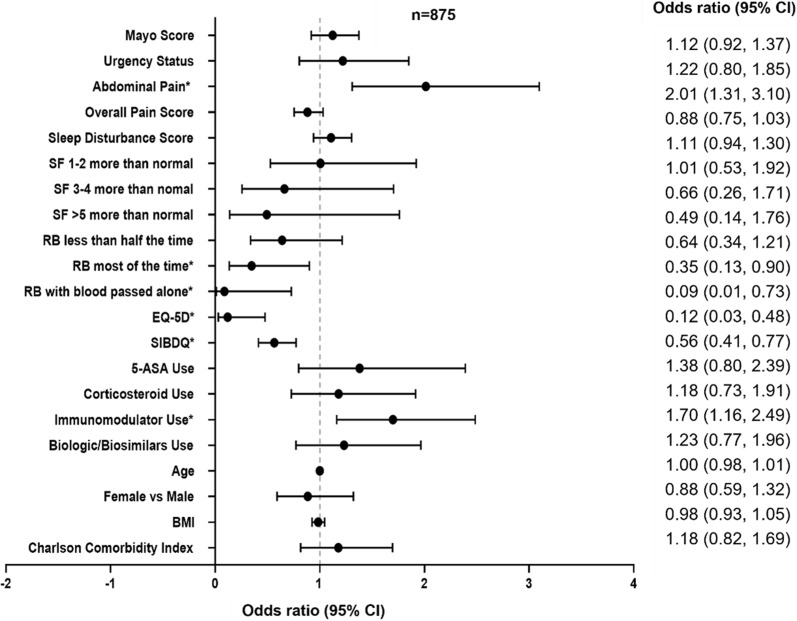
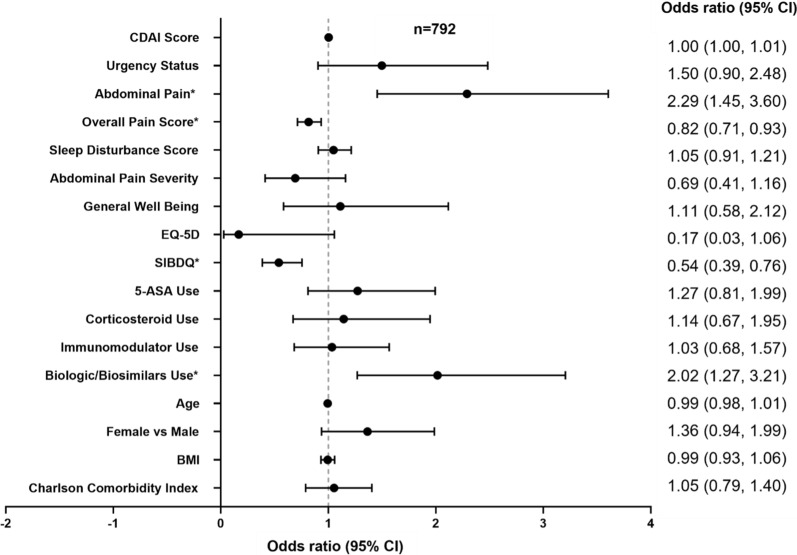
A total of 1057 patients with UC and 1228 patients with CD were included in this analysis. Fatigue was reported in 22.6% of UC and 26.0% of patients with CD. Higher proportion of patients with UC and fatigue had moderate/severe disease activity (p = 0.0001), had a higher Mayo score (5.0 vs. 4.0, p < 0.0001) and were unemployed (5.6% vs. 3.9%, p = 0.0149) compared to those without fatigue. In patients with CD reporting fatigue, a higher proportion were female (55.9% vs. 48.2%, p = 0.0193), were unemployed (5.8% vs. 4.9%, p = 0.0069), had moderate/severe disease (p < 0.0001) and had a higher mean Crohn's Disease Activity Index score (145.0 vs. 96.2, p < 0.0001) than patients without fatigue. Patients with UC and fatigue had higher mean level of pain (p < 0.0001) and sleep disturbance (p < 0.0001), whereas patients with CD and fatigue had lower SIBDQ scores (p < 0.0001) and greater work impairment (p = 0.0015) than patients without fatigue. Abdominal pain (OR: 2.01, p = 0.001) and use of immunomodulators (OR: 1.69, p = 0.006) increased the odds of having fatigue in patients with UC. In patients with CD, abdominal pain (OR: 2.29, p < 0.001) and use of biologics or biosimilars (OR: 2.02, p = 0.003) increased the odds of having fatigue.
Fatigue is a common symptom among patients with UC or CD that is associated with higher levels of disease activity and decreased work productivity and is driven by various factors. A multidisciplinary approach may be needed to manage fatigue.
评估溃疡性结肠炎(UC)或克罗恩病(CD)患者中疲劳的患病率及其与疾病活动度和患者报告结局的相关性。
分析了一项与胃肠病学家及其咨询的成年 UC 或 CD 患者进行的横断面调查的数据。数据通过胃肠病学家填写的患者病历表和患者自我完成的表格收集。患者的人口统计学特征、临床特征、疾病活动度和药物使用情况由胃肠病学家报告,而当前症状(疲劳、直肠急迫感、腹痛、睡眠障碍)、工作生产力和短炎症性肠病问卷(SIBDQ)由患者报告。使用逻辑回归模型确定与疲劳相关的措施,并表示为比值比(OR)和 95%置信区间。p<0.05 被认为具有统计学意义。
本分析共纳入 1057 例 UC 患者和 1228 例 CD 患者。22.6%的 UC 患者和 26.0%的 CD 患者报告有疲劳。UC 患者中疲劳比例较高的患者有中度/重度疾病活动度(p=0.0001),Mayo 评分较高(5.0 分 vs. 4.0 分,p<0.0001),失业(5.6% vs. 3.9%,p=0.0149)。在报告疲劳的 CD 患者中,女性比例较高(55.9% vs. 48.2%,p=0.0193),失业(5.8% vs. 4.9%,p=0.0069),中度/重度疾病(p<0.0001)和克罗恩病活动指数评分较高(145.0 分 vs. 96.2 分,p<0.0001)。UC 患者疲劳时疼痛(p<0.0001)和睡眠障碍(p<0.0001)程度较高,而 CD 患者疲劳时 SIBDQ 评分较低(p<0.0001)和工作障碍程度较高(p=0.0015)。UC 患者腹痛(OR:2.01,p=0.001)和免疫调节剂使用(OR:1.69,p=0.006)增加了疲劳的可能性。在 CD 患者中,腹痛(OR:2.29,p<0.001)和生物制剂或生物类似物使用(OR:2.02,p=0.003)增加了疲劳的可能性。
疲劳是 UC 或 CD 患者的常见症状,与更高的疾病活动度和降低的工作生产力相关,由各种因素驱动。可能需要多学科方法来管理疲劳。