Lees Charlie W, Torres Joana, Leung Yvette, Vermeire Séverine, Fellmann Marc, Modesto Irene, McDonnell Aoibhinn, Lazin Krisztina, Keating Michael, Goetsch Martina, Wu Joseph, Loftus Edward V
Institute of Genetics and Molecular Medicine, University of Edinburgh, Edinburgh, UK.
Edinburgh IBD Unit, Western General Hospital, NHS Lothian, Edinburgh, UK.
Therap Adv Gastroenterol. 2024 Nov 7;17:17562848241293643. doi: 10.1177/17562848241293643. eCollection 2024.
Etrasimod is an oral, once-daily (QD), selective sphingosine 1-phosphate (S1P) receptor modulator for the treatment of moderately to severely active ulcerative colitis (UC). It is known that non-serious treatment-emergent adverse events (TEAEs) may not lead to UC drug discontinuation but can affect treatment tolerability.
This post hoc analysis evaluated the incidence of specific, common, non-serious TEAEs reported in the etrasimod UC clinical programme and the characteristics of affected patients.
Data included patients from the Placebo-controlled UC cohort (phase II OASIS, and phase III ELEVATE UC 52 and ELEVATE UC 12 trials) receiving QD etrasimod (2 or 1 mg) or placebo.
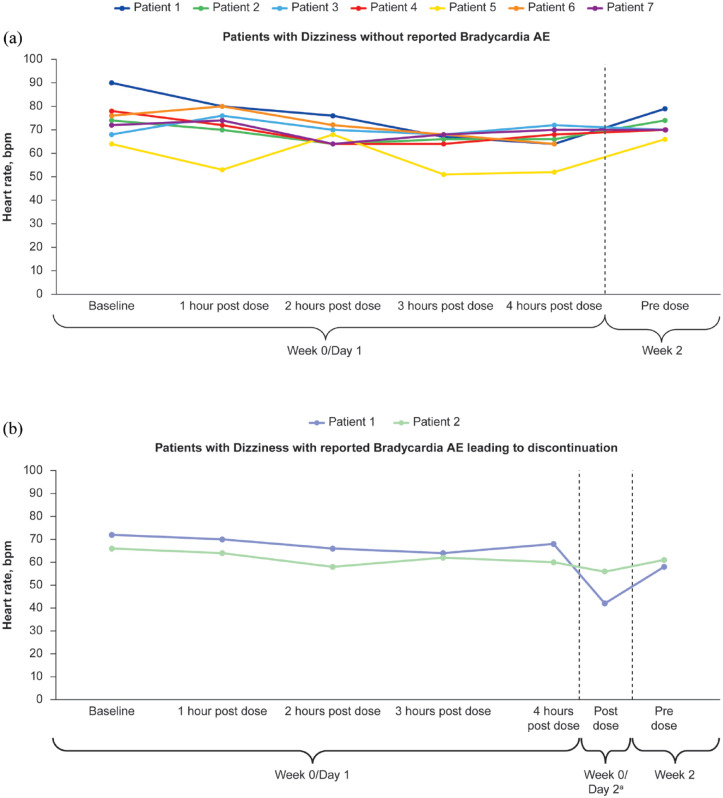
Proportions and incidence rates (IRs; the number of patients with a TEAE divided by the total exposure in patient-years (PYs), per 100 PY) of Headache, Pyrexia, Nausea and Dizziness TEAEs were reported. Changes in heart rate among patients with Dizziness TEAEs were also evaluated.
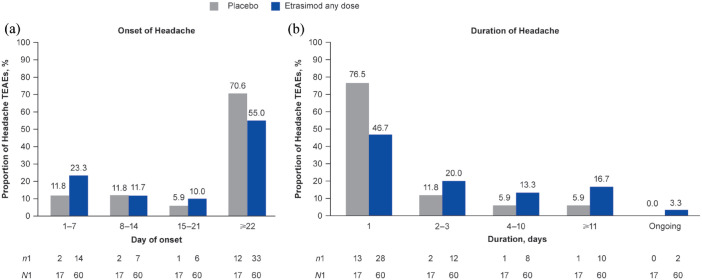
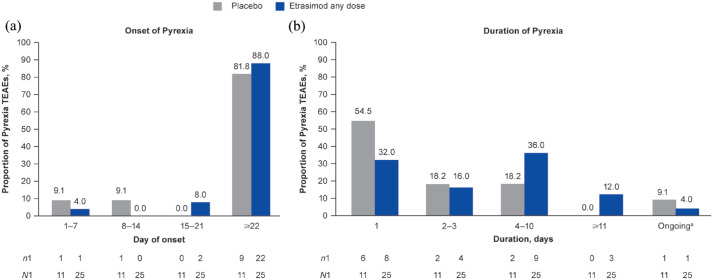
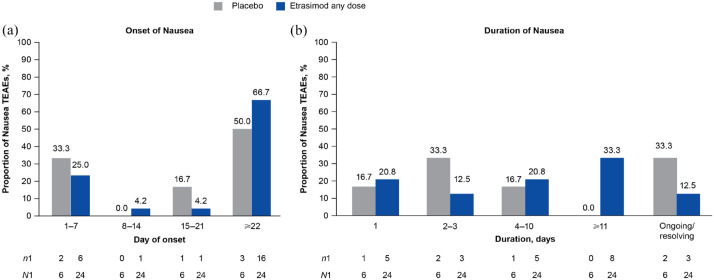
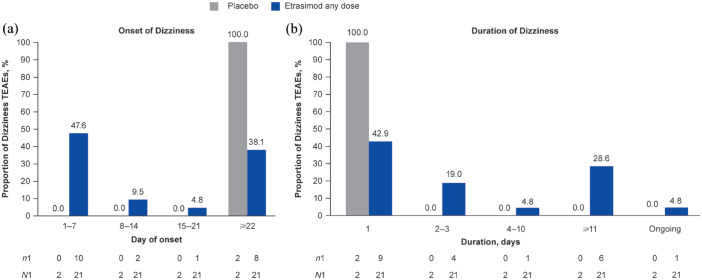
Among 943 patients (etrasimod 2 mg, = 577 (276.7 PY); etrasimod 1 mg, = 52 (11.4 PY); placebo, = 314 (115.1 PY)), 48, 34, 27 and 21 patients experienced events of Headache, Pyrexia, Nausea and Dizziness, respectively. All events were non-serious; one patient treated with etrasimod was discontinued due to a Pyrexia TEAE. Numerically, IRs of Headache and Dizziness TEAEs were higher, and Nausea slightly higher, with etrasimod versus placebo (13.45 vs 8.63 per 100 PY, 6.52 vs 1.69 and 7.18 vs 5.13 per 100 PY, respectively); IRs were similar for Pyrexia. The duration of most TEAEs was 1-10 days.
In the etrasimod UC clinical programme, all Headache, Pyrexia, Nausea and Dizziness events were non-serious. Headache and Dizziness were more frequent, and Nausea slightly more frequent, among patients receiving etrasimod versus placebo. The post hoc nature of this analysis is a limitation. These results reiterate the favourable safety profile and tolerability of etrasimod.
ClinicalTrials.gov: NCT02447302; NCT03945188; NCT03996369.
艾曲莫德是一种口服、每日一次(QD)的选择性1-磷酸鞘氨醇(S1P)受体调节剂,用于治疗中度至重度活动性溃疡性结肠炎(UC)。已知非严重的治疗中出现的不良事件(TEAE)可能不会导致UC药物停用,但会影响治疗耐受性。
这项事后分析评估了艾曲莫德UC临床项目中报告的特定、常见、非严重TEAE的发生率以及受影响患者的特征。
数据包括来自安慰剂对照的UC队列(II期OASIS以及III期ELEVATE UC 52和ELEVATE UC 12试验)中接受QD艾曲莫德(2或1mg)或安慰剂的患者。
报告了头痛、发热、恶心和头晕TEAE的比例和发生率(IR;发生TEAE的患者数量除以患者年(PY)的总暴露量,每100 PY)。还评估了头晕TEAE患者的心率变化。
在943例患者中(艾曲莫德2mg,n = 577(276.7 PY);艾曲莫德1mg,n = 52(11.4 PY);安慰剂,n = 314(115.1 PY)),分别有48、34、27和21例患者发生头痛、发热、恶心和头晕事件。所有事件均不严重;1例接受艾曲莫德治疗的患者因发热TEAE而停药。在数值上,与安慰剂相比,艾曲莫德的头痛和头晕TEAE的IR更高,恶心的IR略高(分别为每100 PY 13.45对8.63、6.52对1.69和7.18对5.13);发热的IR相似。大多数TEAE的持续时间为1至10天。
在艾曲莫德UC临床项目中,所有头痛、发热、恶心和头晕事件均不严重。与接受安慰剂的患者相比,接受艾曲莫德的患者中头痛和头晕更频繁,恶心略更频繁。该分析的事后性质是一个局限性。这些结果重申了艾曲莫德良好的安全性和耐受性。
ClinicalTrials.gov:NCT02447302;NCT03945188;NCT03996369。