Department of Medical OncologyState Key Laboratory of Oncology in South ChinaCollaborative Innovation Center for Cancer Medicine, Sun Yat-Sen University Cancer Center, Guangzhou, China.
Department of Oncology, The First Affiliated Hospital of Jinan University, Guangzhou, China.
BMC Med. 2022 Nov 14;20(1):398. doi: 10.1186/s12916-022-02595-8.
Due to the blood-brain barrier, plasma is not an ideal source to evaluate the genetic characteristics of central nervous system tumors. Thus, cerebrospinal fluid (CSF) is becoming an alternative biopsy type to evaluate the genetic landscape of intracranial tumors. We aimed to explore the genetic profiles of CSF-derived circulating tumor DNA (ctDNA) to predict intracranial tumor responses and monitor mutational evolution during the treatment of non-small cell lung cancer (NSCLC) patients with brain metastases.
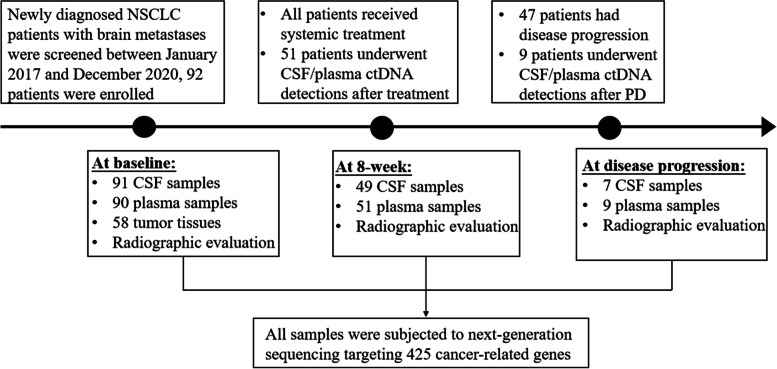
We conducted a prospective study of 92 newly diagnosed NSCLC patients with brain metastases. Paired CSF and plasma samples were collected at baseline, 8 weeks after treatment initiation, and disease progression. All samples underwent next-generation sequencing of 425 cancer-related genes.
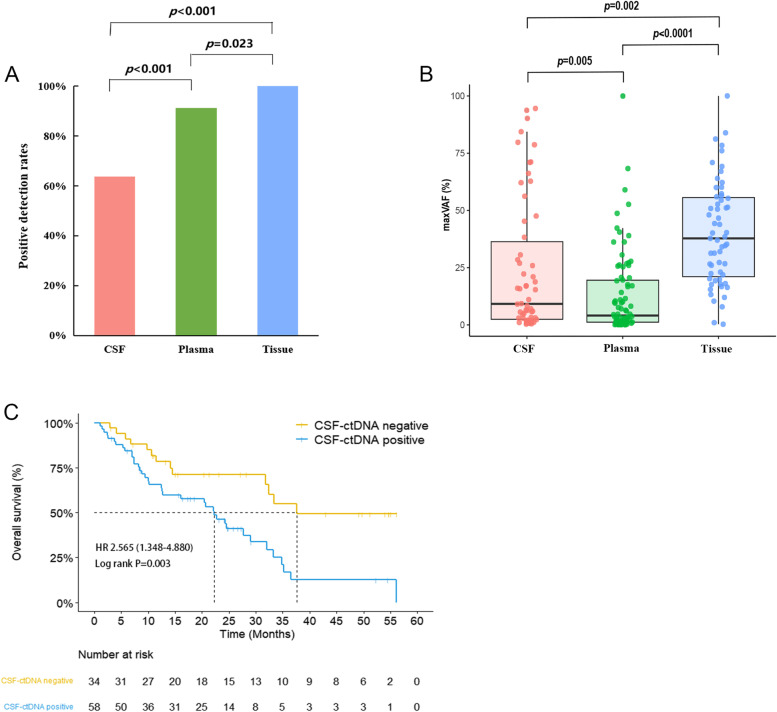
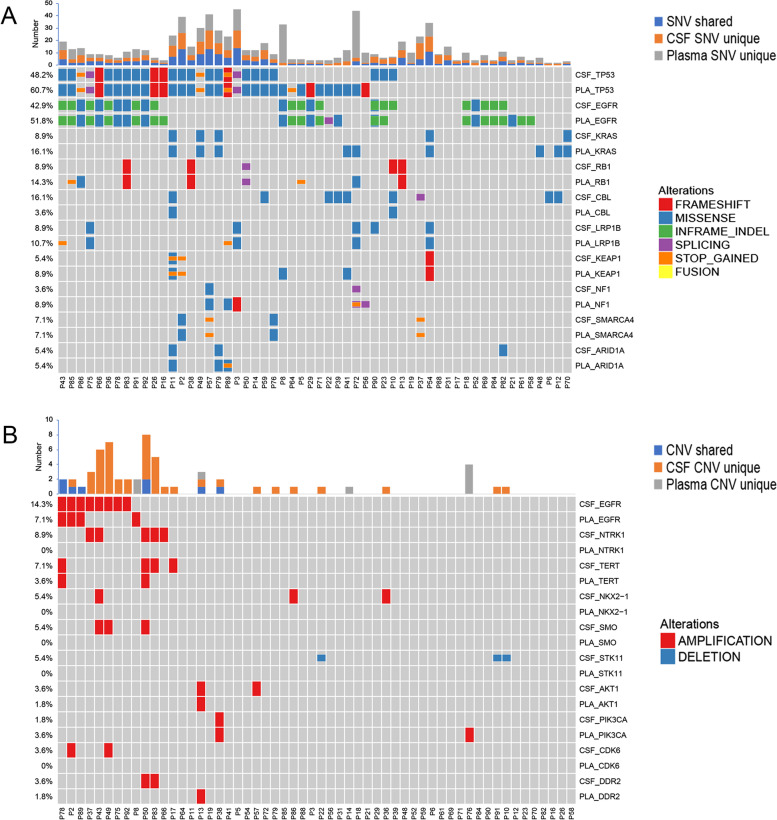
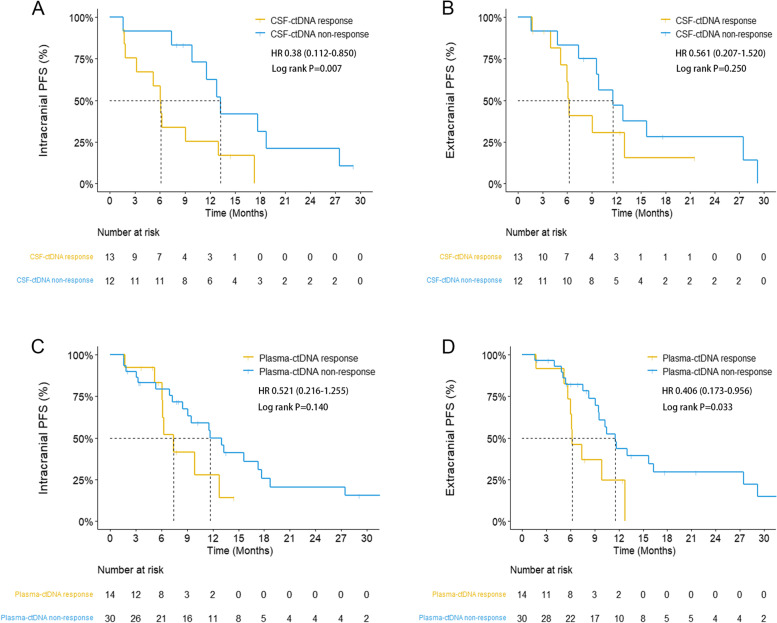
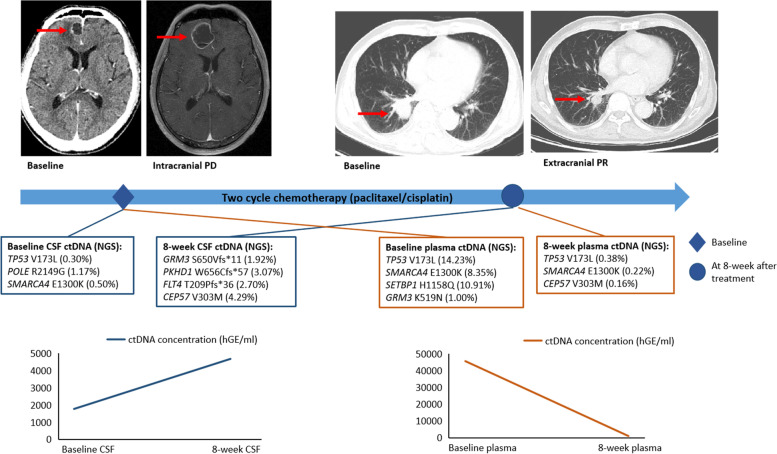
At baseline, the positive detection rates of ctDNA in CSF, plasma, and extracranial tumors were 63.7% (58/91), 91.1% (82/90), and 100% (58/58), respectively. A high level of genetic heterogeneity was observed between paired CSF and plasma, while concordance in driver mutations was also observed. A higher number of unique copy number variations was detected in CSF-ctDNA than in plasma. ctDNA positivity of CSF samples at baseline was associated with poor outcomes (HR=2.565, P=0.003). Moreover, patients with ≥ 50% reductions in the concentrations of CSF ctDNA after 8 weeks of treatment had significantly longer intracranial progression-free survivals (PFS) than patients with < 50% reductions in CSF ctDNA concentrations (13.27 months vs 6.13 months, HR=0.308, P=0.017). A ≥ 50% reduction in CSF ctDNA concentrations had better concordance with radiographic intracranial tumor responses than plasma. A ≥ 50% reduction in plasma ctDNA concentrations was also associated with longer extracranial PFS (11.57 months vs 6.20 months, HR=0.406, P=0.033). Based on clonal evolution analyses, the accumulation of subclonal mutations in CSF ctDNA was observed after 8 weeks of treatment. The clonal mutations that remained in more than 80% in CSF after 8 weeks also predicted shorter intracranial PFS (HR=3.785, P=0.039).
CSF ctDNA exhibited unique genetic profiles of brain metastases, and dynamic changes in CSF ctDNA could better predict intracranial tumor responses and track clonal evolution during treatment in NSCLC patients with brain metastases.
ClinicalTrials.gov identifier: NCT03257735.
由于血脑屏障的存在,血浆并不是评估中枢神经系统肿瘤遗传特征的理想来源。因此,脑脊液(CSF)正成为评估颅内肿瘤遗传图谱的替代活检类型。我们旨在探索 CSF 衍生循环肿瘤 DNA(ctDNA)的遗传特征,以预测非小细胞肺癌(NSCLC)伴脑转移患者的颅内肿瘤反应,并监测治疗过程中的突变进化。
我们对 92 例新诊断的 NSCLC 伴脑转移患者进行了前瞻性研究。在基线、治疗开始后 8 周和疾病进展时采集配对的 CSF 和血浆样本。所有样本均进行了 425 个与癌症相关基因的下一代测序。
基线时,CSF、血浆和颅外肿瘤中 ctDNA 的阳性检出率分别为 63.7%(58/91)、91.1%(82/90)和 100%(58/58)。配对 CSF 和血浆之间观察到高度的遗传异质性,同时也观察到驱动突变的一致性。CSF-ctDNA 中检测到的独特拷贝数变异数量高于血浆。基线时 CSF 样本中 ctDNA 的阳性与不良结局相关(HR=2.565,P=0.003)。此外,治疗 8 周后 CSF ctDNA 浓度降低≥50%的患者颅内无进展生存期(PFS)显著长于 CSF ctDNA 浓度降低<50%的患者(13.27 个月比 6.13 个月,HR=0.308,P=0.017)。CSF ctDNA 浓度降低≥50%与影像学颅内肿瘤反应的一致性优于血浆。血浆 ctDNA 浓度降低≥50%也与颅外 PFS 延长相关(11.57 个月比 6.20 个月,HR=0.406,P=0.033)。基于克隆进化分析,在治疗 8 周后观察到 CSF ctDNA 中亚克隆突变的积累。治疗 8 周后 CSF 中仍有超过 80%的克隆突变也预示着较短的颅内 PFS(HR=3.785,P=0.039)。
CSF ctDNA 表现出脑转移的独特遗传特征,CSF ctDNA 的动态变化可以更好地预测 NSCLC 伴脑转移患者颅内肿瘤反应,并在治疗过程中追踪克隆进化。
ClinicalTrials.gov 标识符:NCT03257735。