Pan Yangdan, Sanati Soheila, Nadafan Marzieh, Abazari Reza, Gao Junkuo, Kirillov Alexander M
The Key Laboratory of Advanced Textile Materials and Manufacturing Technology of Ministry of Education, National Engineering Lab for Textile Fiber Materials and Processing Technology, School of Materials Science and Engineering, Zhejiang Sci-Tech University, Hangzhou310018, China.
Department of Chemistry, Faculty of Science, University of Maragheh, 55181-83111Maragheh, Iran.
Inorg Chem. 2022 Nov 28;61(47):18873-18882. doi: 10.1021/acs.inorgchem.2c02709. Epub 2022 Nov 14.
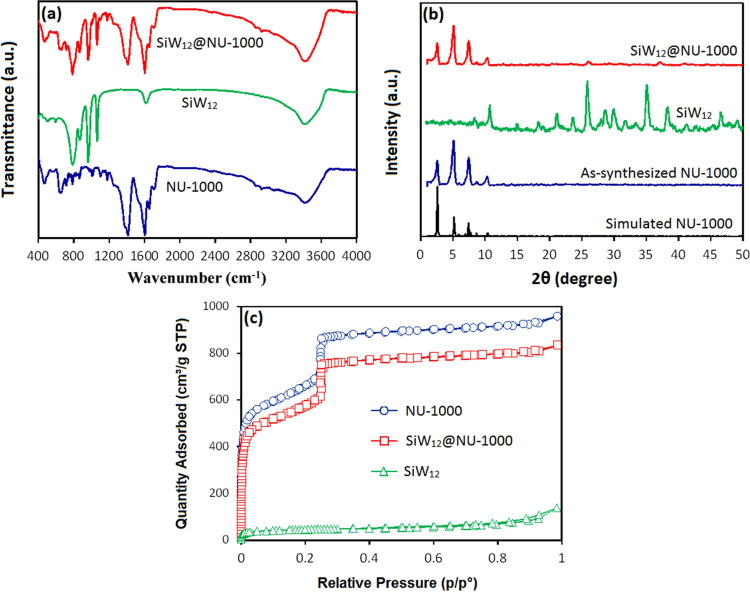
For the advancement of laser technologies and optical engineering, various types of new inorganic and organic materials are emerging. Metal-organic frameworks (MOFs) reveal a promising use in nonlinear optics, given the presence of organic linkers, metal cluster nodes, and possible delocalization of π-electron systems. These properties can be further enhanced by the inclusion of solely inorganic materials such as polyoxometalates as prospective low-cost electron-acceptor species. In this study, a novel hybrid nanocomposite, namely, SiW@NU-1000 composed of SiW (HSiWO) and Zr-based MOF (NU-1000), was assembled, completely characterized, and thoroughly investigated in terms of its nonlinear optical (NLO) performance. The third-order NLO behavior of the developed system was assessed by -scan measurements using a 532 nm laser. The effect of two-photon absorption and self-focusing was significant in both NU-1000 and SiW@NU-1000. Experimental studies suggested a much superior NLO performance of SiW@NU-1000 if compared to that of NU-1000, which can be assigned to the charge-energy transfer between SiW and NU-1000. Negligible light scattering, good stability, and facile postsynthetic fabrication method can promote the applicability of the SiW@NU-1000 nanocomposite for various optoelectronic purposes. This research may thus open new horizons to improve and enhance the NLO performance of MOF-based materials through π-electron delocalization and compositing metal-organic networks with inorganic molecules as electron acceptors, paving the way for the generation of novel types of hybrid materials for prospective NLO applications.
为了推动激光技术和光学工程的发展,各种新型无机和有机材料不断涌现。金属有机框架(MOF)鉴于其有机连接体、金属簇节点以及可能的π电子体系离域现象,在非线性光学领域展现出了广阔的应用前景。通过引入诸如多金属氧酸盐等单一无机材料作为潜在的低成本电子受体物种,这些性能可以得到进一步增强。在本研究中,一种新型的杂化纳米复合材料,即由SiW(HSiWO)和锆基金属有机框架(NU - 1000)组成的SiW@NU - 1000被制备出来,对其进行了全面表征,并就其非线性光学(NLO)性能进行了深入研究。利用532 nm激光通过 -扫描测量评估了所开发体系的三阶NLO行为。双光子吸收和自聚焦效应在NU - 1000和SiW@NU - 1000中都很显著。实验研究表明,与NU - 1000相比,SiW@NU - 1000具有更优异的NLO性能,这可以归因于SiW与NU - 1000之间的电荷 - 能量转移。可忽略不计的光散射、良好的稳定性以及简便的合成后制备方法能够促进SiW@NU - 1000纳米复合材料在各种光电用途中的应用。因此,本研究可能会开创全新的局面,通过π电子离域以及将金属有机网络与作为电子受体的无机分子复合来改善和提高基于MOF材料的NLO性能,为生成用于未来NLO应用的新型杂化材料铺平道路。