Hazan Guy, Fox Carolyn, Mok Huram, Haspel Jeffrey
Division of Pulmonary and Critical Care Medicine, Department of Internal Medicine, Washington University School of Medicine, St Louis, Mo.
Division of Pediatric Allergy and Pulmonary Medicine, Department of Pediatrics, Washington University School of Medicine, St Louis, Mo.
J Allergy Clin Immunol Glob. 2022 Nov;1(4):314-318. doi: 10.1016/j.jacig.2022.06.001. Epub 2022 Aug 10.
Virus mitigation measures enacted early in the coronavirus infectious disease 2019 (COVID-19) pandemic suppressed common respiratory viruses and reduced the number of obstructive lung disease exacerbations. However, many localities began to ease these precautions in the year 2021, leading to a resurgence of non-COVID viruses. How asthma and chronic obstructive pulmonary disease (COPD) activity responded to this upswing in viral abundance is unclear.
Our aim was to examine how viral resurgence during the relaxation of COVID-19 restrictions affected asthma and COPD exacerbations.
We analyzed electronic medical records for emergency department (ED) respiratory virus positivity, asthma visits, and COPD visits. We compared the 52-week interval before the COVID-19 restrictions (the pre-lockdown period [March 22, 2019-March 19, 2020]), the 52-week period immediately following enactment of the restrictions (the lockdown period [March 20, 2020-March 18, 2021]), and the 52-week period thereafter (the post-lockdown period [March 19, 2021-March 18, 2022]). We used MetaCYCLE to analyze seasonal trends in our data.
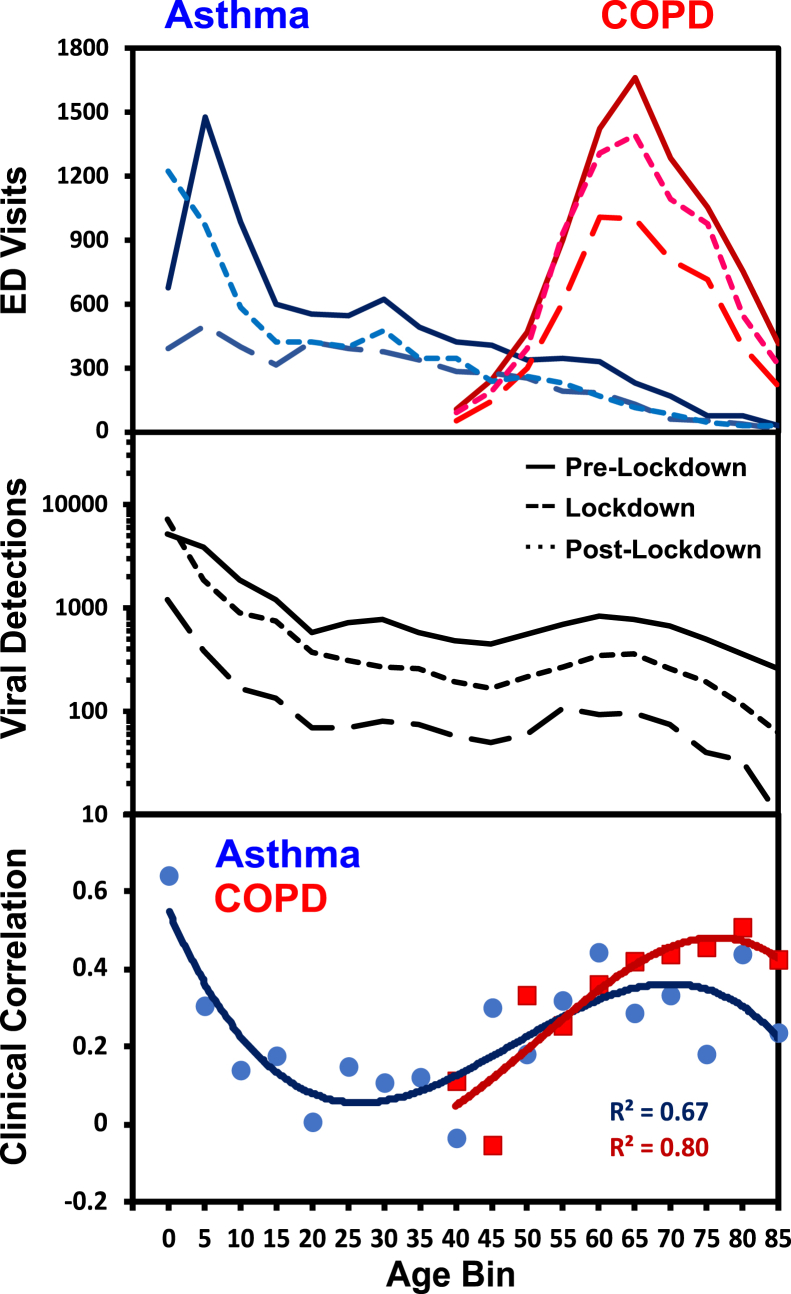
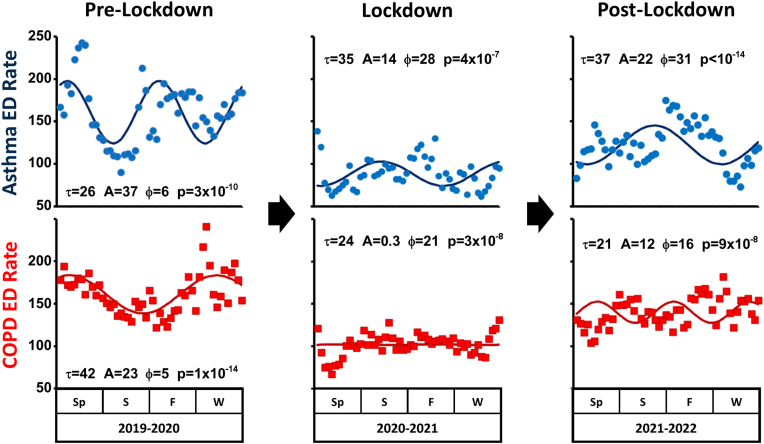
The post-lockdown period was marked by a 400% increase in viral positivity compared with during the lockdown period. Asthma- and COPD-related ED visits each rose 37% compared with during the lockdown, with the rebound in asthma ED visits concentrated in individuals younger than 20 years. Interestingly, after the lockdown period, asthma ED visits overcorrected in children younger than 5 years, rising 81% compared with before the lockdown. Seasonal rhythms in asthma and COPD exacerbations were suppressed during the lockdown and recovered after the lockdown.
COVID-19 precautions had the unexpected effect of magnifying early-childhood asthma activity once common respiratory viruses recurred. These results may have implications for the future use of virus mitigation strategies in young children.
2019冠状病毒病(COVID-19)大流行早期实施的病毒缓解措施抑制了常见呼吸道病毒,并减少了阻塞性肺病急性加重的次数。然而,许多地区在2021年开始放宽这些预防措施,导致非COVID病毒卷土重来。目前尚不清楚哮喘和慢性阻塞性肺疾病(COPD)活动对病毒丰度的这种上升是如何反应的。
我们的目的是研究COVID-19限制措施放宽期间病毒卷土重来如何影响哮喘和COPD急性加重。
我们分析了急诊科(ED)呼吸道病毒阳性、哮喘就诊和COPD就诊的电子病历。我们比较了COVID-19限制措施实施前的52周间隔(封锁前期[2019年3月2日至2020年3月19日])、限制措施实施后的52周期间(封锁期[2020年3月20日至2021年3月18日])以及此后的52周期间(封锁后期[2021年3月19日至2022年3月18日])。我们使用MetaCYCLE分析数据中的季节性趋势。
与封锁期相比,封锁后期病毒阳性率增加了400%。与封锁期间相比,与哮喘和COPD相关的ED就诊次数均增加了37%,哮喘ED就诊次数的反弹集中在20岁以下的个体。有趣的是,在封锁期之后,5岁以下儿童的哮喘ED就诊次数出现过度纠正,与封锁前相比增加了81%。哮喘和COPD急性加重的季节性节律在封锁期间受到抑制,在封锁后恢复。
一旦常见呼吸道病毒复发,COVID-19预防措施会产生意想不到的效果,即放大幼儿期哮喘活动。这些结果可能对未来幼儿病毒缓解策略的使用产生影响。