School of Psychology, University of New South Wales, Sydney, Australia.
Brain Dynamics Centre, Westmead Institute of Medical Research, Sydney, Australia.
Epidemiol Psychiatr Sci. 2022 Nov 15;31:e81. doi: 10.1017/S2045796022000658.
There is increasing evidence that brief psychological interventions delivered by lay providers can reduce common mental disorders in the short-term. This study evaluates the longer-term impact of a brief, lay provider delivered group psychological intervention (Group Problem Management Plus; gPM+) on the mental health of refugees and their children's mental health.
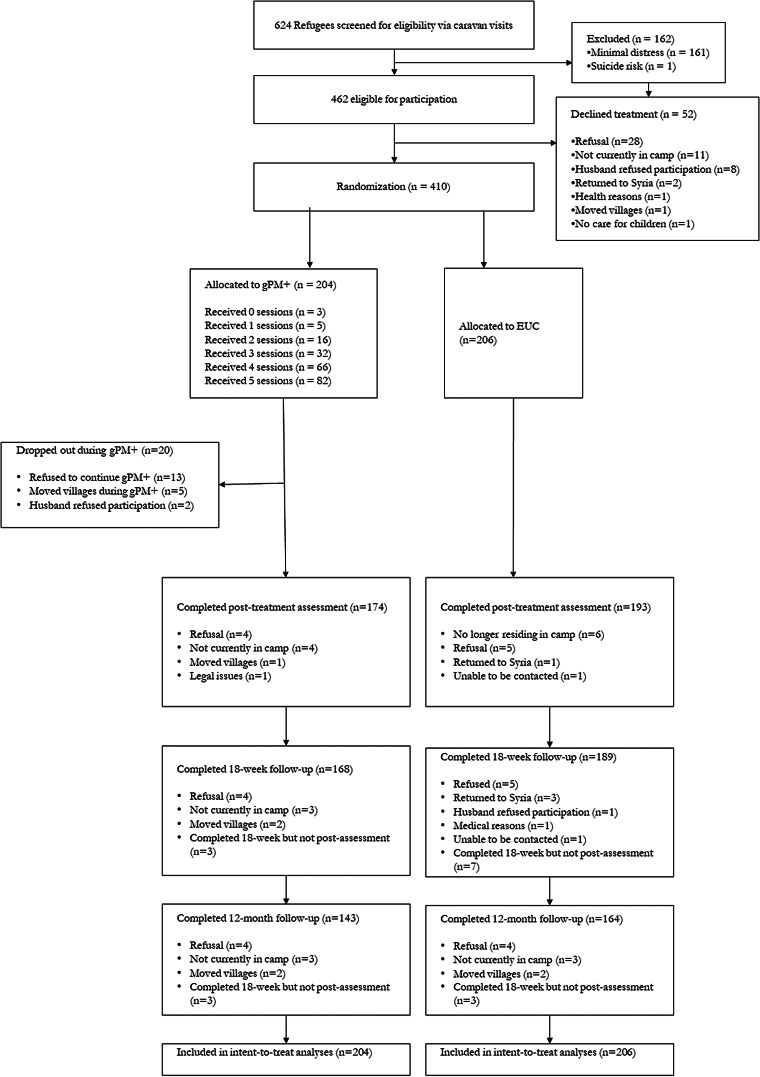
This single-blind, parallel, controlled trial randomised 410 adult Syrians in Azraq Refugee Camp in Jordan who screened positive for distress and impaired functioning to either five sessions of gPM+ or enhanced usual care (EUC). Primary outcomes were scores on the Hopkins Symptom Checklist-25 (HSCL-25; depression and anxiety scales) assessed at baseline, 6 weeks, 3 months and 12 months Secondary outcomes included disability, posttraumatic stress, personally identified problems, prolonged grief, prodromal psychotic symptoms, parenting behaviour and children's mental health.
Between 15 October 2019 and 2 March 2020, 204 participants were assigned to gPM + and 206 to EUC, and 307 (74.9%) were retained at 12 months. Intent-to-treat analyses indicated that although participants in gPM + had greater reductions in depression at 3 months, at 12 months there were no significant differences between treatment arms on depression (mean difference -0.9, 95% CI -3.2 to 1.3; = 0.39) or anxiety (mean difference -1.7, 95% CI -4.8 to -1.3; = 0.06). There were no significant differences between conditions for secondary outcomes except that participants in gPM + had greater increases in positive parenting.
The short-term benefits of a brief, psychological programme delivered by lay providers may not be sustained over longer time periods, and there is a need for sustainable programmes that can prolong benefits gained through gPM + .
越来越多的证据表明,由非专业人员提供的简短心理干预措施可以在短期内减少常见的精神障碍。本研究评估了由非专业人员提供的简短团体心理干预措施(团体问题管理加;gPM+)对难民及其子女心理健康的长期影响。
这项单盲、平行、对照试验随机招募了 410 名在约旦阿兹拉克难民营筛查出有痛苦和功能障碍的叙利亚成年人,将他们分为 gPM+组或增强常规护理(EUC)组。主要结局指标是基线、6 周、3 个月和 12 个月时的霍普金斯症状清单-25 评分(HSCL-25;抑郁和焦虑量表)。次要结局指标包括残疾、创伤后应激、个人确定的问题、长期悲伤、前驱精神病症状、育儿行为和儿童心理健康。
在 2019 年 10 月 15 日至 2020 年 3 月 2 日期间,204 名参与者被分配到 gPM+组,206 名参与者被分配到 EUC 组,307 名(74.9%)在 12 个月时保留。意向治疗分析表明,尽管 gPM+组在 3 个月时抑郁症状减轻幅度更大,但在 12 个月时,治疗组之间的抑郁(平均差值-0.9,95%CI-3.2 至 1.3;P=0.39)或焦虑(平均差值-1.7,95%CI-4.8 至-1.3;P=0.06)均无显著差异。除 gPM+组参与者的积极育儿行为有更大增加外,两种情况下的次要结局均无显著差异。
由非专业人员提供的简短心理干预措施的短期益处可能无法在较长时间内持续,因此需要有可持续的方案,可以延长通过 gPM+获得的益处。