Division of Pediatric Oncology, Sidney Kimmel Comprehensive Cancer Center, Johns Hopkins University, School of Medicine, Baltimore, Maryland, USA.
Pediatric Oncology Branch, Center for Cancer Research, National Cancer Institute, NIH, Bethesda, Maryland, USA.
J Clin Invest. 2022 Nov 15;132(22):e164420. doi: 10.1172/JCI164420.
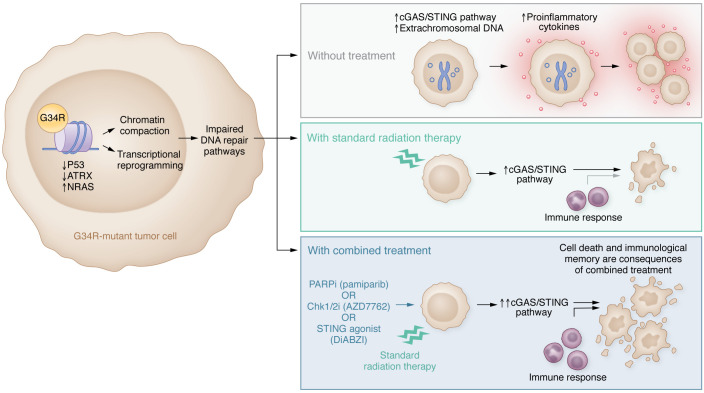
Pediatric high-grade gliomas (pHGGs) are aggressive diseases with poor outcomes. The diverse molecular heterogeneity in these rare tumors and inadequate tumor models have limited the development of effective therapies. In this issue of the JCI, Haase et al. produced a genetically engineered mouse model of H3.3-G34R-mutant pHGG to help identify vulnerabilities in DNA repair pathways. The authors designed a therapy that combined radiation with DNA damage response inhibitors to induce an adaptive immune response and extend survival. These findings suggest that combinations of small-molecule therapies with immunotherapies could drive a more durable response and improve mortality for patients with pHGG.
儿童高级别神经胶质瘤(pHGG)是一种侵袭性疾病,预后不良。这些罕见肿瘤的分子异质性多样,肿瘤模型不足,限制了有效治疗方法的发展。在本期 JCI 中,Haase 等人构建了 H3.3-G34R 突变型 pHGG 的基因工程小鼠模型,以帮助鉴定 DNA 修复途径中的脆弱性。作者设计了一种联合放疗和 DNA 损伤反应抑制剂的治疗方法,以诱导适应性免疫反应并延长生存期。这些发现表明,小分子治疗联合免疫疗法可能会引发更持久的反应,改善 pHGG 患者的死亡率。