Imperial Centre for Cardiovascular Disease Prevention, Department of Primary Care and Public Health, Imperial College London, Reynolds Building, St. Dunstans Road, London, GB.
Department of Public Health and Primary Care, British Heart Foundation, UK.
Glob Heart. 2022 Oct 14;17(1):75. doi: 10.5334/gh.1154. eCollection 2022.
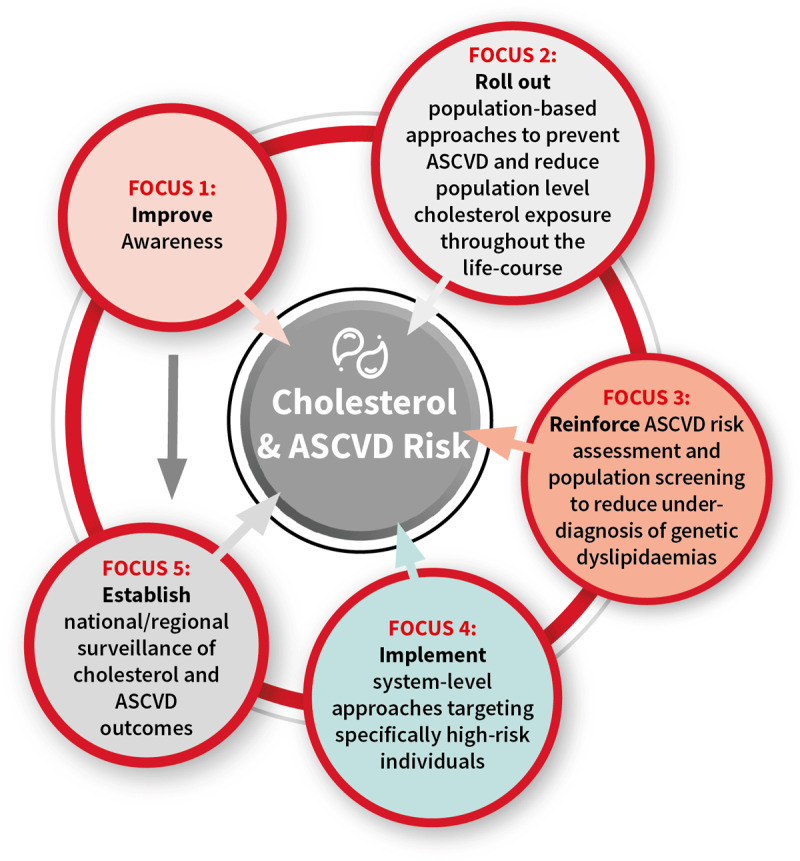
Atherosclerotic cardiovascular diseases (ASCVD) including myocardial infarction, stroke and peripheral arterial disease continue to be major causes of premature death, disability and healthcare expenditure globally. Preventing the accumulation of cholesterol-containing atherogenic lipoproteins in the vessel wall is central to any healthcare strategy to prevent ASCVD. Advances in current concepts about reducing cumulative exposure to apolipoprotein B (apo B) cholesterol-containing lipoproteins and the emergence of novel therapies provide new opportunities to better prevent ASCVD. The present update of the World Heart Federation Cholesterol Roadmap provides a conceptual framework for the development of national policies and health systems approaches, so that potential roadblocks to cholesterol management and thus ASCVD prevention can be overcome.
Through a review of published guidelines and research papers since 2017, and consultation with a committee composed of experts in clinical management of dyslipidaemias and health systems research in low-and-middle income countries (LMICs), this Roadmap identifies (1) key principles to effective ASCVD prevention (2) gaps in implementation of these interventions (knowledge-practice gaps); (3) health system roadblocks to treatment of elevated cholesterol in LMICs; and (4) potential strategies for overcoming these.
Reducing the future burden of ASCVD will require diverse approaches throughout the life-course. These include: a greater focus on primordial prevention; availability of affordable cholesterol testing; availability of universal cholesterol screening for inherited dyslipidaemias; risk stratification moving beyond 10-year risk to look at lifetime risk with adequate risk estimators; wider availability of affordable cholesterol-lowering therapies which should include statins as essential medications globally; use of adequate doses of potent statin regimens; and combination therapies with ezetimibe or other therapies in order to attain and maintain robust reductions in LDL-C in those at highest risk. Continuing efforts are needed on health literacy for both the public and healthcare providers, utilising multi-disciplinary teams in healthcare and applications that quantify both ASCVD risk and benefits of treatment as well as increased adherence to therapies.
The adverse effects of LDL-cholesterol and apo B containing lipoprotein exposure are cumulative and result in ASCVD. These are preventable by implementation of different strategies, aimed at efficiently tackling atherosclerosis at different stages throughout the human life-course. Preventive strategies should therefore be updated to implement health policy, lifestyle changes and when needed pharmacotherapies earlier with investment in, and a shift in focus towards, early preventive strategies that preserve cardiovascular health rather than treat the consequences of ASCVD.
包括心肌梗死、中风和外周动脉疾病在内的动脉粥样硬化性心血管疾病(ASCVD)仍然是全球范围内导致过早死亡、残疾和医疗支出的主要原因。预防胆固醇含量的致动脉粥样硬化脂蛋白在血管壁中的积累是任何预防 ASCVD 的医疗保健策略的核心。当前关于降低载脂蛋白 B(apo B)胆固醇脂蛋白累积暴露的概念的进步和新型疗法的出现为更好地预防 ASCVD 提供了新的机会。世界心脏联合会胆固醇路线图的本次更新为制定国家政策和卫生系统方法提供了一个概念框架,以便克服胆固醇管理和因此预防 ASCVD 的潜在障碍。
通过审查自 2017 年以来发表的指南和研究论文,并与一个由临床血脂异常管理和中低收入国家(LMICs)卫生系统研究专家组成的委员会协商,该路线图确定了(1)有效预防 ASCVD 的关键原则;(2)实施这些干预措施的差距(知识-实践差距);(3)在 LMICs 治疗升高的胆固醇方面的卫生系统障碍;以及(4)克服这些障碍的潜在策略。
减少未来 ASCVD 的负担将需要在整个生命周期中采取多种方法。这些方法包括:更加关注原始预防;提供负担得起的胆固醇检测;提供遗传性血脂异常的普遍胆固醇筛查;风险分层超越 10 年风险,用足够的风险估算器观察终生风险;更广泛地提供负担得起的降胆固醇药物,全球范围内应将他汀类药物作为基本药物;使用有效剂量的强效他汀类药物方案;并联合使用依折麦布或其他药物治疗,以实现并维持高危人群 LDL-C 的稳健降低。需要继续努力提高公众和医疗保健提供者的健康素养,利用多学科团队进行医疗保健,并应用能够量化 ASCVD 风险和治疗益处以及提高对治疗的依从性的方法。
LDL-胆固醇和载脂蛋白 B 含量脂蛋白暴露的不良影响是累积的,导致 ASCVD。通过实施旨在在人类生命周期的不同阶段有效治疗动脉粥样硬化的不同策略,可以预防这些不良影响。因此,预防策略应进行更新,以实施卫生政策、生活方式改变,并在需要时尽早进行药物治疗,投资于并关注早期预防性策略,以保护心血管健康,而不是治疗 ASCVD 的后果。