Heart Center, Department of Cardiology, Amsterdam Cardiovascular Sciences, Amsterdam UMC, University of Amsterdam, Meibergdreef 9, 1105AZ, Amsterdam, Netherlands.
Department of Cardiology, Serviço Cardiologia, Centro Hospitalar Universitário do Porto, Largo Prof. Abel Salazar, 4099-001, Porto, Portugal.
Cardiovasc Diabetol. 2022 Nov 16;21(1):246. doi: 10.1186/s12933-022-01654-x.
Diabetes Mellitus (DM) affects a third of patients with symptomatic severe aortic valve stenosis undergoing transcatheter aortic valve implantation (TAVI). DM is a well-known risk factor for cardiac surgery, but its prognostic impact in TAVI patients remains controversial. This study aimed to evaluate outcomes in diabetic patients undergoing TAVI.
This multicentre registry includes data of > 12,000 patients undergoing transfemoral TAVI. We assessed baseline patient characteristics and clinical outcomes in patients with DM and without DM. Clinical outcomes were defined by the second valve academic research consortium. Propensity score matching was applied to minimize potential confounding.
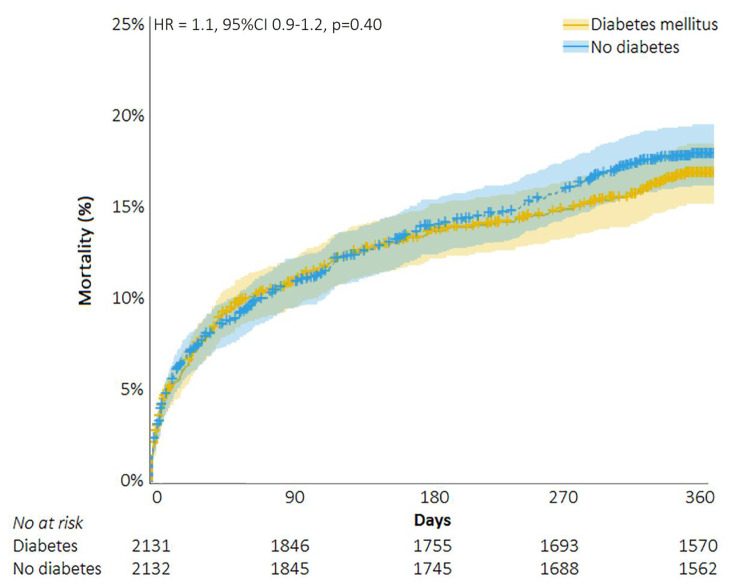
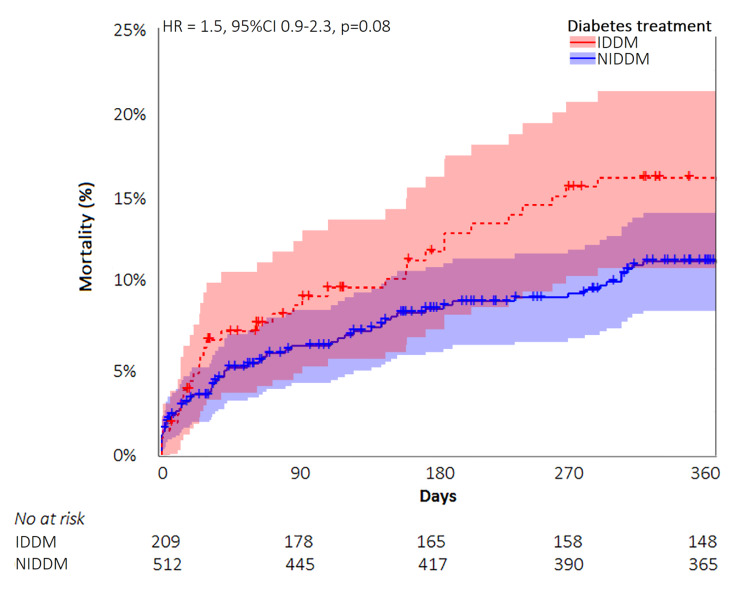
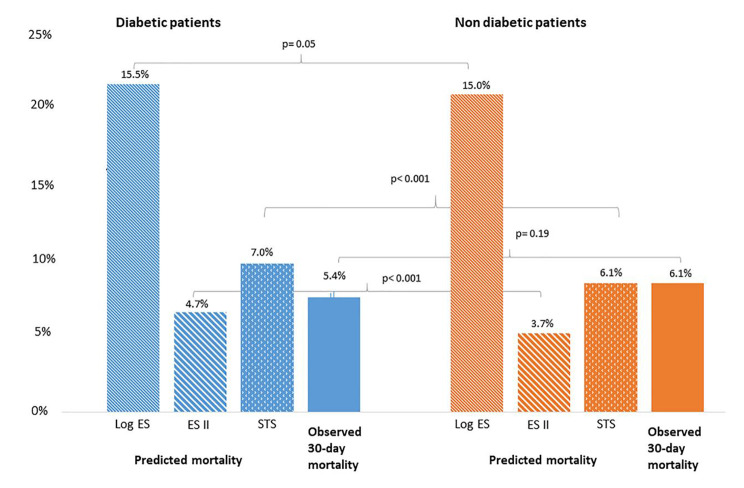
Of the 11,440 patients included, 31% (n = 3550) had DM and 69% (n = 7890) did not have DM. Diabetic patients were younger but had an overall worse cardiovascular risk profile than non-diabetic patients. All-cause mortality rates were comparable at 30 days (4.5% vs. 4.9%, RR 0.9, 95%CI 0.8-1.1, p = 0.43) and at one year (17.5% vs. 17.4%, RR 1.0, 95%CI 0.9-1.1, p = 0.86) in the unmatched population. Propensity score matching obtained 3281 patient-pairs. Also in the matched population, mortality rates were comparable at 30 days (4.7% vs. 4.3%, RR 1.1, 95%CI 0.9-1.4, p = 0.38) and one year (17.3% vs. 16.2%, RR 1.1, 95%CI 0.9-1.2, p = 0.37). Other clinical outcomes including stroke, major bleeding, myocardial infarction and permanent pacemaker implantation, were comparable between patients with DM and without DM. Insulin treated diabetics (n = 314) showed a trend to higher mortality compared with non-insulin treated diabetics (n = 701, Hazard Ratio 1.5, 95%CI 0.9-2.3, p = 0.08). EuroSCORE II was the most accurate risk score and underestimated 30-day mortality with an observed-expected ratio of 1.15 in DM patients, STS-PROM overestimated actual mortality with a ratio of 0.77 and Logistic EuroSCORE with 0.35.
DM was not associated with mortality during the first year after TAVI. DM patients undergoing TAVI had low rates of mortality and other adverse clinical outcomes, comparable to non-DM TAVI patients. Our results underscore the safety of TAVI treatment in DM patients.
The study is registered at clinicaltrials.gov (NCT03588247).
在接受经导管主动脉瓣植入术(TAVI)的有症状严重主动脉瓣狭窄患者中,有三分之一患有糖尿病(DM)。DM 是心脏手术的一个已知危险因素,但它在 TAVI 患者中的预后影响仍存在争议。本研究旨在评估接受 TAVI 的糖尿病患者的结局。
这项多中心注册研究包括了 >12000 例接受经股动脉 TAVI 的患者的数据。我们评估了 DM 患者和无 DM 患者的基线患者特征和临床结局。临床结局由第二瓣膜学术研究联盟定义。应用倾向评分匹配以最小化潜在混杂因素。
在纳入的 11440 例患者中,31%(n=3550)患有 DM,69%(n=7890)没有 DM。糖尿病患者较年轻,但整体心血管风险状况较差。在未匹配的人群中,30 天全因死亡率相当(4.5% vs. 4.9%,RR 0.9,95%CI 0.8-1.1,p=0.43),1 年死亡率相当(17.5% vs. 17.4%,RR 1.0,95%CI 0.9-1.1,p=0.86)。倾向评分匹配获得了 3281 对患者。在匹配的人群中,30 天死亡率相当(4.7% vs. 4.3%,RR 1.1,95%CI 0.9-1.4,p=0.38),1 年死亡率相当(17.3% vs. 16.2%,RR 1.1,95%CI 0.9-1.2,p=0.37)。其他临床结局,包括卒中和大出血、心肌梗死和永久性起搏器植入,在 DM 患者和无 DM 患者之间相当。与非胰岛素治疗的糖尿病患者(n=701)相比,胰岛素治疗的糖尿病患者(n=314)的死亡率有升高的趋势(风险比 1.5,95%CI 0.9-2.3,p=0.08)。EuroSCORE II 是最准确的风险评分,DM 患者的观察到的预期死亡率比实际高 1.15,STS-PROM 高估了实际死亡率,比值为 0.77,Logistic EuroSCORE 为 0.35。
在 TAVI 后 1 年内,DM 与死亡率无关。接受 TAVI 的 DM 患者死亡率和其他不良临床结局较低,与非 DM TAVI 患者相当。我们的研究结果强调了 TAVI 治疗 DM 患者的安全性。
该研究在 clinicaltrials.gov 注册(NCT03588247)。