Wen Ming-Zhe, Li Xin-Yu, Shen Yu-Chen, Wang Zhen-Feng, Zheng Lian-Zhou, Wang De-Ming, Fan Xin-Dong, Su Li-Xin, Yang Xi-Tao
Department of Interventional Therapy, Multidisciplinary Team of Vascular Anomalies, Shanghai Ninth People's Hospital, Shanghai JiaoTong University School of Medicine, Shanghai, China.
Department of Neurosurgery, Shanghai Ninth People's Hospital, Shanghai JiaoTong University School of Medicine, Shanghai, China.
Front Cardiovasc Med. 2022 Oct 26;9:949558. doi: 10.3389/fcvm.2022.949558. eCollection 2022.
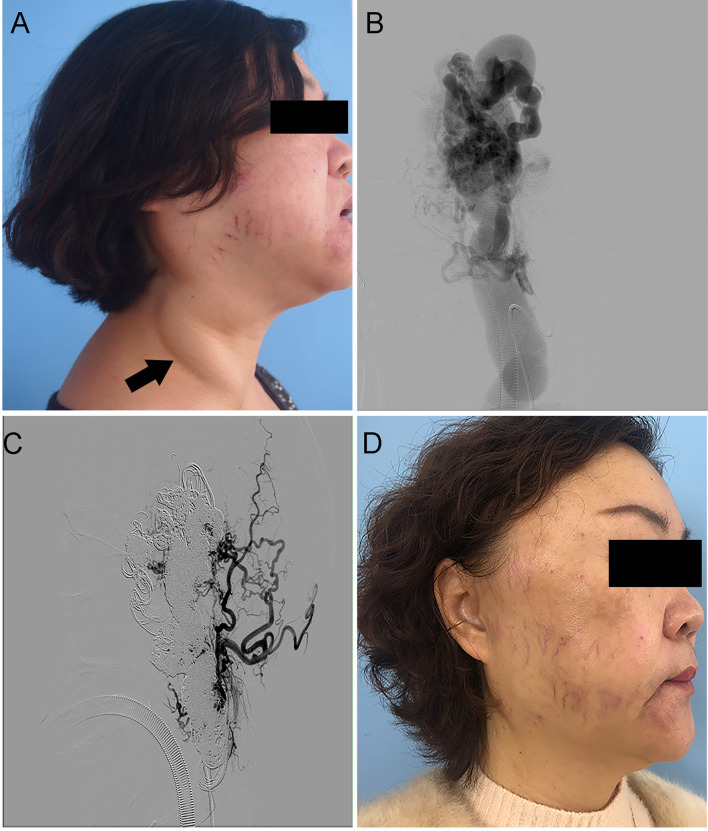
The aim of this study was to describe the treatment technique, outcomes, and complications of Schobinger stage IV head and neck arteriovenous malformations (HNAVMs) with associated high-output cardiac failure (HOCF) using ethanol and coils with the percutaneous suture technique.
From January 2015 to December 2019, 19 patients who had HNAVMs with associated HOCF were treated first with a percutaneous suture of the remarkably dilated dominant drainage vein (RDDOV) and subsequent embolization with coils and ethanol. The percutaneous suture of RDDOV was preferred to be performed, followed by the deployment of coils and the injection of absolute ethanol transarterial approach, direct puncture approach, or both of them. Treatment outcomes and complication rates were evaluated at follow-up.
A total of 19 patients who experienced HNAVMs with HOCF received 19 percutaneous suture procedures and 84 embolization procedures with ethanol and coils. Complete or >90% shunt reduction of the AVM was achieved in 16 patients. Notably, 19 patients with New York Heart Association (NYHA) stage II improved to stage I, and the symptom of dyspnea disappeared after embolization. The symptoms of five patients with bleeding disappeared. All patients presented with cosmetic concerns; Four were cured, and eight had a clearly recognizable improvement. Of note, 19 (100%) patients presented with impairment of daily life, which was resolved. The minor complications were encountered and recovered by the self. No major complications occurred.
This study provides evidence that ethanol and coil embolotherapy is effective and safe in treating HOCF caused by HNAVMs with acceptable complications in these cases. The percutaneous suture technique for RDDOV management can act as an adjunct for embolotherapy.
本研究旨在描述使用乙醇和弹簧圈,并采用经皮缝合技术治疗Schobinger IV期头颈部动静脉畸形(HNAVM)合并高输出量心力衰竭(HOCF)的治疗技术、疗效及并发症。
2015年1月至2019年12月,19例患有HNAVM合并HOCF的患者首先接受经皮缝合明显扩张的主要引流静脉(RDDOV),随后用弹簧圈和乙醇进行栓塞。优先对RDDOV进行经皮缝合,然后通过经动脉途径、直接穿刺途径或两者结合的方式部署弹簧圈并注射无水乙醇。随访时评估治疗效果和并发症发生率。
19例患有HNAVM合并HOCF的患者共接受了19次经皮缝合手术以及84次使用乙醇和弹簧圈的栓塞手术。16例患者实现了动静脉畸形完全或分流减少>90%。值得注意的是,19例纽约心脏协会(NYHA)II级患者改善为I级,栓塞后呼吸困难症状消失。5例出血患者的症状消失。所有患者均存在美观问题;4例治愈,8例有明显改善。值得注意的是,19例(100%)患者存在日常生活障碍,均得到解决。出现了轻微并发症,患者自行恢复。未发生重大并发症。
本研究提供的证据表明,在这些病例中,乙醇和弹簧圈栓塞疗法在治疗由HNAVM引起的HOCF方面有效且安全,并发症可接受。用于RDDOV处理的经皮缝合技术可作为栓塞疗法的辅助手段。