Wang Jie-Ping, Wei Chen-Chan, Peng Yun-Dong, Wang Hsuan-Yun, Hung Chi-Hsiang, Hong Yin-Hui, Liou Yuh-Feng, Hou Chien-Wen
Laboratory of Exercise Biochemistry, Institute of Sports Sciences, University of Taipei, Taipei, Taiwan.
Department of Aquatic Sports, University of Taipei, Taipei, Taiwan.
Front Physiol. 2022 Oct 28;13:999811. doi: 10.3389/fphys.2022.999811. eCollection 2022.
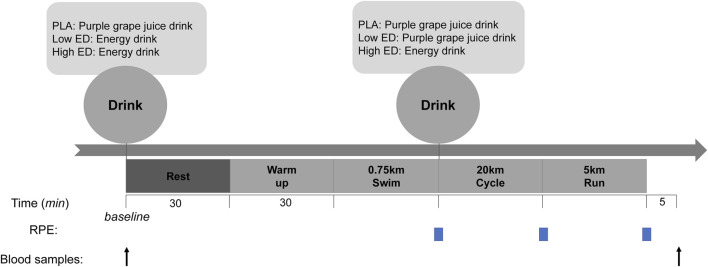
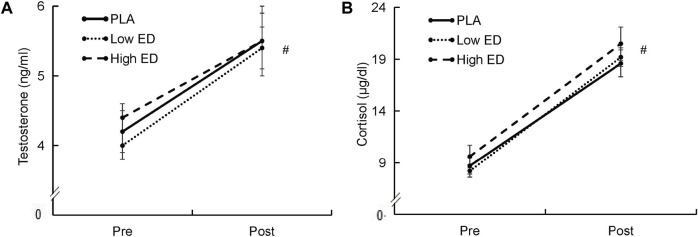
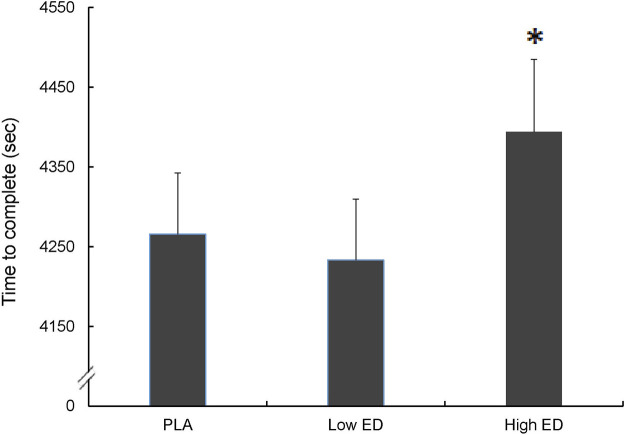
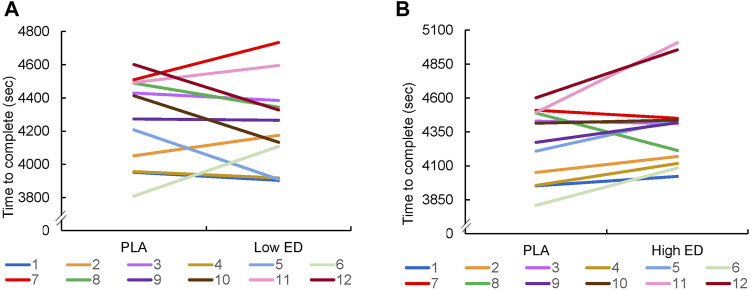
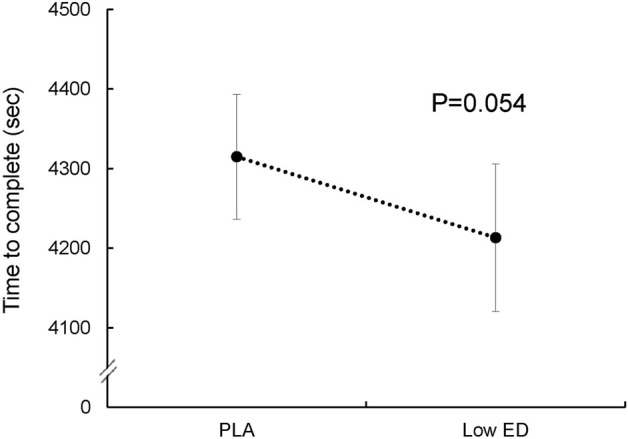
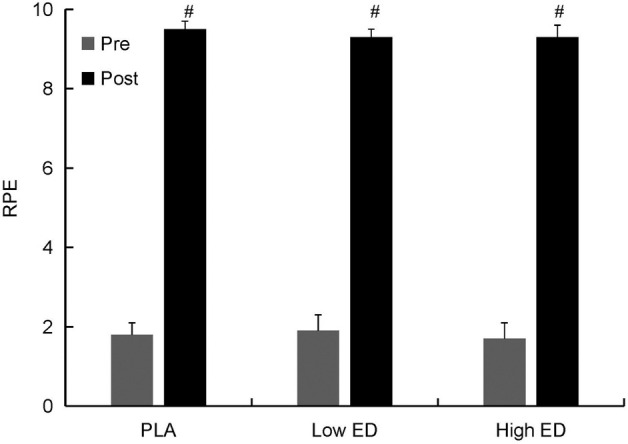
Caffeinated energy drinks are commonly taken to improve exercise performance, but there are few studies on the influence of different doses on an athlete's performance. We conducted a double-blind, randomized, counter-balanced, and crossover research study to examine the effects of low caffeinated energy drink (Low ED) or high caffeinated energy drink (High ED) supplement on the performance, haematological response, and oxidative stress in triathletes. Twelve male participants underwent three testing sessions separated by weekly intervals, consisting of sprint triathlon training (0.75 km swim, 20 km cycle, and 5 km run). Before and during the trials, participants were randomly provided with either placebo (PLA) group, Low ED group, or High ED group. Exercise performance in the High ED group decreased significantly compared with the PLA and Low ED groups ( < 0.05). However, participants in the Low ED group also experienced an improved performance ( = 0.054). Analysis of variance revealed no differences among the three groups in cortisol and testosterone levels, or the Borg Rating of Perceived Exertion score ( > 0.5). Furthermore, superoxide dismutase (SOD) was reduced with exercise and were lowest in the High ED group. However, compared with PLA, a significant decrease of thiobarbituric acid reactive substances (TBARS) was observed in Low ED and High ED groups ( < 0.05). This indicates that caffeinated energy drink consumption may improve performance and reduce oxidative stress in sprint triathlon athletes. However, individual differences should be considered when supplementing with caffeinated energy drinks to decrease side effects.
含咖啡因的能量饮料通常被用来提高运动表现,但关于不同剂量对运动员表现影响的研究较少。我们进行了一项双盲、随机、平衡和交叉研究,以检验低咖啡因能量饮料(Low ED)或高咖啡因能量饮料(High ED)补充剂对铁人三项运动员的表现、血液学反应和氧化应激的影响。12名男性参与者每隔一周进行三次测试,包括短距离铁人三项训练(0.75公里游泳、20公里自行车和5公里跑步)。在试验前和试验期间,参与者被随机分为安慰剂(PLA)组、低咖啡因能量饮料组或高咖啡因能量饮料组。与PLA组和低咖啡因能量饮料组相比,高咖啡因能量饮料组的运动表现显著下降(<0.05)。然而,低咖啡因能量饮料组的参与者表现也有所改善(=0.054)。方差分析显示,三组在皮质醇和睾酮水平或伯格主观用力评分上没有差异(>0.5)。此外,超氧化物歧化酶(SOD)随运动而降低,在高咖啡因能量饮料组中最低。然而,与PLA组相比,低咖啡因能量饮料组和高咖啡因能量饮料组的硫代巴比妥酸反应物质(TBARS)显著降低(<0.05)。这表明饮用含咖啡因的能量饮料可能会提高短距离铁人三项运动员的表现并降低氧化应激。然而,在补充含咖啡因的能量饮料时应考虑个体差异以减少副作用。