Souron Robin, Carayol Marion, Martin Vincent, Piponnier Enzo, Duché Pascale, Gruet Mathieu
Université de Toulon, Laboratoire IAPS (n°201723207F), Toulon, France.
Nantes Université, Movement-Interactions-Performance, MIP, UR 4334, Nantes, France.
Front Physiol. 2022 Oct 31;13:1026012. doi: 10.3389/fphys.2022.1026012. eCollection 2022.
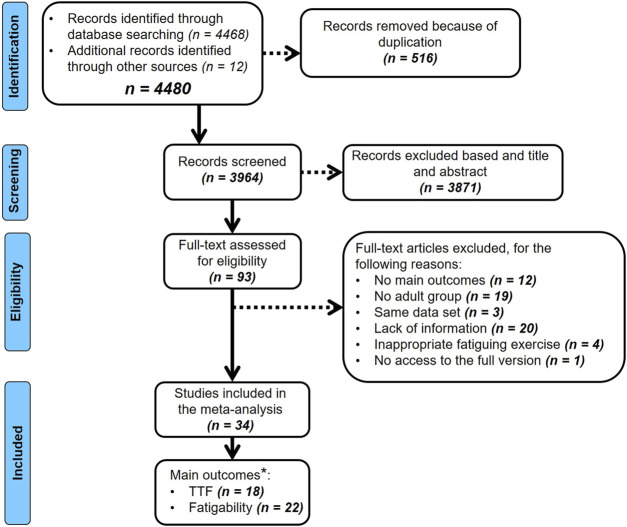
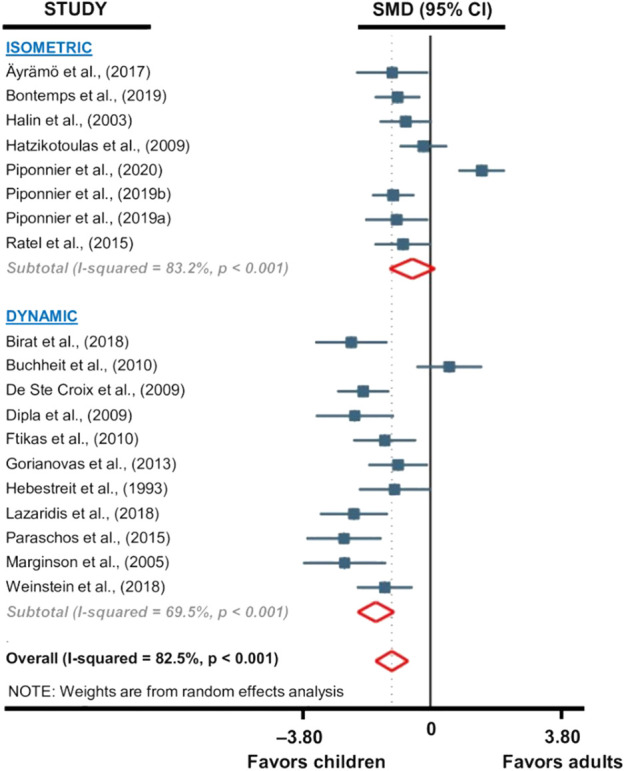
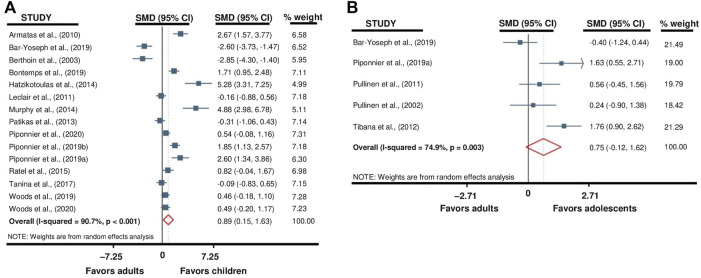
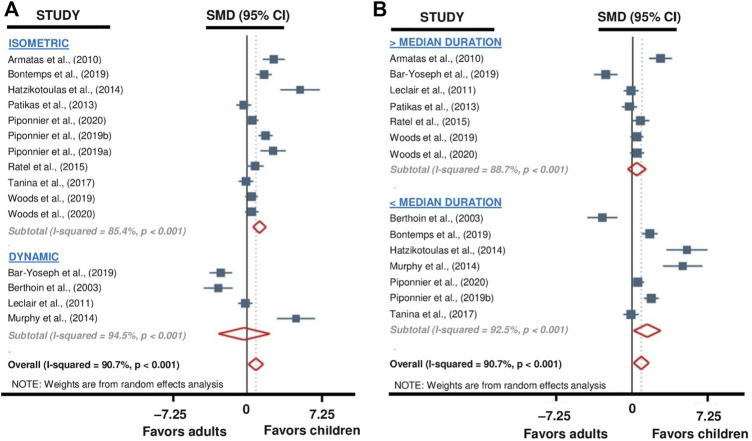
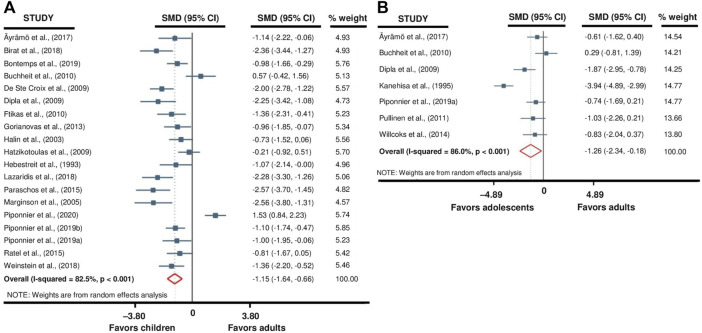
The transition from childhood to adulthood is characterized by many physiological processes impacting exercise performance. Performance fatigability and time to task failure are commonly used to capture exercise performance. This review aimed to determine the differences in fatigability and TTF between youth (including both children and adolescents) and young adults, and to evaluate the influence of exercise modalities (i.e., exercise duration and type of exercise) on these differences. Medline, SPORTDiscus and Cochrane Library were searched. Thirty-four studies were included. The meta-analyses revealed that both children (SMD -1.15; < 0.001) and adolescents (SMD -1.26; = 0.022) were less fatigable than adults. Additional analysis revealed that children were less fatigable during dynamic exercises (SMD -1.58; < 0.001) with no differences during isometric ones (SMD -0.46; = 0.22). Children (SMD 0.89; = 0.018) but not adolescents (SMD 0.75; = 0.090) had longer TTF than adults. Additional analyses revealed 1) that children had longer TTF for isometric (SMD 1.25; < 0.001) but not dynamic exercises (SMD -0.27; = 0.83), and 2) that TTF differences between children and adults were larger for short- (SMD 1.46; = 0.028) than long-duration exercises (SMD 0.20; = 0.64). Children have higher endurance and are less fatigable than adults. These differences are influenced by the exercise modality, suggesting distinct physiological functioning during exercise between children and adults. The low number of studies comparing these outcomes between adolescents versus children and adults prevents robust conclusions and warrants further investigations in adolescent individuals.
从童年到成年的转变具有许多影响运动表现的生理过程。运动疲劳性和任务失败时间通常用于衡量运动表现。本综述旨在确定青少年(包括儿童和青少年)与年轻成年人在疲劳性和任务失败时间方面的差异,并评估运动方式(即运动持续时间和运动类型)对这些差异的影响。检索了Medline、SPORTDiscus和Cochrane图书馆。纳入了34项研究。荟萃分析显示,儿童(标准化均数差-1.15;<0.001)和青少年(标准化均数差-1.26;=0.022)的疲劳性均低于成年人。进一步分析显示,儿童在动态运动期间的疲劳性较低(标准化均数差-1.58;<0.001),而在等长运动期间无差异(标准化均数差-0.46;=0.22)。儿童(标准化均数差0.89;=0.018)而非青少年(标准化均数差0.75;=0.090)的任务失败时间比成年人更长。进一步分析显示:1)儿童在等长运动中的任务失败时间更长(标准化均数差1.25;<0.001),而在动态运动中则不然(标准化均数差-0.27;=0.83);2)儿童与成年人之间的任务失败时间差异在短时间运动(标准化均数差1.46;=0.028)中比长时间运动(标准化均数差0.20;=0.64)中更大。儿童比成年人具有更高的耐力且疲劳性更低。这些差异受运动方式的影响,表明儿童和成年人在运动期间的生理功能不同。比较青少年与儿童及成年人之间这些结果的研究数量较少,无法得出有力结论,因此有必要对青少年个体进行进一步研究。