Bodofsky Shari, Freeman Robert H, Hong Sean S, Chundury Anupama, Hathout Lara, Deek Matthew P, Jabbour Salma K
Department of Radiation Oncology, Rutgers Cancer Institute of New Jersey, Rutgers University, New Brunswick, NJ, USA.
J Gastrointest Oncol. 2022 Oct;13(5):2565-2582. doi: 10.21037/jgo-22-138.
Inflammatory bowel disease (IBD), subdivided into Crohn's disease (CD) and ulcerative colitis (UC), is an auto-inflammatory gastrointestinal condition with an established increased risk of certain malignancies. Compared to sporadic cancers in the general population, IBD-associated malignancies present unique challenges to providing quality care. Radiation therapy (RT) targeting IBD-associated malignancies may directly impact inflamed bowel, with special considerations for the risk of toxicities. Historically, patients with IBD have been less likely to receive radiotherapy in proximity to bowel due to a poor understanding of the potential for acute and chronic toxicities and unclear treatment outcomes. We present a scoping review, to more fully assess IBD-associated malignancies and their treatment. As opposed to a systematic review, this approach allows us to analyze the broadest range of literature, including experimental and non-experimental research, and reflect on current guidelines and practices.
Literature search: a systematic, scoping search of published literature was conducted using applicable PRISMA scoping review (ScR) guidelines. The literature search was conducted on PubMed and was searched systematically by screening all publications from January 1990 to June 2021. Citations from the included articles were also manually searched. Relevant National Comprehensive Cancer Network guidelines were reviewed. Final query was December 2021 in editing. Articles were selected for full text reading if the abstract reported on malignancy in IBD or bowel toxicities.
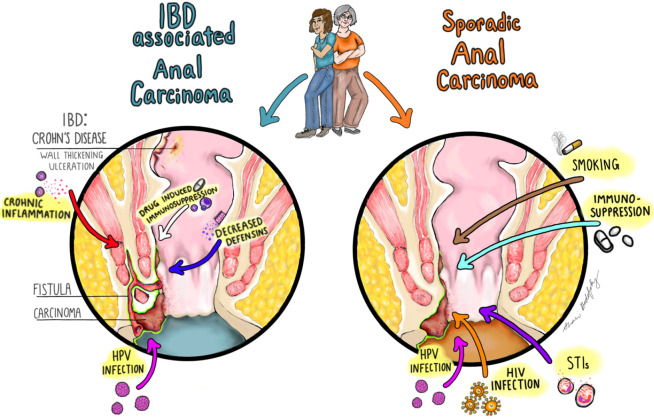
The pelvic malignancies found in the IBD patient population, including colorectal carcinoma, anal carcinoma, lymphoma, small bowel adenocarcinoma (SBA), and prostate cancer (PCa) are outlined in this scoping review. Additional cancers that have a contested relationship with IBD, including cervical, bladder, and upper GI cancers, are also explored. This review provides literature guided recommendations on the eligibility of patients with IBD to receive RT, management of IBD during and after treatment, and counseling for radiation-induced toxicities.
After review of the literature, IBD should not be considered an absolute contraindication to radiation therapy, given the lack of evidence for increased toxicities, and the evolution of RT techniques which limit radiation dose to the bowel.
炎症性肠病(IBD)分为克罗恩病(CD)和溃疡性结肠炎(UC),是一种自身炎症性胃肠道疾病,患某些恶性肿瘤的风险已确定增加。与普通人群中的散发性癌症相比,IBD相关恶性肿瘤在提供优质护理方面带来了独特挑战。针对IBD相关恶性肿瘤的放射治疗(RT)可能会直接影响发炎的肠道,需要特别考虑毒性风险。从历史上看,由于对急性和慢性毒性的可能性认识不足以及治疗结果不明确,IBD患者在肠道附近接受放疗的可能性较小。我们进行了一项范围综述,以更全面地评估IBD相关恶性肿瘤及其治疗。与系统综述不同,这种方法使我们能够分析最广泛的文献,包括实验性和非实验性研究,并反思当前的指南和实践。
文献检索:使用适用的PRISMA范围综述(ScR)指南对已发表文献进行系统的范围检索。文献检索在PubMed上进行,通过筛选1990年1月至2021年6月的所有出版物进行系统检索。还手动检索了纳入文章的参考文献。查阅了相关的美国国立综合癌症网络指南。最终查询时间为2021年12月编辑时。如果摘要报道了IBD中的恶性肿瘤或肠道毒性,则选择文章进行全文阅读。
本范围综述概述了在IBD患者群体中发现的盆腔恶性肿瘤,包括结直肠癌、肛管癌、淋巴瘤、小肠腺癌(SBA)和前列腺癌(PCa)。还探讨了与IBD存在争议关系的其他癌症,包括宫颈癌、膀胱癌和上消化道癌。本综述提供了关于IBD患者接受放疗的资格、治疗期间和治疗后IBD的管理以及放射诱导毒性咨询的文献指导建议。
在对文献进行综述后,鉴于缺乏毒性增加的证据以及RT技术的发展限制了对肠道的辐射剂量,IBD不应被视为放射治疗的绝对禁忌症。