Fanizza Jacopo, Bencardino Sarah, Allocca Mariangela, Furfaro Federica, Zilli Alessandra, Parigi Tommaso Lorenzo, Fiorino Gionata, Peyrin-Biroulet Laurent, Danese Silvio, D'Amico Ferdinando
Department of Gastroenterology and Endoscopy, IRCCS San Raffaele Hospital and Vita-Salute San Raffaele University, 20132 Milan, Italy.
IBD Unit, Department of Gastroenterology and Digestive Endoscopy, San Camillo-Forlanini Hospital, 00152 Rome, Italy.
Cancers (Basel). 2024 Aug 23;16(17):2943. doi: 10.3390/cancers16172943.
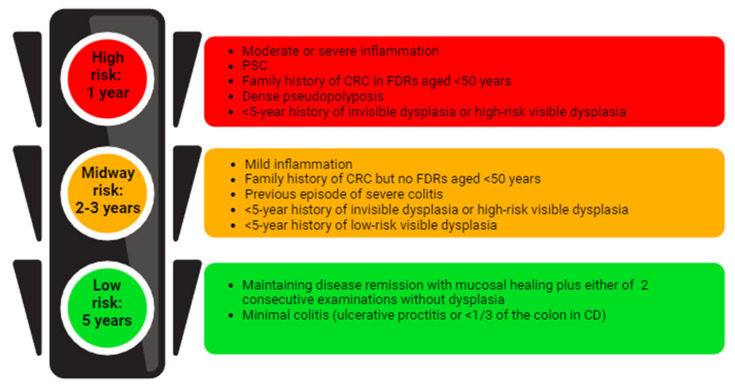
Patients with inflammatory bowel diseases (IBDs), including both ulcerative colitis (UC) and Crohn's disease (CD), are at a higher risk of developing colorectal cancer (CRC). However, advancements in endoscopic imaging techniques, integrated surveillance programs, and improved medical therapies have led to a decrease in the incidence of CRC among IBD patients. Currently, the management of patients with IBD who have a history of or ongoing active malignancy is an unmet need. This involves balancing the risk of cancer recurrence/progression with the potential exacerbation of IBD if the medications are discontinued. The objective of this review is to provide an updated summary of the epidemiology, causes, risk factors, and surveillance approaches for CRC in individuals with IBD, and to offer practical guidance on managing IBD patients with history of previous or active cancer.
患有炎症性肠病(IBD)的患者,包括溃疡性结肠炎(UC)和克罗恩病(CD),患结直肠癌(CRC)的风险更高。然而,内镜成像技术的进步、综合监测计划以及改进的药物治疗已导致IBD患者中CRC的发病率下降。目前,对于有癌症病史或正在患活动性恶性肿瘤的IBD患者的管理仍存在未满足的需求。这涉及在癌症复发/进展风险与停药后IBD可能加重之间取得平衡。本综述的目的是提供IBD患者中CRC的流行病学、病因、危险因素和监测方法的最新总结,并为管理有既往或活动性癌症病史的IBD患者提供实用指导。