Agboola Sefinat Abiola, Aribaba Olufisayo T, Sam-Oyerinde Olapeju Ajoke, Oduneye Femi Chukwunonso, Sule Ademola Ayoda, Akinsola Folasade Bolanle
Department of Ophthalmology, Guinness Eye Center, Lagos University Teaching Hospital, Lagos, Nigeria.
Department of Ophthalmology, College of Medicine, University of Lagos, Lagos, Nigeria.
J West Afr Coll Surg. 2022 Jul-Sep;12(3):104-110. doi: 10.4103/jwas.jwas_149_22. Epub 2022 Oct 6.
To determine the prevalence of presbyopia, near vision spectacle use, and near vision spectacle coverage among cosmetologists in Mushin Local Government Area of Lagos State with the view of creating awareness, improving productivity and quality of life.
This was a descriptive cross-sectional study, conducted among 251 cosmetologists aged ≥ 30 years. All participants had a standardized protocol including visual acuity assessment (distance and near), anterior and posterior segment examinations, and refraction. Spectacle usage, work, productivity impact, and near vision-related quality of life (NVQoL) information were obtained with the 12-item Near Vision-Related Quality of Life Questionnaire, the Spectacle Usage section of the World Health Organisation (WHO) Spectacle and Work Productivity Questionnaire. Data obtained was analysed using Statistical Package for Social Sciences version 23 (IBM Corp. Armonk, NY).
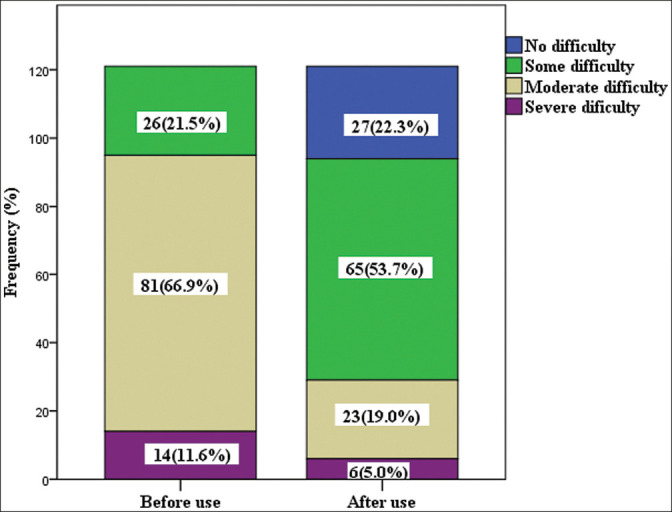
Two hundred and fifty-one cosmetologists were studied with a male to female ratio of 1:6.4 and overall mean age of 43.9 ± 6.5 years. The prevalence of presbyopia was 67.3% and the unmet need was 51.3%. Eighty-four percent of presbyopic participants reported severe difficulty with their NVQoL compared to 16% of non-presbyopes. There was a statistically significant association between uncorrected presbyopia and reduced NVQoL ( < 0.001).
This study demonstrated a relatively high prevalence of presbyopia, high unmet need, and a significant reduction in the near vision-related quality of life. This indicates the need for improved access to refractive services and spectacles among this group of artisans in whom near vision plays an indispensable role.
确定拉各斯州穆欣地方政府辖区美容师中老花眼的患病率、近视力眼镜使用情况及近视力眼镜覆盖率,以期提高认识、提升生产力和改善生活质量。
这是一项描述性横断面研究,对象为251名年龄≥30岁的美容师。所有参与者均接受标准化方案检查,包括视力评估(远视力和近视力)、眼前节和眼后节检查以及验光。通过12项近视力相关生活质量问卷、世界卫生组织(WHO)眼镜与工作生产力问卷的眼镜使用部分,获取眼镜使用情况、工作、生产力影响以及近视力相关生活质量(NVQoL)信息。所获数据使用社会科学统计软件包第23版(IBM公司,纽约州阿蒙克)进行分析。
共研究了251名美容师,男女比例为1:6.4,总体平均年龄为43.9±6.5岁。老花眼患病率为67.3%,未满足的需求为51.3%。84%的老花眼参与者报告其近视力相关生活质量存在严重困难,而非老花眼参与者中这一比例为16%。未矫正的老花眼与近视力相关生活质量降低之间存在统计学显著关联(<0.001)。
本研究表明老花眼患病率相对较高、未满足的需求较高,且近视力相关生活质量显著下降。这表明有必要改善这一群体工匠获取屈光服务和眼镜的机会,因为近视力在他们的工作中起着不可或缺的作用。