Department of Pathology, School of Medicine, São Paulo State University (UNESP), Botucatu, Brazil.
Molecular Genetics and Bioinformatics Laboratory, Experimental Research Unit (Unipex), School of Medicine, São Paulo State University (UNESP), Botucatu, Brazil.
Front Immunol. 2022 Oct 25;13:975918. doi: 10.3389/fimmu.2022.975918. eCollection 2022.
Although aging correlates with a worse prognosis for Covid-19, super elderly still unvaccinated individuals presenting mild or no symptoms have been reported worldwide. Most of the reported genetic variants responsible for increased disease susceptibility are associated with immune response, involving type I IFN immunity and modulation; cluster genes; inflammasome activation; genes of interleukins; and chemokines receptors. On the other hand, little is known about the resistance mechanisms against SARS-CoV-2 infection. Here, we addressed polymorphisms in the MHC region associated with Covid-19 outcome in super elderly resilient patients as compared to younger patients with a severe outcome.
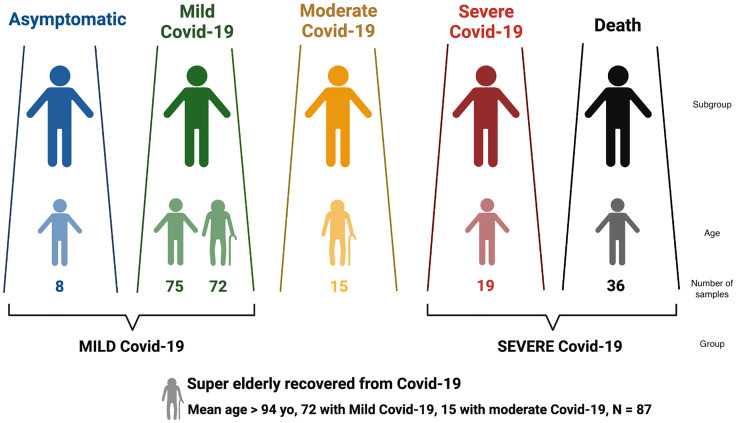
SARS-CoV-2 infection was confirmed by RT-PCR test. Aiming to identify candidate genes associated with host resistance, we investigated 87 individuals older than 90 years who recovered from Covid-19 with mild symptoms or who remained asymptomatic following positive test for SARS-CoV-2 as compared to 55 individuals younger than 60 years who had a severe disease or died due to Covid-19, as well as to the general elderly population from the same city. Whole-exome sequencing and an in-depth analysis of the MHC region was performed. All samples were collected in early 2020 and before the local vaccination programs started.
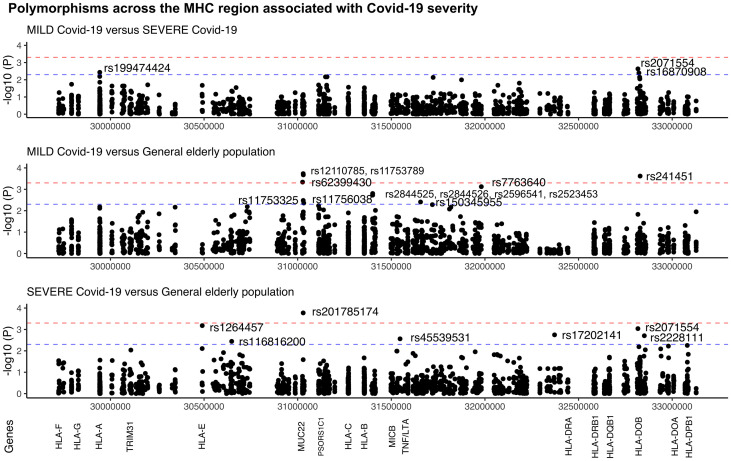
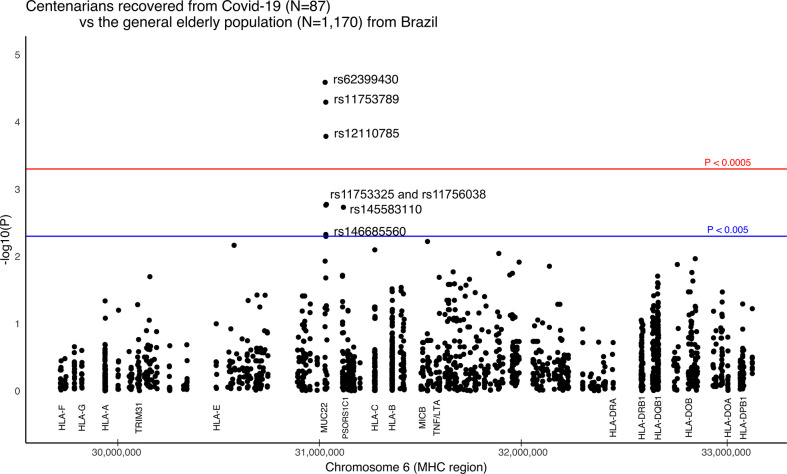
We found that the resilient super elderly group displayed a higher frequency of some missense variants in the gene (a member of the mucins' family) as one of the strongest signals in the MHC region as compared to the severe Covid-19 group and the general elderly control population. For example, the missense variant rs62399430 at is two times more frequent among the resilient super elderly (p = 0.00002, OR = 2.24).
Since the pro-inflammatory basal state in the elderly may enhance the susceptibility to severe Covid-19, we hypothesized that might play an important protective role against severe Covid-19, by reducing overactive immune responses in the senior population.
尽管衰老与 COVID-19 的预后较差相关,但在全球范围内仍有报道称,超级老年人未接种疫苗且表现出轻症或无症状。大多数报道的与疾病易感性增加相关的遗传变异与免疫反应有关,包括 I 型 IFN 免疫和调节;簇基因;炎症小体激活;白细胞介素基因;和趋化因子受体。另一方面,对于 SARS-CoV-2 感染的抗性机制知之甚少。在这里,我们研究了与超级老年抵抗患者 COVID-19 结局相关的 MHC 区域中的多态性,与年轻患者的严重结局相比。
通过 RT-PCR 检测证实 SARS-CoV-2 感染。为了确定与宿主抗性相关的候选基因,我们调查了 87 名年龄在 90 岁以上、从 COVID-19 中康复且症状轻微或 SARS-CoV-2 检测呈阳性后无症状的患者,与 55 名年龄在 60 岁以下、因 COVID-19 而患有严重疾病或死亡的患者以及来自同一城市的一般老年人群进行了比较。进行了全外显子组测序和 MHC 区域的深入分析。所有样本均于 2020 年初采集,且在当地疫苗接种计划开始之前。
我们发现,与严重 COVID-19 组和一般老年对照组相比,抵抗超级老年组在 MHC 区域中,基因(粘蛋白家族的一员)的一些错义变异的频率更高,这是最强的信号之一。例如,在抵抗超级老年组中,位于的错义变体 rs62399430 的频率高出两倍(p = 0.00002,OR = 2.24)。
由于老年人的促炎基础状态可能会增加患严重 COVID-19 的易感性,因此我们假设可能通过降低老年人群中过度活跃的免疫反应,对严重 COVID-19 起到重要的保护作用。