Beijing Youan Hospital, Capital Medical University, Beijing, China.
Beijing Institute of Hepatology, Beijing Youan Hospital, Capital Medical University, Beijing, China.
Front Immunol. 2022 Oct 27;13:971409. doi: 10.3389/fimmu.2022.971409. eCollection 2022.
Rhubarb is an important traditional Chinese medicine, and rhein is one of its most important active ingredients. Studies have found that rhein can improve ulcerative colitis by regulating gut microbes, but there are few reports on its effects on liver diseases. Therefore, this study aims to investigate these effects and underlying mechanisms.
Mice were given rhein (100 mg/kg), with both a normal control group and a model group receiving the same amount of normal saline for one week. Acute liver injury was induced in mice by intraperitoneal injection of D-GalN (800 mg/kg)/LPS (10 ug/kg). Samples (blood, liver, and stool) were then collected and assessed for histological lesions and used for 16S rRNA gene sequencing, high-performance liquid chromatography-mass spectrometry (LC-MS) and RNA-seq analysis.
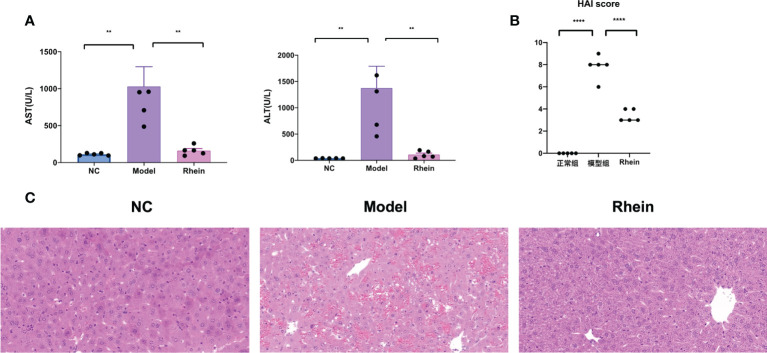
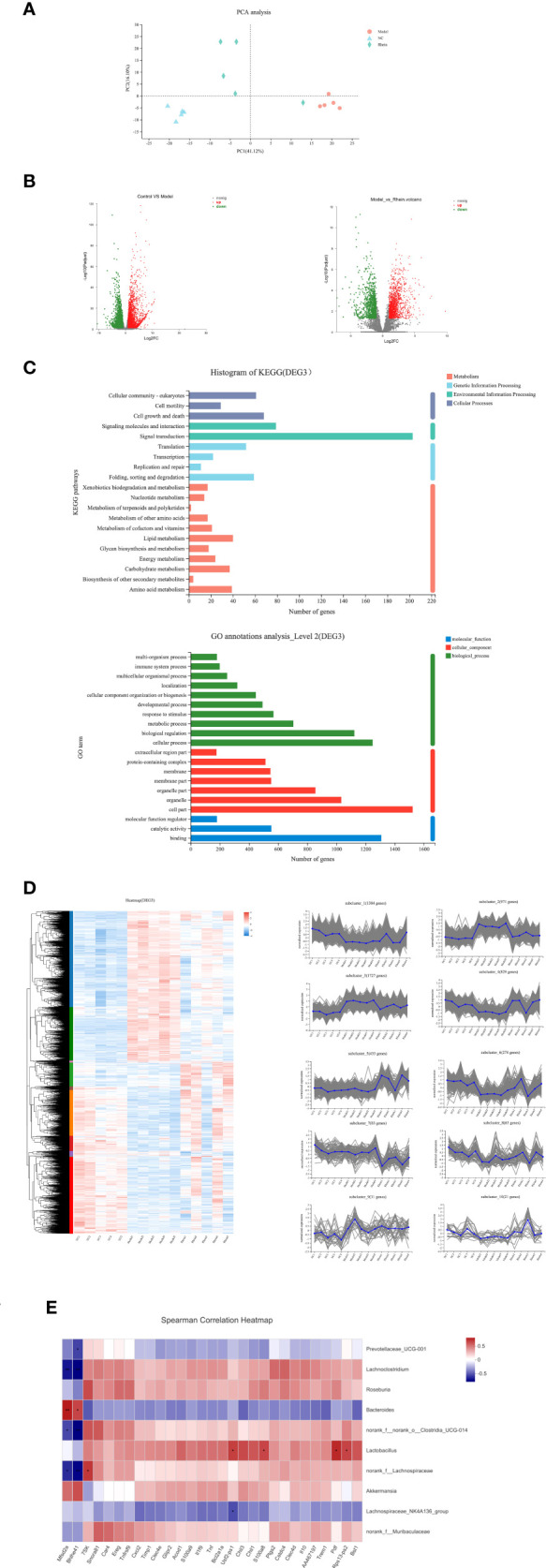
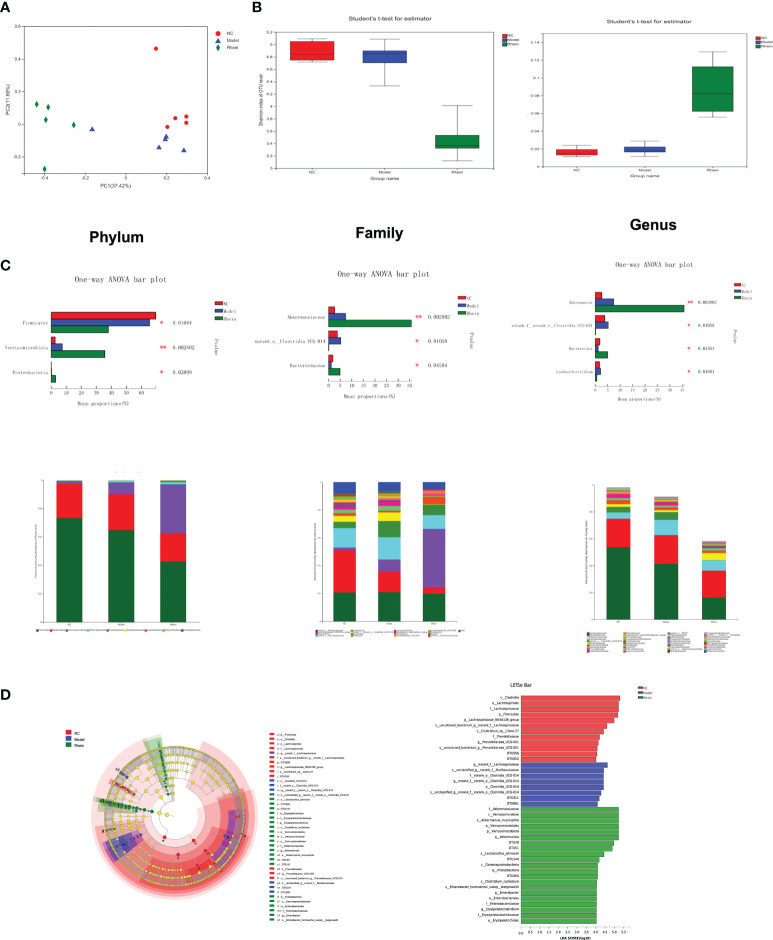
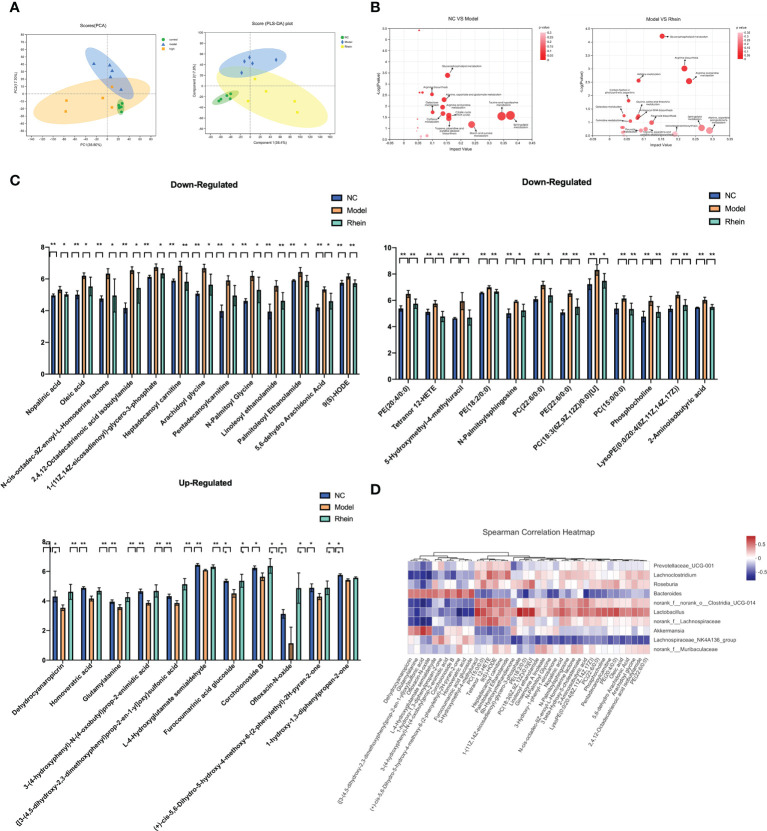
The levels of ALT and AST in the Model group were abnormal higher compared to the normal control group, and the levels of ALT and AST were significantly relieved in the rhein group. Hepatic HE staining showed that the degree of liver injury in the rhein group was lighter than that in the model group, and microbiological results showed that norank_o:Clostridia_UCG-014, Lachnoclostridium, and Roseburia were more abundant in the model group compared to the normal control group. Notably, the rhein treatment group showed reshaped disturbance of intestinal microbial community by D-GalN/LPS and these mice also had higher levels of Verrucomicrobia, Akkermansiaceae and Bacteroidetes. Additionally, There were multiple metabolites that were significantly different between the normal control group and the model group, such as L-α-amino acid, ofloxacin-N-oxide, 1-hydroxy-1,3-diphenylpropan-2-one,and L-4-hydroxyglutamate semialdehyde, but that returned to normal levels after rhein treatment. The gene expression level in the model group also changed significantly, various genes such as Cxcl2, S100a9, Tnf, Ereg, and IL-10 were up-regulated, while Mfsd2a and Bhlhe41 were down-regulated, which were recovered after rhein treatment.
Overall, our results show that rhein alleviated D-GalN/LPS-induced acute liver injury in mice. It may help modulate gut microbiota in mice, thereby changing metabolism in the intestine. Meanwhile, rhein also may help regulate genes expression level to alleviate D-GalN/LPS-induced acute liver injury.
大黄是一种重要的中药,大黄酸是其最重要的活性成分之一。研究发现,大黄酸通过调节肠道微生物来改善溃疡性结肠炎,但关于其对肝脏疾病影响的报道较少。因此,本研究旨在探讨大黄酸的这些作用及其潜在机制。
给小鼠灌胃大黄酸(100mg/kg),同时设正常对照组和模型组,均给予等体积生理盐水,连续 1 周。通过腹腔注射 D-GalN(800mg/kg)/LPS(10μg/kg)诱导急性肝损伤。然后采集血液、肝脏和粪便样本,进行组织学损伤评估,并进行 16S rRNA 基因测序、高效液相色谱-质谱联用(LC-MS)和 RNA-seq 分析。
与正常对照组相比,模型组 ALT 和 AST 水平明显升高,大黄酸组 ALT 和 AST 水平明显降低。肝组织 HE 染色显示,大黄酸组肝损伤程度较模型组轻,微生物学结果显示,与正常对照组相比,模型组中 norank_o:Clostridia_UCG-014、Lachnoclostridium 和 Roseburia 更为丰富。值得注意的是,大黄酸处理组可重塑 D-GalN/LPS 诱导的肠道微生物群落紊乱,且该组小鼠的 Verrucomicrobia、Akkermansiaceae 和 Bacteroidetes 丰度更高。此外,正常对照组和模型组之间有多个代谢物存在显著差异,如 L-α-氨基酸、氧氟沙星-N-氧化物、1-羟基-1,3-二苯基-2-丙酮和 L-4-羟基谷氨酸半醛等,但大黄酸处理后这些代谢物水平恢复正常。模型组基因表达水平也发生了显著变化,Cxcl2、S100a9、Tnf、Ereg 和 Il-10 等多种基因上调,Mfsd2a 和 Bhlhe41 下调,大黄酸处理后恢复正常。
总之,本研究结果表明,大黄酸可缓解 D-GalN/LPS 诱导的小鼠急性肝损伤,可能通过调节肠道微生物,从而改变肠道代谢。同时,大黄酸还可能通过调节基因表达水平缓解 D-GalN/LPS 诱导的急性肝损伤。