Department of Obstetrics and Gynecology, Division of Reproductive Sciences, University of Colorado Anschutz Medical Campus, Aurora, Colorado, USA.
Department of Obstetrics and Gynecology, Division of Reproductive Endocrinology and Infertility, Aurora, Colorado, USA.
Am J Reprod Immunol. 2023 Mar;89(3):e13649. doi: 10.1111/aji.13649. Epub 2022 Dec 26.
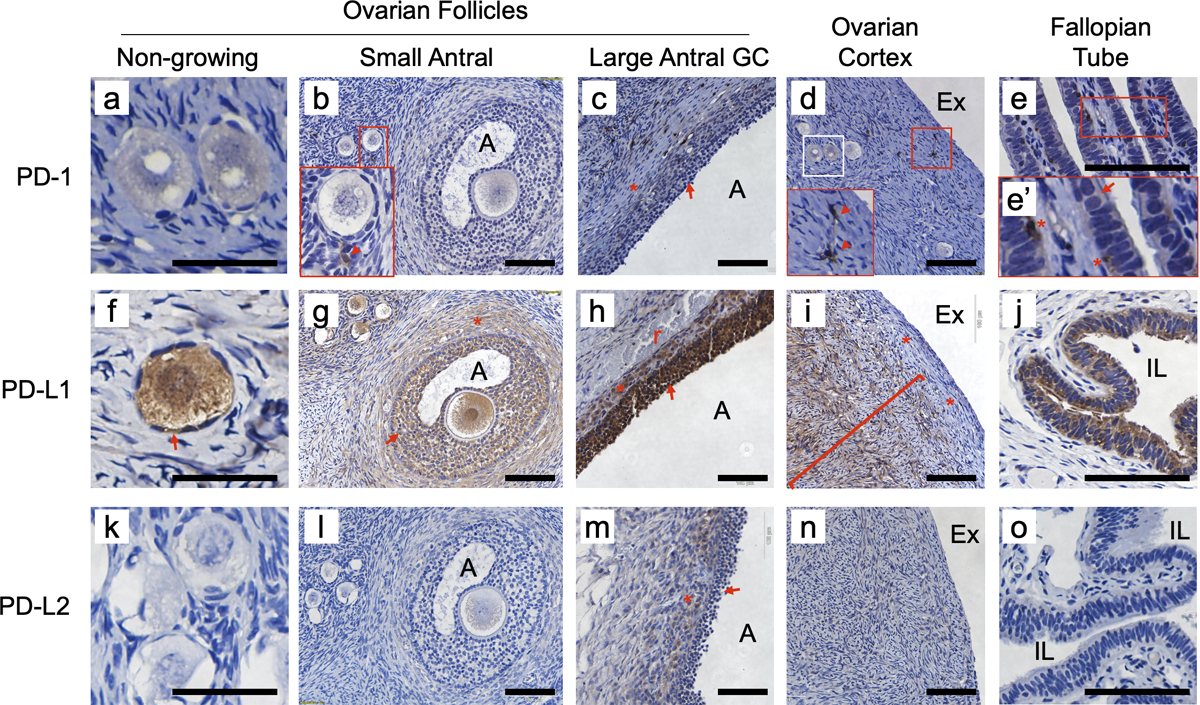
Immune cell trafficking and surveillance within the ovary and fallopian tube are thought to impact fertility and also tumorigenesis in those organs. However, little is known of how native cells of the ovary and fallopian tube interact with resident immune cells. Interaction of the Programmed Cell Death Protein-1 (PD-1/PDCD-1/CD279) checkpoint with PD-L1 is associated with downregulated immune response. We have begun to address the question of whether PD-1 ligand or its receptors (PD-L1/-L2) can regulate immune cell function in these tissues of the female reproductive tract.
PD-1 and ligand protein expression was evaluated in human ovary and fallopian tube specimens, the latter of which included stages of tubal cell transformation and early tumorigenesis. Ovarian expression analysis included the determination of the proteins in human follicular fluid (HFF) specimens collected during in vitro fertilization procedures. Finally, checkpoint bioactivity of HFF was determined by treatment of separately-isolated human T cells and the measurement of interferon gamma (IFNγ).
We show that membrane bound and soluble variants of PD-1 and ligands are expressed by permanent constituent cell types of the human ovary and fallopian tube, including granulosa cells and oocytes. PD-1 and soluble ligands were present in HFF at bioactive levels that control T cell PD-1 activation and IFNγ production; full-length checkpoint proteins were found to be highly enriched in HFF exosome fractions.
The detection of PD-1 checkpoint proteins in the human ovary and fallopian tube suggests that the pathway is involved in immunomodulation during folliculogenesis, the window of ovulation, and subsequent egg and embryo immune-privilege. Immunomodulatory action of receptor and ligands in HFF exosomes is suggestive of an acute checkpoint role during ovulation. This is the first study in the role of PD-1 checkpoint proteins in human tubo-ovarian specimens and the first examination of its potential regulatory action in the contexts of normal and assisted reproduction.
人们认为卵巢和输卵管内免疫细胞的迁移和监测会影响这些器官的生育能力和肿瘤发生。然而,人们对卵巢和输卵管的固有细胞如何与驻留免疫细胞相互作用知之甚少。程序性细胞死亡蛋白-1(PD-1/PDCD-1/CD279)检查点与 PD-L1 的相互作用与免疫反应下调有关。我们已经开始研究 PD-1 配体或其受体(PD-L1/-L2)是否可以调节女性生殖道这些组织中的免疫细胞功能。
评估了人卵巢和输卵管标本中的 PD-1 和配体蛋白表达,后者包括输卵管细胞转化和早期肿瘤发生的阶段。卵巢表达分析包括在体外受精过程中收集的人卵泡液(HFF)标本中蛋白质的测定。最后,通过单独分离的人 T 细胞处理和干扰素γ(IFNγ)的测量来确定 HFF 的检查点生物活性。
我们表明,膜结合和可溶性 PD-1 和配体变体由人卵巢和输卵管的永久组成细胞类型表达,包括颗粒细胞和卵母细胞。PD-1 和可溶性配体存在于具有控制 T 细胞 PD-1 激活和 IFNγ产生的生物活性水平的 HFF 中;全长检查点蛋白在 HFF 外泌体部分中高度富集。
在人卵巢和输卵管中检测到 PD-1 检查点蛋白表明该途径参与了卵泡发生、排卵窗口以及随后的卵子和胚胎免疫特权期间的免疫调节。HFF 外泌体中受体和配体的免疫调节作用表明在排卵期间存在急性检查点作用。这是 PD-1 检查点蛋白在人卵巢输卵管标本中的作用的第一项研究,也是其在正常和辅助生殖背景下潜在调节作用的首次检查。